
Why Put a Brain in Every Robot When One Cloud Brain Can Run a Hundred of Them?
Table of Contents
- 1. A Month of Setup, Down to Two Hours
- 2. The Old Way: Every Robot Thinks for Itself
- 3. What GRID Actually Does Instead
- 4. The CEO's Own Words on Why This Matters
- 5. A Platform That Builds Its Own Solutions
- 6. The Rest of the Numbers, Beyond That Headline One
- 7. A Year of Work, Done in Minutes, Inside a Biolab
- 8. Not Everything Lives in the Cloud — Milliseconds Still Matter
- 9. The People and Money Behind This Bet
- 10. The Industries Still Holding Back
- 11. How Innovative Academy Fits Into This Story
- 12. Closing Thoughts
A robot that takes a month to get up and running in production isn't unusual—it has actually been the industry norm for decades. General Robotics thinks that's about to change.
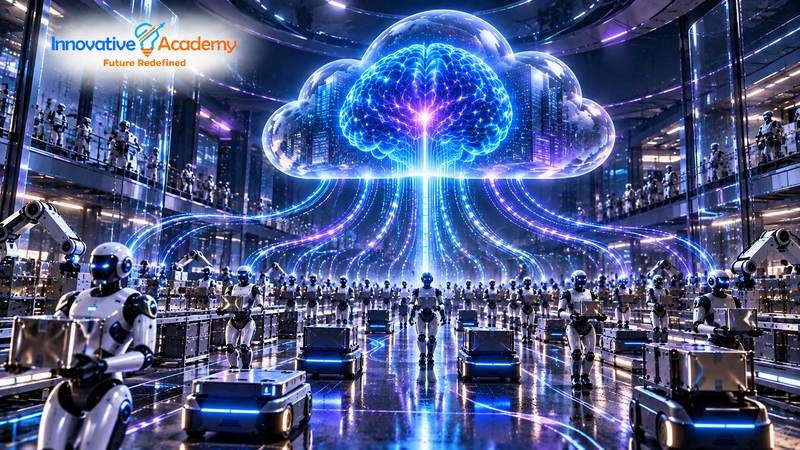
Its answer isn't simply a smarter individual robot. Instead, the company is moving much of the intelligence out of individual robots and into a shared cloud platform capable of managing dozens of machines at once.
1. A Month of Setup, Down to Two Hours
Start with the number that makes General Robotics' pitch stand out: getting a robot into production deployment used to take roughly a month.
On General Robotics' GRID platform, that same process can reportedly take about two hours.
That's more than an incremental efficiency improvement. A reduction from weeks to hours can change which robotics projects are practical to deploy, test, and scale.
The broader idea is simple: instead of treating every robot as a separate engineering project, a centralized intelligence platform can make deployment more repeatable.
2. The Old Way: Every Robot Thinks for Itself
For much of the robotics industry's history, intelligence has been closely tied to the individual machine. Each robot carries its own computing resources, software stack, models, and control systems.
That approach makes sense when robots need to operate independently, but it can also create duplicated engineering work. Different robot manufacturers may build separate AI stacks for similar tasks, even when the underlying capabilities are largely the same.
General Robotics argues that robotics is approaching a transition similar to the one computing experienced with cloud infrastructure.
Instead of requiring every machine to be completely self-sufficient, centralized infrastructure can provide shared intelligence and capabilities while individual devices retain the processing they need locally.
This shift also highlights why AWS training in Bangalore and practical cloud computing skills are becoming increasingly relevant to modern distributed technologies.
3. What GRID Actually Does Instead
GRID functions as an intelligence layer positioned above the robots themselves. It is designed to connect machines from different manufacturers to a shared collection of skills, foundation models, simulations, and control techniques.
The platform centrally hosts models, simulations, robot representations, data, and agents that can create and refine robotic skills.
This architecture aims to reduce the need for every robot manufacturer to independently build and maintain an isolated artificial intelligence stack.
The important distinction is that GRID isn't simply a cloud storage system for robot models. Its goal is to provide an operational layer capable of coordinating intelligence across multiple types of robotic hardware.
The architecture is closely related to modern AWS DevOps practices, where automation, cloud infrastructure, deployment pipelines, monitoring, and scalable systems work together.
4. The CEO's Own Words on Why This Matters
General Robotics CEO Ashish Kapoor summarized the company's philosophy around centralized robotics intelligence:
“Having one layer that looks after 50 to 100 robots is way more important than 50 or 100 robots that operate completely independently.”
The statement captures the company's fundamental architectural bet.
Kapoor previously spent 17 years leading autonomous systems and robotics research at Microsoft before co-founding General Robotics. His background helps explain why the company is approaching robotics from an infrastructure and systems perspective rather than focusing exclusively on individual robot hardware.
5. A Platform That Builds Its Own Solutions
One of the more interesting aspects of GRID is its attempt to automate parts of the robotics engineering process itself.
When given a particular task, the platform can identify the skills required, combine appropriate models and control techniques, create simulation environments, test the resulting configuration, deploy the solution, and monitor its performance after deployment.
The system uses knowledge graphs containing structured information about robots, tasks, models, and failures.
The underlying concept is that every deployment can contribute knowledge that improves future engineering workflows while keeping individual customers' data separated.
This creates a potential feedback loop:
- Define a robotic task.
- Identify the required capabilities.
- Assemble models and skills.
- Test the solution in simulation.
- Deploy it to the appropriate robot.
- Monitor real-world performance.
- Use operational knowledge to improve future deployments.
These principles are also important in DevOps Bootcamp training, where automation and repeatable deployment processes are central to modern infrastructure management.
6. The Rest of the Numbers, Beyond That Headline One
The reported two-hour deployment figure isn't the only dramatic before-and-after associated with the GRID platform.
| Robotics Engineering Task | Previous Time | GRID Reported Time |
|---|---|---|
| Production deployment | About 1 month | About 2 hours |
| AI model ingestion | About 3 days | About 20 minutes |
| Transfer a skill between robot types | About 3 days | About 1.5 hours |
| Create a new skill | — | About 2 days |
Viewed together, these figures illustrate the larger objective: compressing the robotics development cycle across model integration, skill development, testing, and deployment.
Cloud automation is a major part of achieving this type of scalability. Professionals interested in these technologies can explore Innovative Academy's IT training programs covering cloud, networking, DevOps, programming, and cybersecurity.
7. A Year of Work, Done in Minutes, Inside a Biolab
One example makes the potential impact easier to understand.
Inside a biolab environment, AI agents operating through GRID reportedly created hybrid simulations for complex fluid-dynamics modeling. Work that would ordinarily have required roughly a year of manual effort was completed in minutes.
Examples like this are important because they demonstrate what automated robotics engineering could look like beyond simple robot control.
The combination of simulation, AI agents, physics models, and centralized computing could allow engineers to explore complicated environments much faster than conventional development workflows.
8. Not Everything Lives in the Cloud — Milliseconds Still Matter
The cloud-centric architecture doesn't mean every robotic decision has to travel to a remote data center.
GRID uses GPU-based cloud infrastructure and a hybrid simulator that combines physics modeling with AI agents. At the same time, the platform keeps the fastest physical control processes close to the robot.
These inner control loops operate at millisecond-level speeds, making local edge processing essential for actions that cannot tolerate network latency.
This creates a hybrid architecture:
- Cloud: models, simulation, large-scale computation, data, and higher-level intelligence.
- Edge: time-critical control loops and immediate physical responses.
- Robot: the physical system that executes the resulting actions.
This cloud-and-edge model also reinforces the importance of networking fundamentals. Understanding connectivity, routing, latency, and distributed infrastructure is valuable for anyone working with modern cloud systems. Learners can explore Networking Fundamentals Training to build that foundation.
9. The People and Money Behind This Bet
General Robotics began in 2023 under the name Scaled Foundations in Redmond, Washington.
The company was founded by former Microsoft researchers Ashish Kapoor, Sai Vemprala, and Shuhang Chen.
Its investors include Construct Capital, Accenture Ventures, Nvidia, Khosla Ventures, E14 Fund, Shorooq Partners, and Valo Ventures.
On the deployment side, companies including Fanuc America and Galaxea Dynamics have worked with the platform.
The company's customer base also extends across government agencies and major organizations in areas including automotive, port operations, power generation, and food and beverage.
10. The Industries Still Holding Back
Despite the promise of centralized robotic intelligence, not every industry can immediately adopt a cloud-first architecture.
Cloud-to-Robot Latency
Physical robots often need to react within milliseconds. Sending every control decision to a remote cloud environment introduces latency that can be unacceptable for safety-critical or highly dynamic movements.
That's why hybrid architectures that combine cloud intelligence with local edge processing remain important.
Data Security and Privacy
Manufacturing environments can contain highly sensitive operational data, proprietary processes, and intellectual property.
For industries such as automotive manufacturing, moving robotic intelligence and associated data into centralized cloud infrastructure can create additional security, compliance, and data-governance considerations.
Security is therefore another important component of modern cloud architecture. Professionals interested in protecting cloud and network environments can explore Cybersecurity Training in Bangalore.
11. How Innovative Academy Fits Into This Story
The architecture behind platforms such as GRID highlights an increasingly important technology skill: understanding how centralized cloud infrastructure and local edge systems work together.
The same architectural principles apply beyond robotics. They are relevant to connected devices, IoT platforms, distributed applications, industrial automation, cloud services, and modern DevOps environments.
Innovative Academy's AWS DevOps Training in Bangalore provides hands-on learning around cloud infrastructure, deployment automation, Linux, AWS, DevOps practices, and real-world implementation.
Students interested in Linux and cloud infrastructure can also explore Linux Administration Training in Bangalore, which provides an important foundation for working with servers, cloud environments, and DevOps infrastructure.
For learners interested in cloud computing and DevOps careers, understanding where computation should happen—centrally in the cloud or locally at the edge—is becoming an important part of designing reliable distributed systems.
12. Closing Thoughts
The efficiency numbers make General Robotics' GRID platform worth watching, but the more significant idea is architectural.
The company is betting that robotic intelligence can become more valuable when it is managed centrally rather than rebuilt independently inside every machine.
If robotics scales toward the enormous numbers predicted for the coming decades, centralized intelligence could potentially make it easier to develop, update, deploy, and manage large fleets of machines.
At the same time, the cloud cannot replace everything. Millisecond-level physical control still belongs close to the robot.
That leaves a hybrid model: centralized intelligence in the cloud combined with enough local computing to handle decisions that cannot wait.
For anyone building a career in cloud computing, DevOps, or distributed systems, robotics offers a useful example of this broader trend.
When a new class of hardware begins scaling rapidly, the winning architecture may not be to make every device independently smarter. Instead, it may be to build a strong shared intelligence layer and give each device exactly the local processing it needs.
That could make the cloud-to-edge architecture one of the defining patterns of the next generation of robotics.
Learn Cloud, Networking and DevOps Skills
Interested in building practical skills for modern cloud and distributed infrastructure? Explore Innovative Academy's IT training programs and learn through hands-on training in cloud computing, AWS, DevOps, networking, Linux, cybersecurity, and programming.