
Why Engineering Graduates Aren't Getting Hired: What the Data Actually Shows
1. Introduction
"Engineers can't find jobs" gets said so often that it has become background noise. But that isn't quite the right way to frame the problem.
A more useful explanation is that employability in India varies significantly by discipline and, increasingly, by the skills graduates bring alongside their degrees. The difference is not simply about having an engineering qualification; it is also about whether graduates can demonstrate current technical knowledge, practical experience, communication ability, and a clear career strategy.
This article looks at four major gaps that can affect engineering graduates: the skills gap, exposure gap, presentation gap, and strategy gap—and explains what can help close each one.
2. The Real Numbers Behind "No Jobs After Graduation"
The India Skills Report 2026 places overall graduate employability at around 56.35%. However, employability varies considerably across disciplines. Computer science engineering graduates are reported at roughly 80% employability, while IT engineering graduates are around 78%. General BE/BTech employability is reported at 70.15%.
The figures highlight an important distinction: an engineering degree remains valuable, but employers increasingly look for skills that align with current technology and business requirements.
Demand is particularly visible around areas such as artificial intelligence, data analytics, automation, cloud computing, software development, networking, and DevOps. The India Skills Report 2026 also points to changing demand for technology-oriented capabilities.
Another notable finding from the report is that women's employability has reportedly reached approximately 54%, compared with 51.5% for men, representing a change from previous years.
These figures should not be interpreted as meaning that one engineering branch automatically guarantees employment. Instead, they illustrate how employability can vary according to discipline, skills, and alignment with current hiring requirements.
3. Gap One: The Skills Gap
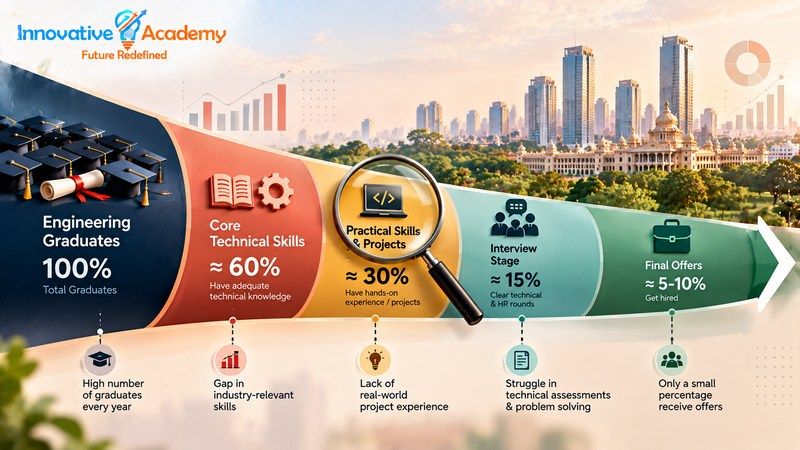
The skills gap is one of the most visible challenges facing engineering graduates. It generally appears in three connected forms.
Practical Skills Shortfall
Many students spend years learning through lectures, textbooks, and examinations without getting enough opportunities to build or troubleshoot real systems. As a result, they may understand a definition but struggle to apply the concept in a practical situation.
Curriculum Lag
Technology changes quickly. Employers may expect familiarity with cloud platforms, DevOps tools, automation, cybersecurity practices, data technologies, and modern development frameworks that are not always covered deeply in traditional academic programs.
Shallow Conceptual Understanding
Memorising material for examinations is different from understanding it well enough to explain and apply it. Interviews can expose this difference when candidates are asked to troubleshoot a networking issue, explain database design, discuss operating-system behaviour, or describe how an application works in production.
The practical response is straightforward: graduates need opportunities for hands-on labs, current tools, projects, troubleshooting, and repeated practice.
4. Gap Two: The Exposure Gap
A degree can provide theoretical knowledge, but it does not necessarily show students what working inside a technology team looks like.
Professional environments involve collaboration, changing priorities, documentation, troubleshooting, deadlines, code reviews, infrastructure management, and communication between different teams.
Internships can help bridge this gap, but the value depends on the quality of the experience. A structured internship or meaningful project gives graduates something concrete to discuss during an interview.
For example, instead of simply saying that they studied AWS, a candidate can explain how they deployed an application, configured access controls, monitored resources, or troubleshot a particular issue.
That difference turns theoretical knowledge into demonstrable experience.
5. Gap Three: The Presentation Gap
Technical ability is only one part of the hiring process. Candidates also need to communicate their skills clearly.
A resume containing only a list of academic subjects can make it difficult for recruiters to understand what a candidate can actually do. Projects, technical tools, measurable outcomes, GitHub work, internships, and relevant certifications can provide stronger evidence of capability.
Communication also matters during interviews. A candidate may understand a technical concept but struggle to explain the reasoning behind a solution. Regular practice explaining technical decisions can make a significant difference.
Three practical improvements include:
- Building a focused, role-specific resume.
- Maintaining relevant projects and technical work on GitHub.
- Practising spoken explanations through mock technical and HR interviews.
6. Gap Four: The Strategy Gap
The fourth gap concerns how graduates approach their job search.
Choosing a specialization only because friends selected it or because a college offered it may result in a poor fit. A better approach is to examine personal interests alongside actual market requirements and the skills needed for specific job roles.
Interview preparation is another important part of the strategy. Candidates should understand the technical topics associated with their target roles and practise answering questions before attending interviews.
Job searching should also extend beyond campus placement drives. Job portals, professional networking platforms, company career pages, walk-in opportunities, referrals, and direct outreach can expand the number of opportunities a graduate can consider.
7. What Actually Closes These Gaps
The four gaps point toward a common solution: a degree by itself may not provide every skill required for a specific technology role.
Job-focused training can complement an engineering degree when it includes:
- Hands-on technical labs.
- Current industry tools and platforms.
- Realistic projects.
- Troubleshooting exercises.
- Resume development.
- Mock technical interviews.
- Communication and interview practice.
- Career guidance based on specific job roles.
The goal should not simply be to collect another certificate. The goal is to develop skills that a candidate can demonstrate and explain during the hiring process.
8. Closing the Gap at Innovative Academy
Innovative Academy provides IT-focused training designed to help students build practical, job-oriented technical skills alongside their academic background.
Its training areas include AWS Cloud, Azure, DevOps, Linux Administration, CCNA and networking, cybersecurity, Java, and Python full-stack development.
The programs emphasise practical learning through labs and projects, helping learners move beyond theory and gain experience working with technology tools and workflows.
Career preparation is also incorporated into the learning process through resume support, interview preparation, mock interviews, and communication-focused guidance. These activities are intended to address the presentation and strategy challenges that graduates can face during their job search.
For engineering graduates who already have a degree but need to build a more focused technology skill set, structured training can provide a way to add practical capabilities without repeating an entire undergraduate program.
Learn more about the available programs through the Innovative Academy training programs.
9. FAQs
Does a general engineering degree hurt someone's job prospects compared with a CS degree?
Not necessarily. Employability data shows differences between disciplines, but a graduate's technical skills, practical experience, communication ability, and relevance to a target role also matter. A mechanical or electrical engineering graduate who develops strong cloud, DevOps, networking, or programming skills can pursue technology roles that require those capabilities.
Is it true that women now have better employability outcomes than men in India?
According to the India Skills Report 2026 figures cited above, women's employability was approximately 54%, compared with 51.5% for men. The report presents this as a notable change from previous years, although the figures alone do not establish the reasons behind the difference.
How long does it take to close a skills gap through additional training?
There is no single timeline because the answer depends on the starting skill level, target role, technology, and depth of training. Focused project-based programs can take several weeks to a few months, allowing graduates to develop a specific skill layer without undertaking another full degree.
10. Final Thoughts
The idea that engineering graduates simply "can't get jobs" misses an important part of the picture. The employment market increasingly distinguishes between academic qualifications and demonstrated, job-relevant capabilities.
The skills, exposure, presentation, and strategy gaps can all affect how a graduate performs in the hiring process. Practical projects, hands-on training, interview preparation, communication practice, and focused specialization can help address those gaps.
For engineering graduates, the objective is not to discard the value of their degree. It is to build an additional layer of practical and current skills that allows them to demonstrate what they can actually do when they enter the job market.