
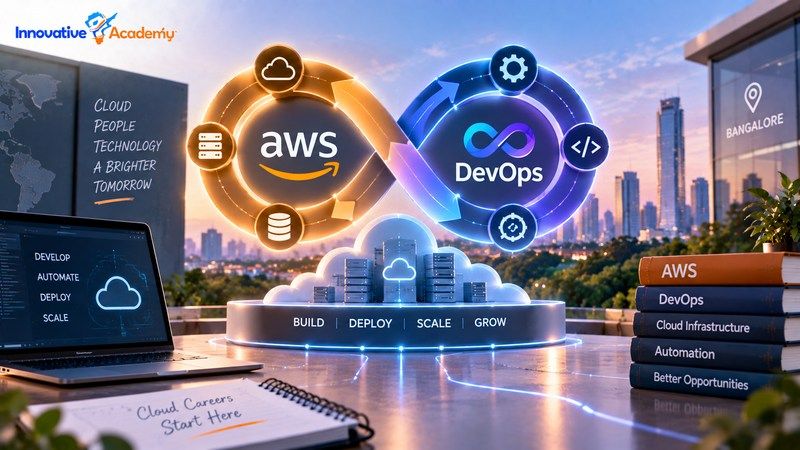

Why AWS and DevOps Make Such a Strong Combination for a Cloud Career
Table of Contents
- Two Skill Sets, One Career Track
- What Makes AWS Worth Learning in the First Place
- DevOps, Stripped of the Buzzwords
- Building DevOps Skills From Zero
- A Realistic Roadmap, Step by Step
- Where This Actually Leads
For many people exploring cloud careers, AWS and DevOps can look like two separate skills to learn. In practice, they complement each other extremely well. AWS provides the cloud infrastructure and services, while DevOps provides the practices and tools used to build, deploy, automate, monitor, and maintain applications efficiently.
Learning AWS and DevOps together can therefore give beginners a clearer understanding of how modern applications move from development to production. This guide explains why the combination works, which skills to learn first, and how to build a practical cloud career roadmap.
1. Two Skill Sets, One Career Track
Many people researching cloud careers treat "learn AWS" and "learn DevOps" as two separate items on a learning checklist. They may choose one, become familiar with it, and then consider learning the other later.
A more connected approach is to understand how the two areas work together. Modern DevOps environments frequently use cloud infrastructure as the foundation for application deployment, testing, automation, monitoring, and scaling.
AWS provides services for areas such as compute, storage, networking, databases, security, and monitoring. DevOps practices then help teams automate and manage the software delivery lifecycle across those environments.
Learning both skill sets together can therefore help you understand the complete workflow—from writing and managing code to deploying applications and maintaining reliable infrastructure.
For learners starting with networking fundamentals, exploring a structured Networking Fundamentals Training in Bangalore can also provide useful groundwork before moving deeper into cloud and DevOps.
2. What Makes AWS Worth Learning in the First Place
Amazon Web Services (AWS) is one of the major cloud platforms used by organizations to build, deploy, and operate applications. Its large collection of cloud services makes it relevant across infrastructure, application development, data, analytics, security, and other technology areas.
A Broad Cloud Ecosystem
AWS includes services covering compute, storage, networking, databases, security, monitoring, analytics, machine learning, and more. This breadth allows professionals to develop different specializations depending on their interests and career goals.
Someone interested in infrastructure can explore services such as Amazon EC2 and VPC, while professionals working toward application development, data, or AI can build skills around other parts of the AWS ecosystem.
Practical Cloud Skills
Learning AWS is not only about memorizing service names. A strong learning path should help you understand how cloud resources are designed, secured, connected, monitored, and optimized.
For learners looking for structured training, the AWS Training in Bangalore program at Innovative Academy can be explored as part of a broader cloud learning journey.
AWS Certifications
AWS certifications can provide structured learning goals and demonstrate familiarity with specific areas of the AWS platform. Beginner learners can start with foundational certification content before progressing toward associate-level certifications.
The AWS Certified Cloud Practitioner certification introduces foundational concepts, while the AWS Certified Solutions Architect – Associate focuses more deeply on designing AWS solutions.
3. DevOps, Stripped of the Buzzwords
DevOps is a combination of practices, cultural principles, and technologies that help development and operations teams collaborate more effectively throughout the software lifecycle.
Instead of treating development and operations as completely separate stages, DevOps encourages collaboration, automation, continuous feedback, and shared responsibility.
Why DevOps Matters
One of the biggest challenges in software delivery is the transition between developing an application and running it reliably in a production environment.
DevOps practices help reduce this friction by introducing automation and repeatable processes for activities such as:
- Source code management
- Automated testing
- Continuous integration
- Continuous delivery
- Infrastructure provisioning
- Application deployment
- Monitoring and logging
- Incident response and feedback
When these practices are combined with AWS infrastructure, teams can create automated workflows for deploying and managing applications in the cloud.
4. Building DevOps Skills From Zero
Beginners can easily become overwhelmed by the number of DevOps tools available. A better approach is to learn the underlying concepts first and then introduce tools that solve specific problems.
Start With DevOps Principles
Begin by understanding concepts such as continuous integration (CI), continuous delivery (CD), automation, collaboration, monitoring, and continuous feedback.
Understanding why these practices exist makes it easier to understand the role of individual DevOps tools later.
Learn Git and Version Control
Git is an essential foundation for modern software development and DevOps workflows. It allows teams to track changes, collaborate on projects, manage branches, and maintain different versions of source code.
Explore CI/CD Tools
Once you understand version control, move into continuous integration and continuous delivery. Tools such as Jenkins and other CI/CD platforms can automate activities such as building applications, running tests, and deploying software.
Get Hands-On With Docker
Docker introduces containerization, allowing applications and their dependencies to be packaged into portable containers. This helps reduce differences between development, testing, and production environments.
Move to Kubernetes
After becoming comfortable with containers, Kubernetes can be introduced to understand container orchestration. Kubernetes helps automate the deployment, scaling, and management of containerized workloads.
Learn Infrastructure as Code
Infrastructure as Code (IaC) allows infrastructure configurations to be defined through code. Tools such as Terraform and AWS CloudFormation can be used to create repeatable and manageable infrastructure environments.
This is particularly relevant when learning AWS and DevOps together because cloud infrastructure can be provisioned and managed using automation rather than relying entirely on manual configuration.
Those looking for a structured path can also explore the DevOps Bootcamp Training in Bangalore to build skills across Linux, Git, CI/CD, containers, orchestration, automation, and cloud technologies.
5. A Realistic Roadmap, Step by Step
Step 1: Build Cloud Fundamentals
Start by understanding basic cloud computing concepts and AWS fundamentals. Topics such as compute, storage, networking, security, pricing, and shared responsibility provide a foundation for more advanced learning.
Step 2: Prepare for an AWS Certification
A beginner can use the AWS Certified Cloud Practitioner curriculum as a structured way to learn the fundamentals of AWS.
After gaining foundational knowledge and practical exposure, learners can consider progressing toward the AWS Certified Solutions Architect – Associate certification.
Step 3: Learn DevOps Systematically
Move through DevOps concepts in a logical sequence. Start with Git and Linux, then learn CI/CD, Docker, Kubernetes, Infrastructure as Code, cloud automation, and monitoring.
Hands-on practice should accompany every major topic so that you understand how the tools work together rather than learning each tool in isolation.
Step 4: Build Practical Projects
Projects are an important part of developing cloud and DevOps skills. Instead of completing only isolated tutorials, create projects that connect multiple technologies.
For example, a project could involve:
- Managing application code with Git
- Creating a Docker container
- Building a CI/CD pipeline
- Deploying the application on AWS
- Provisioning infrastructure with Terraform
- Adding monitoring and logging
This type of project gives you an opportunity to understand how AWS and DevOps technologies fit together in a realistic workflow.
Step 5: Develop Problem-Solving Skills
Cloud and DevOps work involves troubleshooting as much as implementation. Practice diagnosing failed deployments, networking problems, permission issues, application errors, container failures, and infrastructure configuration problems.
Step 6: Learn From the Community
AWS and DevOps have large technical communities. Documentation, technical forums, local meetups, open-source projects, and professional communities can help learners discover real-world implementation patterns and common challenges.
6. Where This Actually Leads
Combining AWS knowledge with DevOps skills can prepare learners for several technology roles involving cloud infrastructure, automation, deployment, and operations.
Depending on their experience and specialization, learners may explore roles such as:
- Cloud Engineer
- AWS Cloud Engineer
- DevOps Engineer
- Cloud Operations Engineer
- Site Reliability Engineer
- Cloud Infrastructure Engineer
- Automation Engineer
The exact requirements vary by organization and role. Job descriptions may emphasize different combinations of AWS, Linux, networking, scripting, CI/CD, containers, Kubernetes, Infrastructure as Code, security, and monitoring.
AWS + DevOps: Understanding the Connection
AWS and DevOps complement each other because they address different parts of the modern cloud workflow. AWS provides the infrastructure and managed services, while DevOps practices help teams automate software delivery and infrastructure management.
For example, an organization may use AWS for its compute and networking infrastructure, Git for source control, Jenkins for CI/CD, Docker for application containers, Kubernetes for orchestration, and Terraform for infrastructure provisioning.
Understanding how these technologies interact is more valuable than simply memorizing individual commands or service definitions.
Conclusion
AWS and DevOps form a connected learning path for people interested in cloud infrastructure and modern software delivery. AWS helps you understand cloud platforms and services, while DevOps introduces the automation, collaboration, deployment, and operational practices used to manage applications efficiently.
For beginners, the most useful approach is to build a strong foundation, learn the tools progressively, and apply each concept through practical projects. Certifications can provide structure, but consistent hands-on practice is essential for developing real technical confidence.
If your goal is to build skills across networking, Linux, AWS, and DevOps, a structured learning path can help you connect these technologies instead of studying them as completely separate subjects.
Frequently Asked Questions
Is AWS useful for learning DevOps?
Yes. AWS provides cloud infrastructure and services that can be used to practice many DevOps concepts, including deployment, automation, monitoring, containers, and Infrastructure as Code.
Should beginners learn AWS before DevOps?
Beginners can learn both progressively. Understanding basic cloud concepts first can make it easier to understand how DevOps tools are applied to cloud infrastructure.
Which DevOps tools should beginners learn?
A practical starting set includes Git, Linux, a CI/CD tool such as Jenkins, Docker, Kubernetes, and an Infrastructure as Code tool such as Terraform. AWS services can then be incorporated into projects.
Are AWS certifications enough to become a DevOps professional?
Certifications can validate structured knowledge, but they are only one part of the learning process. Practical projects, troubleshooting experience, Linux, networking, scripting, CI/CD, containers, and cloud infrastructure skills are also important.
Can AWS and DevOps be learned together?
Yes. Learning them together can help you understand how cloud infrastructure and software delivery automation work as part of the same technology workflow.