
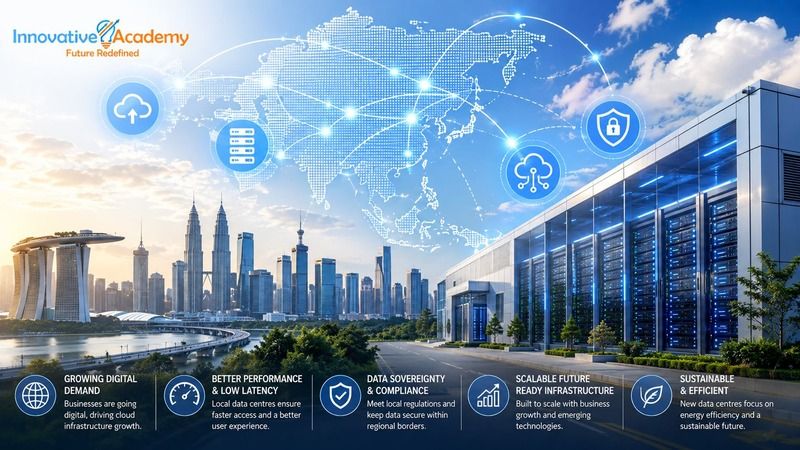

Why Asia Is Becoming the Next Global Cloud Data Centre Hub
Table of Contents
- What Is Driving Asia's Data Centre Boom?
- Why Cloud Providers Need More Data Centres
- Southeast Asia and Malaysia: The Region Attracting the Most Investment
- South Korea's Growing Cloud Infrastructure
- The Role of Internet Connectivity
- Data Sovereignty and Local Infrastructure
- What Data Centres Mean for Businesses
- New Opportunities for IT Professionals
- Challenges Behind the Expansion
- What Comes Next?
- Conclusion
Asia is becoming one of the world's most important destinations for cloud infrastructure. Across countries such as South Korea, Malaysia, Indonesia, Thailand, India, and Singapore, cloud providers are expanding their data centre footprints to meet growing demand for cloud services, digital applications, online businesses, and enterprise technology.
The trend is becoming increasingly visible in 2026. Alibaba Cloud opened its third data center in South Korea this August, expanding its local infrastructure to provide businesses with greater cloud capacity and reliability. Around the same time, Tencent Cloud launched its first cloud region in Malaysia — with up to three availability zones in Johor — adding another major technology company to Southeast Asia's rapidly expanding infrastructure landscape.
So why are companies building so many data centers across Asia? The answer goes beyond simply needing more storage.
1. What Is Driving Asia's Data Centre Boom?
The way businesses use technology has changed significantly. Companies that once operated their own physical servers are increasingly moving workloads to cloud platforms. Applications, databases, websites, enterprise software, streaming platforms, online banking systems, and digital services all depend on computing infrastructure.
As more businesses move online, cloud providers need infrastructure closer to their customers. This is why companies such as AWS, Microsoft Azure, Google Cloud, Alibaba Cloud and Tencent Cloud continue expanding their regional infrastructure.
For professionals looking to build cloud skills, cloud computing training programs at Innovative Academy can provide a practical starting point for understanding modern cloud infrastructure.
The growth is particularly noticeable across Asia-Pacific, and the scale behind it is large. McKinsey estimates that meeting global data center demand will require roughly $6.7 trillion in cumulative capital investment between 2025 and 2030, with Asia-Pacific's share of global demand rising to about 34% by 2030—behind only North America.
Western hyperscalers (AWS, Google, Microsoft, and Oracle) have already pledged more than $160 billion toward AI infrastructure in the region between January 2024 and May 2026, while Alibaba alone has committed roughly $53 billion globally to cloud and AI infrastructure over three years.
2. Why Cloud Providers Need More Data Centres
A data center is much more than a building filled with computers. It contains servers, networking equipment, storage systems, cooling infrastructure, backup power systems, security systems, and connectivity infrastructure.
Cloud providers distribute these facilities across different geographic locations for several reasons.
Faster performance
When a company's application and its users are geographically closer to a data center, network latency can be reduced. An organization serving customers in South Korea, for example, may benefit from having its cloud workloads hosted in South Korea rather than relying entirely on infrastructure located elsewhere.
Better reliability
Cloud providers typically distribute workloads across multiple availability zones and facilities. If one facility experiences an outage, workloads can potentially be shifted to another location — which is part of what Alibaba Cloud's latest South Korean expansion gives customers: additional local infrastructure and availability options.
Growing customer demand
Businesses are increasingly using cloud services for website hosting, databases, enterprise applications, data analytics, software development, backup and disaster recovery, content delivery, digital banking, e-commerce, and other business applications.
More customers mean more computing capacity.
3. Southeast Asia and Malaysia: The Region Attracting the Most Investment
Southeast Asia has become one of the most closely watched data center markets in the world. Countries including Malaysia, Indonesia, Thailand, and the Philippines are attracting investment because of their growing digital economies, improving connectivity, and increasing demand for cloud services.
There is also an important geographical factor. Singapore has historically been the region's major data center hub, but constraints around land, electricity and development have encouraged companies to look at neighboring markets—and Malaysia, particularly Johor, has been the biggest beneficiary.
Johor's proximity to Singapore, combined with more available land, has made it Asia-Pacific's largest data center hub by pipeline, according to Knight Frank research published in mid-2026.
The scale of investment flowing into Johor is substantial. Singapore-based DayOne Data Centers, for instance, announced plans in 2026 to invest more than RM28 billion (roughly US$6.96 billion) in Malaysia, doubling its local workforce to around 1,200 employees and training over 1,000 data center engineers at a new Johor facility.
Tencent Cloud's first Malaysian cloud region, in the same state, is designed to give Malaysian enterprises local data compliance and lower latency for AI workloads while serving as a base for companies expanding across ASEAN.
Malaysia also benefits from its role in the wider semiconductor and technology supply chain. But rapid development is creating new pressure: data centers consume large amounts of electricity and require significant cooling and water resources, and Malaysia's recent economic growth has been partly powered by this same manufacturing and data-center boom—even as concerns about energy and water consumption grow alongside it.
Thailand and Indonesia are also becoming important locations for future capacity, spreading investment across a wider regional network rather than concentrating it in one country.
4. South Korea's Growing Cloud Infrastructure
South Korea is another important market. The country has a highly connected population, advanced digital services, major technology companies, and significant demand for enterprise cloud infrastructure.
Alibaba Cloud entered the South Korean market in 2016, opened its first local data center in 2022, added a second in June 2025, and opened its third in August 2026.
Alibaba Cloud's country manager for South Korea, Yongjoon Yoon, described the newest facility as more than an infrastructure expansion: "It is an investment to help South Korean enterprises operate AI and cloud-based services more reliably."
The rapid expansion demonstrates an important principle of cloud infrastructure: providers want capacity where customers already have strong demand, and additional infrastructure can improve redundancy, performance, and service availability.
5. The Role of Internet Connectivity
A data center is only useful if customers can reliably connect to it. That makes telecommunications infrastructure critical.
Undersea cables connect Asian countries to one another and to major global internet hubs. New cable routes can improve connectivity, reduce latency, and provide additional redundancy—one reason countries investing in digital infrastructure are also focusing on telecommunications networks.
The future cloud infrastructure ecosystem therefore depends on several interconnected systems: data centres, fiber networks, subsea cables, electricity, and cloud platforms.
A weakness in any one of these areas can affect the wider digital ecosystem.
6. Data Sovereignty and Local Infrastructure
Another major reason cloud companies are building local infrastructure is data regulation. Governments increasingly want certain categories of information to remain within national or regional boundaries—including government data, financial information, healthcare records, customer information, business data, and critical infrastructure data.
Local data centers can make it easier for companies to meet these regulatory and compliance requirements.
This is contributing to a broader shift from simply asking "which cloud provider should we use?" to "where should our data and workloads physically reside?"
Southeast Asian governments are increasingly treating cloud infrastructure as strategic infrastructure rather than simply a technology service.
7. What Data Centres Mean for Businesses
The expansion of cloud infrastructure gives businesses more choices. A company can select a cloud region based on latency, cost, compliance, availability, disaster recovery, customer location, and security requirements.
An Indian company serving customers across Asia, for example, may choose different cloud regions for different workloads. A multinational company may distribute its applications across several regions to reduce dependency on any one location.
This is one of the major advantages of modern cloud architecture: instead of relying on a single physical server room, organizations can build distributed infrastructure.
Businesses and IT professionals can explore cloud and infrastructure-focused training programs to develop practical knowledge of these technologies.
8. New Opportunities for IT Professionals
The data-centre boom is not only creating demand for physical infrastructure; it is also creating demand for the people who design, deploy, monitor, and secure these environments.
DayOne's Johor investment alone includes plans to train more than 1,000 data center engineers, which is a useful signal of how directly this construction wave translates into hiring.
Cloud Computing Engineers
Cloud computing engineers work with platforms such as AWS, Microsoft Azure, and Google Cloud to build and manage infrastructure. Professionals interested in developing these skills can explore AWS and Azure training programs at Innovative Academy.
Networking Professionals
Networking professionals are responsible for the connectivity, routing, switching, and traffic management that high-performance data centers depend on. Strong networking fundamentals remain important even as organizations move workloads into the cloud.
For professionals looking to strengthen their networking foundation, CCNA training in Bangalore can help build practical knowledge of networking concepts, routing, switching, and network infrastructure.
Cybersecurity Professionals
Cybersecurity teams protect a growing surface area of cloud environments, networks, applications, and sensitive data as more infrastructure comes online.
DevOps Engineers
DevOps teams automate infrastructure deployment, application delivery and monitoring. As cloud environments become larger and more complex, automation and infrastructure management become increasingly important.
Professionals interested in developing these skills can explore DevOps training at Innovative Academy.
Data Centre Operations Professionals
Data center operations roles require people who understand servers, storage, cooling, power systems and hardware management directly on-site.
The professionals most in demand tend to combine several of these areas—cloud, networking, security, and automation—together rather than specializing narrowly in just one.
Training providers such as Innovative Academy run job-oriented programs in these exact areas, including AWS, Microsoft Azure, CCNA/networking, and DevOps engineering, for readers who want to move into this hiring wave rather than just read about it.
9. Challenges Behind the Expansion
Building more data centers is not without problems.
Electricity demand
Data centers require significant amounts of electricity, and as facilities become larger, access to reliable power becomes a critical consideration.
Water consumption
Traditional cooling systems can require substantial amounts of water, which has increased interest in more efficient cooling technologies and alternative designs.
Land availability
Large facilities require significant amounts of land, which can be difficult to secure in densely populated areas — part of why Johor's excess capacity relative to Singapore has made it so attractive.
Environmental impact
Data center operators increasingly need to account for carbon emissions, renewable energy sourcing and energy efficiency.
Skilled workforce
Infrastructure expansion also requires people with the technical skills to build and operate these environments, creating an important connection between infrastructure investment and IT education and training.
For people looking to develop practical skills across networking, cloud computing, and DevOps, Innovative Academy's technology training programs provide an opportunity to build skills aligned with these growing infrastructure requirements.
10. What Comes Next?
Asia's data-centre expansion is unlikely to stay limited to a few technology hubs. Markets such as Malaysia, Indonesia, Thailand, South Korea and India are increasingly becoming part of a broader regional infrastructure network.
The next stage will likely focus on making that infrastructure faster, more reliable, more secure, more energy efficient, better connected and easier to scale.
Cloud providers will continue balancing customer demand with the realities of power availability, land, regulation and sustainability, while businesses gain more options for where and how they run their technology infrastructure.
11. Conclusion
Asia is becoming a major centre of global cloud infrastructure expansion, and the numbers behind it are no longer abstract: trillions of dollars in projected global investment, tens of billions already committed by individual providers, and a region on track for roughly a third of global data-centre demand by 2030.
Alibaba Cloud's third South Korean data centre and Tencent Cloud's entry into Malaysia, both landing within days of each other in August 2026, are simply the most recent evidence of how fast that landscape is moving.
The reasons are straightforward — more workloads moving to the cloud, expanding digital services, governments emphasizing local infrastructure — but the boom is also creating real tension around electricity, water, land and skilled talent.
For IT professionals, that tension is the opportunity: the servers may sit inside data centres, but the people who design the networks, manage the cloud platforms, secure the infrastructure and automate the systems are the ones this growth depends on.
For readers looking to build those skills, Innovative Academy offers hands-on, job-oriented training in cloud computing, networking, and DevOps in Bangalore.