
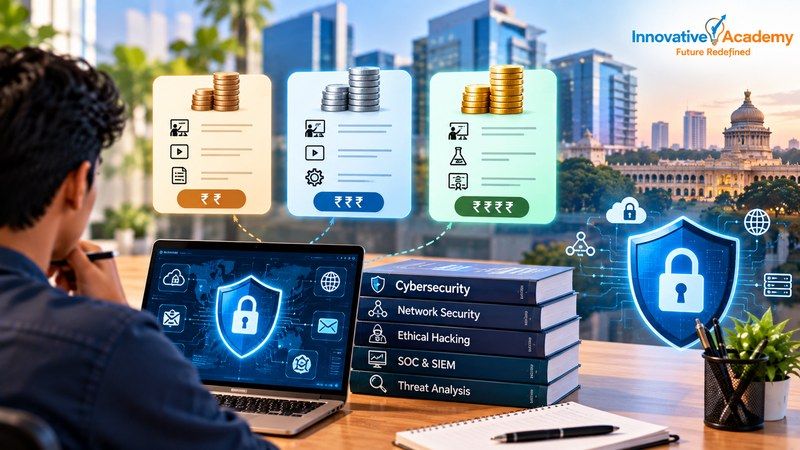

What a Cybersecurity Course in Bangalore Actually Costs in 2026—and What Each Price Tier Actually Gets You
Table of Contents
- Introduction
- The Real Spread: From Nearly Free to Several Lakhs
- What Bangalore-Specific Pricing Looks Like
- Certification Exam Costs Are a Separate Line Item
- What Actually Drives the Price Difference
- The Cheap Option Isn't Automatically the Bad One—but Check This First
- Where a Foundations-First Approach Fits Into This
- Learning Security Fundamentals at Innovative Academy
- FAQs
- Final Thoughts
1. Introduction
Search for cybersecurity course fees and you'll quickly find a surprisingly wide range of prices. In India, cybersecurity training can cost anywhere from a few hundred rupees for basic self-paced content to several lakhs for intensive, long-duration academic or professional programs.
That spread can make it difficult for students and career switchers to understand what they're actually paying for. A low-cost course may provide structured video lessons, while a more expensive program may include instructor-led sessions, hands-on security labs, simulated environments, certification preparation, or career support.
This guide breaks down the major cybersecurity training price tiers in 2026 and looks at what tends to explain the difference between them.
2. The Real Spread: From Nearly Free to Several Lakhs
National-level pricing research places cybersecurity training in India into several distinct tiers.
- Short self-paced online courses: Approximately ₹499 to ₹8,000, with content ranging from around ten hours to several months.
- Instructor-led online programs: Typically ₹50,000 to ₹1,50,000 for programs lasting roughly three to nine months.
- Specialized SOC and cloud-security programs: Approximately ₹80,000 to ₹2,00,000 for six-to-twelve-month programs that may include live attack simulations and access to SIEM environments.
- Intensive full-time bootcamps: Around ₹1,50,000 to ₹3,00,000 for programs lasting approximately three to six months.
- Diploma programs: These vary considerably, from approximately ₹50,000 for a one-year program to ₹3,00,000 or more for advanced programs lasting 1.5 to 2 years.
The important point is that these aren't simply different prices for exactly the same product. Duration, instructor involvement, laboratory access, specialization, academic structure, and career services can all change what a student receives.
3. What Bangalore-Specific Pricing Looks Like
Bangalore-focused pricing guides show a broadly similar structure, although the ranges are often divided slightly differently:
- Beginner-level courses: Approximately ₹15,000 to ₹30,000 for one to three months.
- Intermediate courses: Approximately ₹30,000 to ₹60,000 for three to six months.
- Advanced certification tracks: Approximately ₹60,000 to ₹1,50,000 for six to twelve months.
- Postgraduate or degree-style programs: Approximately ₹1,00,000 to ₹4,00,000 for one to two years.
Examples commonly cited in cybersecurity-training research include programs from providers such as Simplilearn and K7 Computing, along with longer academic programs associated with institutions such as C-DAC and IGIT.
The useful takeaway isn't that one particular price is automatically correct. Instead, duration and depth are major factors behind the price difference. A short introductory course and a year-long advanced security program are not directly comparable simply because both are described as cybersecurity training.
4. Certification Exam Costs Are a Separate Line Item
One of the easiest ways to misunderstand cybersecurity training costs is to treat the training fee and certification examination fee as the same expense.
In many cases, the training program prepares you for a certification, while the certification examination itself is a separate purchase. Depending on the provider and package, an exam voucher may or may not be included.
Some commonly pursued security certifications can involve substantial examination costs:
- CompTIA Security+: The examination fee can add a significant amount to the overall learning budget.
- CISSP: The certification examination is another substantial cost separate from most training programs.
- CCSP: Cloud-security certification also carries a separate examination fee.
- CEH: Pricing requires particular attention because third-party training packages can quote different voucher prices from the official examination pricing published by the certification provider.
For this reason, students should check whether an advertised course price includes an actual examination voucher or simply includes certification preparation.
For certifications such as CEH, checking the current price directly with the official certification body before making a purchase is particularly important. Third-party package pricing can include discounts, bundles, or other conditions that make direct comparisons difficult.
5. What Actually Drives the Price Difference
Once the marketing language is stripped away, several practical factors explain much of the difference between cybersecurity course fees.
Hands-On Lab Access
Actual laboratory access is one of the most important factors to investigate. A course that provides virtual machines, attack-and-defense environments, networking labs, security tools, or investigation scenarios offers a different learning experience from a course based primarily on recorded lectures.
Certification Voucher
Students should determine whether the certification examination voucher is genuinely included in the advertised fee. A course can provide certification preparation without paying for the official examination.
Instructor Support
Live instructor-led sessions, doubt-clearing, practical assignments, project reviews, and individual feedback can increase the cost of delivering a program compared with a completely self-paced course.
Security Tools and Platforms
Training that provides exposure to production-style security tools can require additional infrastructure. Examples include SIEM platforms, incident-response environments, endpoint-security tools, vulnerability scanners, and cloud-security platforms.
Career and Placement Support
Career services can also differ substantially. Resume assistance, mock interviews, interview preparation, and employer connections require more involvement than simply issuing a course-completion certificate.
6. The Cheap Option Isn't Automatically the Bad One—but Check This First
A cybersecurity course costing less than ₹10,000 isn't automatically poor quality, and an expensive course isn't automatically better.
For someone who already understands networking, operating systems, and basic infrastructure, a low-cost self-paced course can be a practical way to learn a specific security topic or organize existing knowledge.
The situation is different for a complete beginner. If a course assumes knowledge of IP addressing, routing, Linux, Windows administration, networking protocols, or system architecture, someone starting from zero may need foundational training before getting maximum value from the security content.
Before paying for any cybersecurity program, ask two simple questions:
- Does the program include genuine hands-on laboratory practice?
- Is the certification examination voucher actually included, or is certification preparation the only thing included?
Those questions can reveal a significant difference between programs that appear similar from their advertisements.
7. Where a Foundations-First Approach Fits Into This
Cybersecurity doesn't exist separately from networking, operating systems, cloud infrastructure, and hardware. Security professionals need to understand how systems normally behave before they can confidently identify abnormal behavior.
For example, interpreting a SIEM alert requires an understanding of the underlying systems and network activity generating that alert. Recognizing suspicious traffic is easier when you already understand what normal traffic patterns look like.
That's why a foundations-first learning path can make sense for beginners. Networking fundamentals, Linux, operating systems, hardware, and cloud concepts can provide the technical context that later security training builds upon.
The cost of a cybersecurity certification or bootcamp therefore shouldn't be considered in isolation. Students should also consider whether they already possess the technical foundation the program expects.
8. Learning Security Fundamentals at Innovative Academy
At Innovative Academy in Bangalore, the approach is focused on building foundational IT skills that can support later cybersecurity learning. Rather than positioning security as a completely isolated subject, the institute incorporates relevant security fundamentals into its networking and Hardware & Networking training.
Students can build practical understanding around areas such as computer hardware, networking concepts, operating systems, and infrastructure before moving toward more specialized security topics.
For learners looking for a foundation in networking and infrastructure, you can explore the CCNA training program in Bangalore or learn more about Hardware & Networking training in Bangalore.
Course fees and current offers can change, so students should confirm the latest fee, schedule, course inclusions, and available learning options directly with Innovative Academy before enrolling.
9. FAQs
1. Why do cybersecurity course prices vary so much between providers?
The main differences are usually duration, depth, instructor involvement, hands-on laboratory access, certification preparation, examination vouchers, infrastructure, and career support. Two courses carrying the same "cybersecurity" label can therefore offer very different learning experiences.
2. Is a very cheap cybersecurity course under ₹10,000 worth it?
It can be useful for someone who already has foundational networking and systems knowledge and wants structured, low-cost learning. Beginners should first check whether the course assumes prior knowledge and whether it provides meaningful hands-on practice.
3. Are certification exam fees included in cybersecurity course fees?
Not always. Some providers include an examination voucher in a package, while others charge separately. Students should ask for a written breakdown of what the advertised course fee includes.
4. What should I check before choosing a cybersecurity course?
Check the course duration, syllabus, instructor support, practical labs, tools covered, projects, certification preparation, examination voucher, placement or career assistance, refund terms, and total cost.
5. Do I need networking knowledge before learning cybersecurity?
Not every cybersecurity course requires the same level of networking knowledge, but networking fundamentals are highly relevant to many security roles. Understanding protocols, IP addressing, routing, traffic flows, and network behavior can make later security concepts easier to understand.
10. Final Thoughts
Cybersecurity course pricing in India spans a very wide range—from inexpensive self-paced learning to advanced academic and professional programs costing several lakhs.
That difference doesn't automatically tell you which course is appropriate. The more useful comparison is what each program actually provides for the money: hands-on lab access, instructor support, course duration, technical depth, certification costs, tools, projects, and career support.
Before choosing a cybersecurity course in Bangalore, look beyond the headline fee. Check what is included, identify any separate certification costs, understand the prerequisites, and compare the practical learning experience rather than comparing prices alone.
For beginners, building a solid foundation in networking, systems, Linux, hardware, and infrastructure can also provide useful preparation for more specialized cybersecurity training later.