
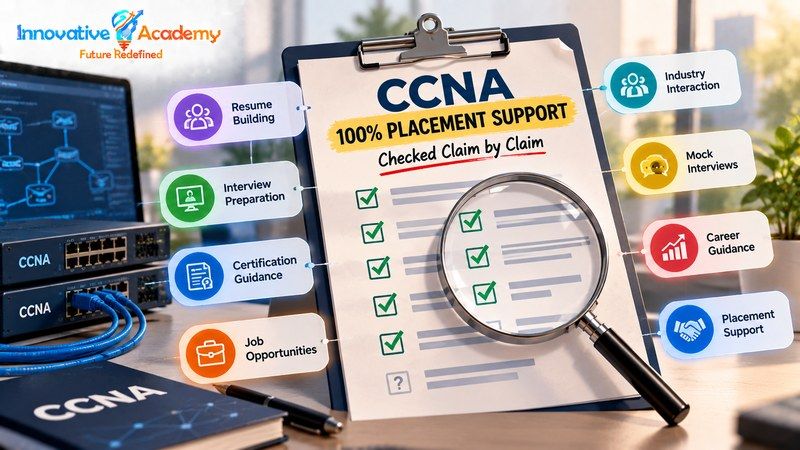

What "100% Placement Support" for CCNA Actually Includes, Checked Claim by Claim
1. Introduction
"100% Placement Support" gets attached to many CCNA programs without much explanation of what is actually included. A typical seven-part placement package may mention resume assistance, interview preparation, lab practice, job opportunities, HR support, soft skills training, and career guidance.
Each of these services can be useful, but they do not all carry the same practical value. Some are concrete activities that students can verify. Others are broad marketing descriptions that need more context.
This guide examines each claim individually and separates practical placement support from statements that may sound more precise than the available evidence allows.
2. The "3x More Interview Calls" Resume Claim
Resume quality genuinely matters for a CCNA fresher. A resume that identifies specific labs completed, protocols configured, networking scenarios practiced, and troubleshooting exercises handled gives recruiters more evidence than a resume containing only a "CCNA certified" statement.
What deserves caution is the specific claim that improving a resume results in "3x more interview calls." A number like this requires a clearly documented methodology, including a defined baseline, sample size, comparison group, time period, and measurement method.
Without that information, the multiplier should not be treated as a verified benchmark.
The more defensible takeaway is simpler: a resume built around specific, demonstrable networking skills and practical work can communicate a fresher's capabilities more effectively than a generic certification-only resume.
3. Interview Prep and Lab Time — The Two Parts That Genuinely Hold Up
Hands-on lab practice and structured interview preparation are two of the most practical components of a CCNA placement-support program.
Hands-On Networking Practice
CCNA preparation is not only about memorizing networking terminology. Students need opportunities to work with concepts such as VLANs, routing, switching, IP addressing, network troubleshooting, and security fundamentals.
Practical exposure helps students understand how networking concepts behave in real configurations rather than only in theory.
Scenario-Based Interview Preparation
Mock interviews become more useful when they move beyond simple definition-based questions. Candidates can practice explaining troubleshooting situations, identifying configuration problems, discussing network design decisions, and communicating their approach clearly.
For example, explaining how they would investigate an OSPF adjacency problem is different from simply defining OSPF. Scenario-based practice helps candidates become more comfortable explaining their technical reasoning during interviews.
These two components—practical labs and realistic interview preparation—are therefore meaningful parts of placement assistance when they are delivered consistently.
4. What "Unlimited Job Opportunities" Actually Promises
The word "unlimited" needs to be interpreted carefully in placement marketing.
A placement team can continue sharing relevant vacancies and supporting applications without restricting students to a fixed number of opportunities. This can include networking positions, NOC roles, technical support openings, infrastructure positions, and other related entry-level opportunities.
However, the number of opportunities presented to a student cannot be equated with a guaranteed job offer. Every employer controls its own screening process, technical assessment, interview requirements, and final hiring decision.
Therefore, "unlimited job opportunities" is more accurately understood as continued access to relevant openings and placement assistance rather than an unlimited guarantee of employment.
5. HR Support, Soft Skills, and the Career Roadmap — Sorting Real From Vague
HR Support
HR support can include application coordination, interview scheduling, reminders, follow-ups, communication about openings, and assistance during the recruitment process.
These are concrete services. Prospective students should ask exactly how frequently the placement team communicates opportunities and what support is provided after an application is submitted.
Soft Skills and Communication
Communication training can be valuable for freshers who have strong technical knowledge but limited interview experience. However, the depth of such training varies between programs.
There is a meaningful difference between a single communication workshop and repeated practice involving mock interviews, self-introduction, technical explanation, aptitude preparation, and interview feedback.
Career Roadmap
After CCNA, learners may explore areas such as CCNP, Linux, cloud computing, cybersecurity, or DevOps. These are possible progression paths, but a career roadmap should be understood as guidance about what to learn next—not as an additional certification or guaranteed career progression.
6. The Fresher Salary Range, Checked Role by Role
Salary claims need to be separated by job title, experience level, location, employer, and technical responsibilities.
A broad ₹2.8–4.5 lakh range for entry-level networking positions should not be interpreted as a guaranteed salary floor for every fresher role.
Network Engineer
Entry-level network engineer compensation can begin below ₹2.8 lakh and increase as candidates gain practical experience, additional certifications, and broader infrastructure skills.
NOC Engineer
NOC roles can also begin around the lower end of the entry-level market. Responsibilities, shift requirements, employer type, and technical scope can significantly affect compensation.
Desktop and IT Support
Some CCNA holders begin their careers in desktop support, technical support, or IT helpdesk positions. These roles can have lower starting compensation than dedicated networking positions.
For this reason, ₹2.8 lakh should not be presented as a universal minimum for every job available to a CCNA fresher.
After Experience or CCNP
With professional experience and deeper networking skills, candidates can progress toward network administration, network engineering, infrastructure, cloud networking, and related positions. A second-level certification such as CCNP may complement that progression, although certification alone does not determine salary.
7. The 7,000+ Number Isn't What It Sounds Like
A figure such as "7,000+ students have started their career in IT with us" needs to be read in its proper context.
If the number represents students across multiple programs offered by Innovative Academy, it should not be interpreted as the number of CCNA students placed specifically through the CCNA program.
A course-specific placement figure and an institute-wide student figure represent two different measurements. Keeping those figures separate makes placement communication clearer and easier for prospective students to understand.
8. CCNA and Placement Support at Innovative Academy
Innovative Academy offers CCNA training in Bangalore with a focus on networking fundamentals, routing and switching concepts, security fundamentals, and practical learning.
The placement-support component can include hands-on lab practice, interview preparation, HR coordination, resume guidance, communication support, and assistance with relevant job opportunities.
Students considering the program can explore the detailed course information here: CCNA Training in Bangalore at Innovative Academy.
The important distinction is between placement assistance and guaranteed employment. Placement support can improve preparation, provide access to opportunities, and help students navigate recruitment processes, while the final hiring decision remains with the employer.
9. FAQs
Is "100% Placement Assistance" the same thing as a guaranteed job?
No. Placement assistance refers to the support provided during the job-search and recruitment process. It does not mean that every student is guaranteed an offer because employers make their own hiring decisions.
Should I trust a claim that a good resume gets 3x more interview calls?
The specific multiplier should be treated cautiously unless the organization provides a transparent methodology and supporting data. The broader point remains useful: resumes that demonstrate specific technical skills and practical work can be stronger than generic certification-only resumes.
Is the ₹2.8–4.5 LPA fresher range realistic for every entry-level networking role?
No. Entry-level compensation varies by role, employer, location, skills, and experience. Network engineering, NOC, desktop support, and IT helpdesk roles can have different starting salary levels.
Does CCNA guarantee a networking job?
No. CCNA can demonstrate foundational networking knowledge, but employers may also assess practical skills, troubleshooting ability, communication, experience, and other job-specific requirements.
What should I look for in CCNA placement assistance?
Look for specific services such as practical labs, resume reviews, mock interviews, technical interview preparation, job-opening communication, HR coordination, and continued application support.
10. Final Thoughts
The seven-part placement-support model commonly attached to CCNA programs contains several genuinely useful components. Hands-on lab practice, technical interview preparation, resume guidance, HR coordination, and access to relevant job opportunities can all contribute to a more structured job-search process.
The claims become less reliable when precise numbers are presented without supporting methodology. A "3x more interviews" figure, a universal fresher salary floor, or an institute-wide student figure presented as a course-specific result should each be examined carefully.
The most useful way to evaluate "100% Placement Support" is therefore to ask what the placement team actually does, how often it does it, and what evidence is available for the claims being made.
For a fresher considering CCNA, the combination of practical networking skills, interview preparation, a focused resume, and sustained placement assistance can provide a structured starting point for entering the IT and networking field.