
Table of Contents
- Start With the Timeline
- The One Sentence That Actually Matters: What Got Frozen
- Unpacking PERM for Anyone Who's Never Had to Think About It
- The Numbers the Administration Is Using to Justify This
- One Company Got Singled Out by Name
- Three Things People Keep Getting Wrong About This Story
- The Counter-Story Running at the Same Time, in the Same Country
- Two Different People, Two Different Amounts of Reason to Worry
- A Skills-First Way to Read This, at Innovative Academy
- FAQs
- Final Thoughts
1. Start With the Timeline
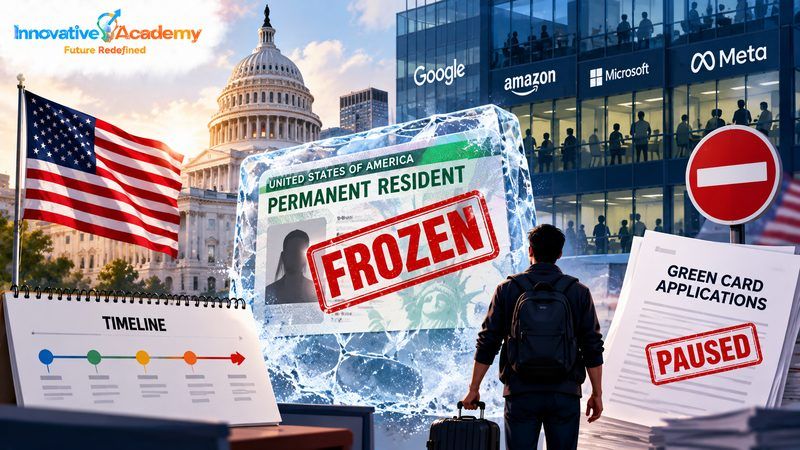
September 2026: the US Department of Labor takes a narrower action against Cognizant alone over its PERM filings. October 8, 2026: that single-company action widens into an eight-company one. This time, the action names Tata Consultancy Services, Infosys, Wipro, HCL, Cognizant, Capgemini, Microsoft, and Adobe. Labor Secretary Keith Sonderling announces it in one blunt line: his department will neither accept new filings from these companies nor keep processing the ones already sitting in the queue. No end date comes attached to the announcement.
2. The One Sentence That Actually Matters: What Got Frozen
Strip away everything else in this story, and one sentence carries the entire practical weight of it: eight named companies can no longer file new, or advance pending, Permanent Labor Certification applications with the US government. That's it. That's the mechanism. Everything else in the coverage, the political framing, the company-by-company reactions, the historical numbers, sits on top of that one administrative fact.
3. Unpacking PERM for Anyone Who's Never Had to Think About It
Most people outside immigration law have no reason to know what PERM stands for, so it's worth building the concept from the ground up rather than assuming familiarity. A US employer that wants to sponsor someone for most kinds of employment-based permanent residency first has to clear a labor-market test: prove no qualified American candidate was available for the role and show that bringing in the foreign worker won't drag down pay or conditions for similar American employees doing similar work. That test is PERM. Pass it, and the employer can then file the next step, an immigrant petition, moving the employee meaningfully closer to a green card. Freeze a company's access to PERM, and you've frozen the entry point to that entire downstream sequence, for that company specifically, not for the immigration system generally.
4. The Numbers the Administration Is Using to Justify This
The administration isn't framing the situation as eight isolated incidents; it's framing it as a pattern stretching back nearly two decades. Sonderling's office puts the combined total at close to three million foreign-worker requests from this group since 2009, translating into more than 230,000 approved H-1B visas and upward of 100,000 completed PERM certifications over that span. Scale, in this framing, is the evidence: a volume of filings large enough, the administration argues, that it couldn't have happened without displacing American applicants along the way.
5. One Company Got Singled Out by Name
Of the eight, Microsoft drew a specific, pointed accusation from Vice President JD Vance rather than a generic mention in a list. His claim: Microsoft cut roughly 6,000 American jobs in the same stretch where it picked up 6,300 H-1B visas and close to 3,000 green cards, and did so, in his telling, by advertising openings in a way unlikely to attract many qualified US applicants before turning to foreign-worker sponsorship. His pointed advice to the company was to simply "hire great American workers." None of this, worth stating plainly, has been established through any completed legal or administrative finding; it's an allegation attached to a policy action, and the distinction matters.
6. Three Things People Keep Getting Wrong About This Story
First: The ruling is not a cancellation of visas or green cards already granted. Nothing here reaches back and undoes status someone already holds.
Second: This is not a universal ban on hiring foreign workers across the US tech industry. It's a specific action against eight named companies' PERM access specifically.
Third: This is not described anywhere as permanent. The suspension has no announced end date, which is a different thing from having no possible end at all.
Getting these three distinctions right is most of what separates an accurate read of this story from an alarmist one.
7. The Counter-Story Running at the Same Time, in the Same Country
While this suspension was making headlines, a mostly unrelated story was quietly setting records in the same country where the suspended companies are headquartered. India's Global Capability Centres, the in-house tech and operations arms multinationals run directly inside India rather than outsourcing to firms like the ones named above, are on track to cross 510,000 jobs in 2026, a figure that didn't exist at even a third of that size back in 2021.
More than 227,000 of those hires already happened in just the first six months of this year, 11% ahead of the same period in 2025, even as general white-collar hiring across India was actually shrinking over the same stretch. This year, nearly two out of every three new roles created inside these centres specifically call for skills in AI, data science, or automation. None of that growth routes through a PERM filing. None of it depends on this suspension resolving one way or the other.
8. Two Different People, Two Different Amounts of Reason to Worry
Picture two people reading this news on the same morning. The first has a PERM application already filed, through one of these eight employers, as their actual step toward a US green card. That person has a real, immediate reason for concern and reasonably needs to start thinking through alternatives while the situation plays out with no announced timeline.
The second is a student or early-career developer in Bangalore who hasn't filed anything yet and is weighing a broader set of career paths. That person is reading a story about a narrow US administrative process, not a verdict on whether building technical skills in India still has a strong payoff. The headline doesn't distinguish between these two readers. The actual facts underneath it very much do.
9. A Skills-First Way to Read This, at Innovative Academy
Innovative Academy's Java Full Stack program in Bangalore trains toward the specific technical capability that's underpinned hiring at both the suspended IT-services giants and at the Global Capability Centres now outpacing them in growth: Spring Boot, enterprise application architecture, and database-backed real projects. That's the kind of thing that shows up the same way on a resume no matter which specific employer, or which specific government's immigration policy, happens to be making news that particular week.
10. FAQs
1. Did the ban cancel anyone's existing H-1B visa or green card?
No. It only stops these eight companies from filing new, or progressing pending, PERM applications. The status someone already holds isn't affected by this action.
2. Who exactly got suspended?
Tata Consultancy Services, Infosys, Wipro, HCL, Cognizant, Capgemini, Microsoft, and Adobe. Cognizant had already faced a narrower version of this action on its own in September, before the broader eight-company suspension in October.
3. When does it end?
Unannounced. The Department of Labor hasn't said how long the suspension lasts or what these companies must do to be reinstated.
4. Has any wrongdoing actually been proven?
No, there has not been any completed legal or administrative finding. The action is based on the administration's allegations about filing volume and hiring practices, not on an adjudicated ruling against any of the eight companies.
5. Does the ruling make it harder to find a tech job in India right now?
Not based on the available evidence. It's a US government process affecting a path to US permanent residency through eight specific employers. Hiring inside India, including at the country's Global Capability Centres, is a separate and currently growing track untouched by this action.
11. Final Thoughts
Pull this story apart, and it's really two stories wearing one headline: a real, specific, currently open-ended freeze on one immigration pathway through eight named companies, and a much larger, mostly unconnected trend of India-based hiring that's actually accelerating at the same moment. Whether this particular news should worry someone depends almost entirely on which of those two stories actually applies to their situation, and that's worth figuring out before reacting to the headline alone.
Innovative Academy — Contact for course details: 8447712333
Sources:
- Gulf News — US Suspends India Tech Giants Tata, Infosys, and Wipro From Green Card Process
- India TV News — Infosys, TCS, and Wipro Among 8 IT Firms Suspended From US Green Card Program in Major H-1B Crackdown
- Business Today — At 5.1 Lakh Jobs, India's Global Capability Centre Hiring Boom Scales New Peak
- Innovative Academy — Java Full Stack Course in Bangalore