
Top Online DevOps Bootcamp: Transform Your Career with Innovative Academy
Table of Contents
- Introduction
- Why DevOps Skills Are Worth Investing In Right Now
- What the Bootcamp Actually Covers
- The Projects You Actually Build
- Who This Program Is Built For
- What DevOps Roles Actually Pay
- What Backs Up the Curriculum
- How to Enroll
- Conclusion
- FAQs
1. Introduction
DevOps has moved well beyond being a niche specialization. It has become an important part of how modern software organizations build, deploy, monitor, and maintain applications. As organizations rely more heavily on automation, cloud infrastructure, continuous integration, and continuous delivery, professionals with practical DevOps skills continue to be relevant across technology teams.
If you are considering building DevOps skills or looking for a structured way to learn the tools used in modern infrastructure environments, an online DevOps bootcamp can provide a focused learning path. Innovative Academy's DevOps Bootcamp in Bangalore is designed around foundational concepts, cloud technologies, automation tools, projects, and career preparation.
2. Why DevOps Skills Are Worth Investing In Right Now
Organizations are increasingly using automation, continuous integration and delivery, cloud infrastructure, and containerization to deliver software efficiently while maintaining reliability. These environments require professionals who can configure, automate, monitor, troubleshoot, and improve technology workflows.
Learning DevOps through a structured program can help reduce the difficulty of navigating a large collection of technologies independently. A well-organized bootcamp brings related concepts together and provides opportunities to apply them through practical exercises.
The value of DevOps training depends heavily on the quality of hands-on learning. Understanding commands or definitions is different from being able to build a deployment pipeline, configure infrastructure, troubleshoot a container, or explain an automation workflow during an interview.
3. What the Bootcamp Actually Covers
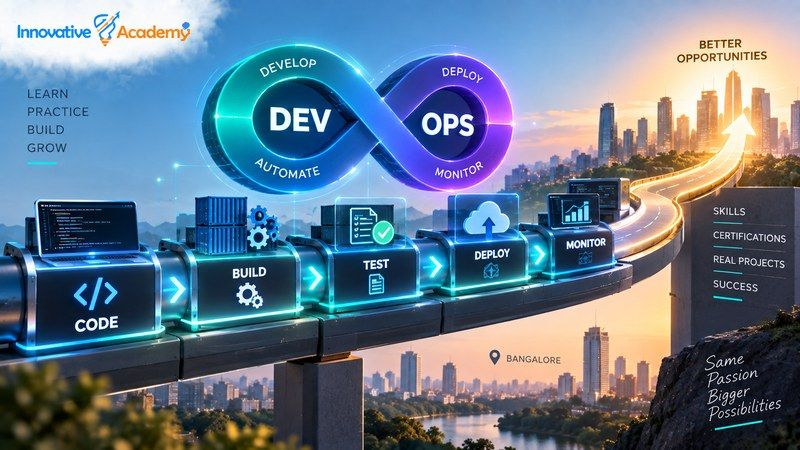
Innovative Academy's DevOps Bootcamp follows a structured learning path covering core infrastructure, cloud, automation, CI/CD, containers, orchestration, infrastructure as code, monitoring, and projects.
Foundation Skills
The foundation phase introduces networking fundamentals, Linux administration, and Bash shell scripting. These concepts provide an important base for working with servers, cloud environments, automation, and DevOps tools.
AWS, Git, and Configuration Management
The next stage introduces AWS Solutions Architecture, Git version control, and Ansible. Students learn how cloud infrastructure and configuration management fit into modern development and operations workflows.
CI/CD and Containers
The CI/CD and containerization stage covers Jenkins, Docker, and Kubernetes. These technologies are widely used to automate software delivery and manage applications in containerized environments.
Infrastructure as Code and Monitoring
The final stage introduces infrastructure as code, monitoring, and logging before moving into the final project and interview preparation. The curriculum is designed to connect individual tools into practical DevOps workflows.
Students interested in combining networking, Linux, AWS, and DevOps can also explore the broader Innovative Academy programs available for different technology career paths.
4. The Projects You Actually Build
Practical projects are an important part of developing DevOps skills. Instead of relying only on theoretical lessons, the bootcamp includes multiple hands-on exercises across different areas of the curriculum.
- Building a highly available web application
- Creating an end-to-end CI/CD pipeline
- Using Terraform for infrastructure provisioning
- Containerizing applications and working with microservices
- Managing workloads with Kubernetes
- Setting up monitoring and observability workflows
- Exploring cloud cost optimization
- Applying security practices to CI/CD pipelines
- Centralizing application and infrastructure logs
- Completing a larger project that combines multiple DevOps technologies
Working on several focused projects can also make it easier to discuss practical experience during technical interviews. Candidates can explain what they built, why they selected particular tools, how the components worked together, and how they handled problems.
5. Who This Program Is Built For
Beginners and Non-IT Learners
The program starts with fundamentals such as networking, Linux, and scripting, making it suitable for learners who are beginning their technology journey.
Software Developers
Developers who want to understand deployment, cloud infrastructure, automation, and operational workflows can use DevOps training to expand their existing technical skill set.
IT Professionals and System Administrators
System administrators, cloud support professionals, and other infrastructure-focused professionals can use structured DevOps training to strengthen their automation and cloud skills.
Career Changers and Graduates
Recent graduates and professionals changing careers can build a portfolio of practical projects while developing foundational knowledge across Linux, cloud computing, automation, and DevOps.
6. What DevOps Roles Actually Pay
DevOps salaries vary significantly depending on experience, location, organization, technical specialization, and the responsibilities associated with the role. Salary figures should therefore be treated as market indicators rather than guaranteed outcomes from completing a course.
Entry-level professionals may start at considerably different salary levels depending on their skills and employer. With experience, professionals can move toward positions involving cloud architecture, platform engineering, site reliability, automation, infrastructure engineering, and senior DevOps responsibilities.
For candidates entering the field, practical skills can be particularly useful when employers evaluate technical ability. Being able to explain projects involving AWS, Linux, Git, Jenkins, Docker, Kubernetes, Terraform, monitoring, and troubleshooting can help demonstrate applied knowledge during interviews.
7. What Backs Up the Curriculum
Innovative Academy provides DevOps training through online and classroom learning formats. The program combines technical instruction with practical exercises and career-oriented preparation.
The training includes exposure to technologies such as Linux, AWS, Git, Jenkins, Docker, Kubernetes, Ansible, Terraform, monitoring, and logging. Students also receive support with resume preparation and interview practice as part of the career-development process.
Students completing the program receive an Innovative Academy certificate. Learners can also explore relevant external industry certifications in areas such as AWS and Linux based on their individual career goals.
The focus of the program is not limited to completing lessons. Practical project work, technical discussions, interview preparation, and placement assistance are intended to help learners move from classroom learning toward employment opportunities.
8. How to Enroll
Getting started with the DevOps Bootcamp is straightforward. Visit the Innovative Academy website, review the program information, and contact the academic team for current batch details and enrollment guidance.
Prospective students can also discuss their educational background, career goals, and preferred learning format before selecting a suitable batch.
For detailed information about the program, visit the Innovative Academy DevOps Bootcamp page.
9. Conclusion
DevOps combines development, infrastructure, cloud computing, automation, deployment, monitoring, and operational practices. Learning these areas independently can take considerable time, while a structured bootcamp can provide a more organized path through the technologies and concepts involved.
Innovative Academy's online DevOps Bootcamp focuses on foundational knowledge, practical projects, cloud technologies, automation, containers, infrastructure as code, and career preparation. For beginners, graduates, IT professionals, developers, and career changers, the program provides a structured environment for developing practical DevOps skills.
Students looking to build a broader cloud and infrastructure foundation can also explore AWS training in Bangalore and Linux administration training from Innovative Academy.
10. FAQs
1. Do I need a coding or IT background to join this bootcamp?
No. The program introduces fundamental areas such as networking and Linux before progressing into cloud, automation, CI/CD, containers, and other DevOps technologies. Beginners can therefore use the structured curriculum to build their knowledge progressively.
2. How long does the DevOps Bootcamp take, and is it available online?
The program follows a structured six-month learning path and is available through online and classroom learning formats. Contact Innovative Academy for the latest batch schedule and delivery details.
3. What tools are covered in the DevOps Bootcamp?
The curriculum covers technologies and tools including Linux, AWS, Git, Jenkins, Docker, Kubernetes, Ansible, Terraform, monitoring, and logging.
4. Does the DevOps Bootcamp include projects?
Yes. The program includes multiple hands-on exercises covering areas such as CI/CD, infrastructure provisioning, containers, Kubernetes, monitoring, security, logging, and cloud optimization.
5. Does Innovative Academy provide placement assistance?
Innovative Academy provides placement assistance to eligible students as part of its career-support process. This can include resume support, interview preparation, and assistance with relevant hiring opportunities.
6. Where can I get more details or enroll in Innovative Academy's DevOps Bootcamp?
Visit the Innovative Academy DevOps Bootcamp page for program information, or contact Innovative Academy for current batch dates, enrollment details, and career counseling.