
Java Just Overtook C++ in the World's Most-Watched Language Ranking — Here's What Actually Shifted
Table of Contents
- What TIOBE actually measures, and what it doesn't
- The headline move: Java passes C++
- Python's lead is still enormous, even as its own number slides
- Go pushes Rust out of the top 10
- The quieter story: Dart cracks the top 20
- Why this is a useful signal, not a popularity contest, for anyone choosing what to learn
- What we're not claiming
Once a month, TIOBE publishes a ranking that gets quoted constantly and understood precisely a lot less often. The November 2026 edition has three genuinely interesting movements buried in it — not just "Python is still first," which is true but not the story.
What TIOBE actually measures, and what it doesn't
Before any of the numbers below mean anything, here's exactly what TIOBE's rating does and doesn't represent: it's built from search-engine query results and related signals (TIOBE itself has never published the exact formula in full), meant as a proxy for how much a language is being talked about, searched for, and supported by tooling and skilled engineers — not a direct count of lines of code in production, job postings, or GitHub commits. That distinction matters because a language can rise or fall in this index for reasons that have more to do with search trends and tutorial traffic than with how many companies are actually shipping production systems in it. Treat the numbers below as a reasonably informative buzz-and-visibility signal, not a hiring forecast.
The headline move: Java passes C++
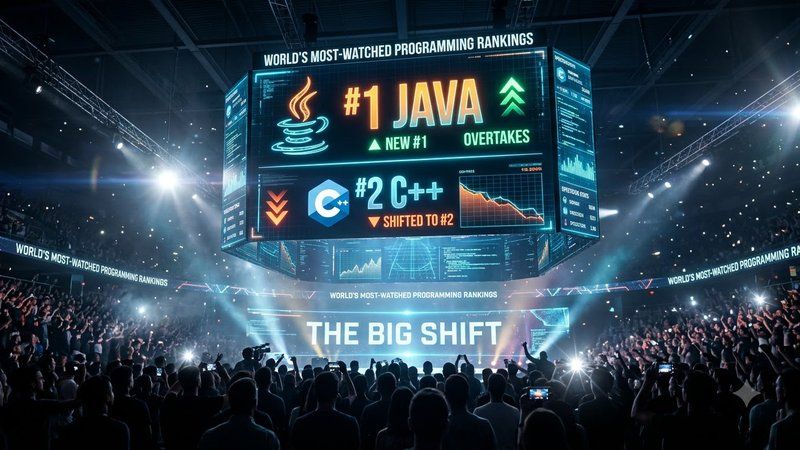
The single most talked-about shift in TIOBE's November 2026 index, published November 10, 2026 by CEO Paul Jansen: Java climbed from 4th place to 3rd, with a rating of 8.89% (up 0.34 percentage points from a year earlier), while C++ slipped from 3rd to 4th, at 8.35% (down 0.60 points). That's a genuinely close race — a gap of just 0.54 percentage points separates them — and it's the kind of ranking swap that happens when one language gains ground steadily while the other loses it, rather than either side posting a dramatic single-month move.
Python's lead is still enormous, even as its own number slides
Python held firmly onto first place, as it has for a long stretch now, but its own rating actually fell — from a year earlier, Python's share dropped 2.51 percentage points to 20.86%. Put the two facts side by side and the real takeaway is proportion, not direction: even after losing more ground in a single year than Java gained, Python's rating is still more than double second-place C's 11.48%, and well over double Java's own 8.89%. A shrinking lead is still a massive lead.
Go pushes Rust out of the top 10
Rust dropped out of TIOBE's top 10 this month, losing its spot to Go. The margin is narrow: Go sits at 10th with 1.69%, and Rust sits at 11th with 1.63% — a gap of just 0.06 percentage points, and Go's own rating actually fell slightly too (down 0.03 points), which says more about Rust easing back than Go surging forward. Worth keeping in perspective: Rust was ranked 14th a year earlier, so even dropping just outside the top 10 now still represents a year-over-year improvement in position, not a language in decline — this is a case where a single-month ranking change and a year-over-year trend point in different directions, and both are worth knowing.
The quieter story: Dart cracks the top 20
The detail that got less attention but may be more genuinely informative about where development work is heading: Dart entered TIOBE's top 20 for the first time in the index's history, landing at 20th with a 0.74% rating. TIOBE's own commentary attributes this directly to Flutter, Google's cross-platform UI framework, which uses Dart as its primary language — a reminder that a language's visibility can rise almost entirely on the strength of one popular framework built on top of it, rather than broad independent adoption of the language itself.
Why this is a useful signal, not a popularity contest, for anyone choosing what to learn
None of this should be read as "learn whichever language is ranked higher this month" — that's precisely the overreaction the methodology caveat above exists to head off. What it's genuinely useful for is noticing durable patterns over time, which is a fundamentally different habit than reacting to one month's snapshot: Python's dominance has held for years despite month-to-month noise, Java and C++ have been trading places in a tight band for a while rather than one decisively pulling away, and newer languages like Go and Rust are both still climbing in the bigger picture even when one month's numbers show them swapping places. Innovative Academy teaches Python, Java, and C/C++ as separate, dedicated courses in Bangalore specifically because each one occupies a genuinely different place in the industry — not because one index ranking makes one more worth learning than another this month. Contact for course details: 8447712333.
What we're not claiming
We're not claiming TIOBE's rating percentages translate directly into job-market demand, salary potential, or actual codebase usage — TIOBE's own methodology is a search-and-visibility proxy, not a labor-market survey, and conflating the two is a common misreading of this index that this piece is deliberately avoiding. We're not claiming Rust's drop out of the top 10 reflects an actual decline in the language's real-world adoption — a 0.06-percentage-point gap against a language ranked 14th a year ago reads more like short-term volatility near a crowded cutoff than a meaningful downturn. And we're not claiming Dart's rise reflects broad enterprise adoption of Dart itself, independent of Flutter — TIOBE's own commentary ties the increase specifically to Flutter's popularity, and nothing here stretches that credit any further than TIOBE itself does.