
The Mistakes That Actually Slow Down AWS Students in Bangalore
1. Introduction
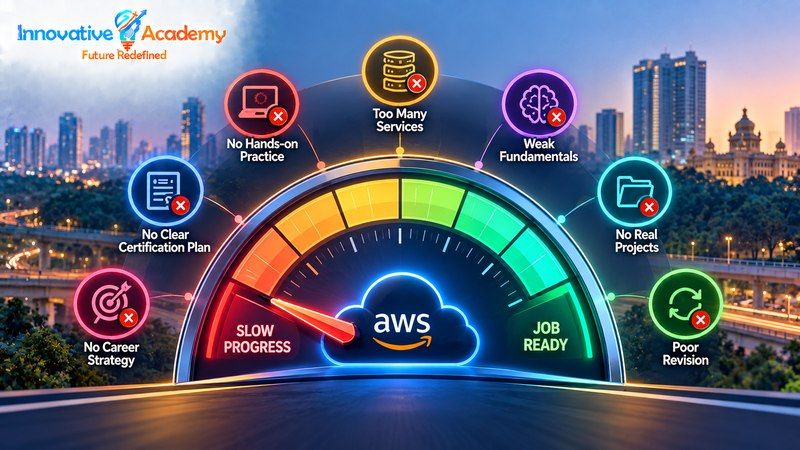
AWS training doesn't fail students because the material is too challenging. It often becomes difficult because the same handful of avoidable habits show up repeatedly, quietly compounding until someone who genuinely put in the hours still struggles in an interview.
These mistakes can be grouped into five major categories rather than treated as a flat list. Most of them share the same root cause, and fixing that root cause can improve several areas of AWS learning at once.
2. Foundation Mistakes: Skipping the Layer AWS Sits On
Jumping straight into EC2 and VPC without a working grasp of basic networking and Linux can create frustration later. AWS is a powerful abstraction over traditional IT concepts, not a complete replacement for understanding them.
Students who skip networking fundamentals may struggle when a security group behaves unexpectedly, a subnet does not route correctly, or they need to troubleshoot connectivity between resources.
A closely related mistake is attempting to learn AWS's entire service catalog at once. AWS provides hundreds of services and features, but trying to memorize everything simultaneously can result in information overload and shallow recall.
Another foundation gap is treating AWS as an isolated skill. Modern cloud environments commonly involve automation, infrastructure as code, CI/CD pipelines, Linux, Git, and container technologies. Understanding how these technologies connect with AWS can provide a more realistic picture of cloud engineering work.
Build the Foundation Before Going Deep
A practical learning sequence is:
- Networking fundamentals
- Linux fundamentals
- AWS core services
- IAM and security basics
- Cloud architecture
- Automation and infrastructure as code
- Projects and troubleshooting
3. Practice Mistakes: Learning About AWS Instead of Learning AWS
Watching recorded sessions can feel productive, but cloud computing is a practical skill. Students need repeated exposure to the AWS console, command-line tools, configuration tasks, troubleshooting, and real deployment scenarios.
A student who watches multiple EC2 tutorials without actually launching and managing an instance may struggle when an interview changes from "explain EC2" to "show me how you would deploy and troubleshoot it."
A useful approach is to combine theory with substantial hands-on practice. Important exercises include:
- Launching and managing EC2 instances
- Creating and configuring S3 buckets
- Working with IAM users, roles, and policies
- Building a basic VPC
- Configuring security groups
- Deploying a simple Lambda function
- Monitoring resources with CloudWatch
Don't Treat IAM as an Afterthought
IAM deserves particular attention because identity and permissions influence how users and AWS resources interact with the platform.
Students should practice concepts such as least-privilege permissions, MFA, IAM policies, roles, users, and resource access instead of simply memorizing their definitions.
4. Depth Mistakes: Stopping at "It Works"
Getting an AWS service to work and understanding why it is configured in a particular way are two different levels of knowledge.
Students who rely exclusively on simplified notes can miss the precise concepts needed for troubleshooting and architecture discussions. AWS documentation, FAQs, pricing information, and service guides provide useful primary-source material for developing deeper knowledge.
Architecture Requires More Than Service Definitions
Knowing what EC2 and RDS do individually is different from understanding when to use RDS instead of DynamoDB, how a three-tier architecture works, or why a workload might require multi-AZ deployment.
Architecture learning should therefore focus on decisions and trade-offs rather than memorizing isolated service descriptions.
Learn the Cost Side of AWS
Cloud skills also involve understanding cost. Students should become familiar with concepts such as usage-based pricing, budgets, Cost Explorer, resource optimization, and the financial impact of leaving resources running unnecessarily.
Cost awareness is useful both for real-world cloud administration and for scenario-based certification questions.
5. Strategy Mistakes: Studying Without a Real Plan
Completing an AWS course and preparing effectively for a certification exam are related but different activities. Memorizing practice-question answers without understanding the underlying scenarios can create weak preparation.
A stronger study strategy includes:
- Completing the core course material
- Practicing AWS services directly
- Reading relevant AWS documentation and whitepapers
- Taking timed practice exams
- Reviewing incorrect answers carefully
- Repeating difficult hands-on exercises
- Building small AWS projects independently
The same principle applies after certification. Students who continue exploring the AWS console, reading technical documentation, following AWS announcements, and building projects are better positioned to keep developing their skills.
6. Career-Readiness Mistakes: Skills With Nowhere to Land
Technical knowledge is only one part of job readiness. Students also need to communicate what they know and demonstrate it through projects and practical examples.
Don't Stay Silent When You Are Stuck
Allowing a small doubt to remain unresolved can create larger gaps later. Asking questions during training, participating in labs, joining study groups, and using dedicated doubt-clearing sessions can help prevent this.
Don't Put Only "AWS" on Your Resume
A resume that simply lists "AWS" as a skill provides little evidence of practical ability. Projects should explain what was built, which AWS services were used, and what the student actually configured or solved.
Supporting skills such as Linux, Git, Docker, networking, and scripting can also provide useful context depending on the target role.
Practice Explaining Technical Decisions
Interview preparation should go beyond technical definitions. Students should practice scenario-based questions, troubleshooting walkthroughs, architecture discussions, and explaining project decisions clearly.
7. What the Salary Numbers Actually Look Like
A single salary range such as ₹4–18 lakh can be misleading because it combines very different experience levels and job roles.
For a genuine newcomer entering the cloud field, a more realistic starting expectation is often around ₹3–8 lakh per year, although actual offers vary according to the employer, role, location, existing technical skills, interview performance, and prior experience.
Higher compensation figures generally correspond to roles requiring greater experience and project responsibility. Cloud administrators, cloud engineers, and solutions architects can have significantly different compensation depending on seniority and organization.
The important distinction is that a certification by itself does not guarantee a particular salary. Employers generally evaluate the combination of technical skills, practical experience, projects, communication, interview performance, and role fit.
8. Avoiding These Mistakes at Innovative Academy
Innovative Academy's AWS Training in Bangalore is designed around practical learning alongside technical concepts.
The training approach focuses on hands-on exposure to AWS services, including areas such as EC2, S3, VPC, IAM, and cloud architecture. Practical exercises can help students move beyond simply watching demonstrations and instead gain experience working with AWS environments.
The learning process can also be strengthened through project work, doubt-clearing support, resume guidance, and mock interview preparation. These elements address both technical learning and the career-readiness gaps that can affect students during the job search.
What Students Should Focus On
- Build networking and Linux fundamentals.
- Practice AWS services instead of relying only on theory.
- Understand IAM and security properly.
- Build projects that demonstrate practical skills.
- Learn architecture concepts and trade-offs.
- Develop basic cloud cost awareness.
- Prepare for scenario-based interviews.
- Keep learning after completing the course or certification.
9. FAQs
1. Is it necessary to learn Linux and networking before starting AWS training?
It is not strictly mandatory to begin AWS training, but having basic networking and Linux knowledge can make the learning process easier. Concepts such as IP addressing, routing, ports, DNS, permissions, processes, and command-line administration appear frequently when working with AWS resources.
2. How many AWS services do I need to know for a job or the SAA-C03 exam?
You do not need to memorize the entire AWS service catalog. Beginners should develop strong knowledge of core areas such as EC2, S3, VPC, IAM, RDS, Lambda, and CloudWatch, then expand into additional services based on their target role and certification objectives.
3. Is a ₹4–18 lakh salary range realistic for a fresher after AWS training?
The lower end can be realistic for some entry-level roles, but the upper end generally represents positions requiring substantially more experience and responsibility. A fresher should avoid treating a high-end salary figure as an expected outcome simply because they completed AWS training or obtained a certification.
4. Is AWS certification enough to get a cloud job?
Certification can demonstrate structured learning and knowledge, but it does not replace practical experience. Projects, troubleshooting ability, Linux and networking knowledge, communication skills, and interview preparation can all matter during recruitment.
5. Should AWS students build projects?
Yes. Projects give students an opportunity to demonstrate that they can apply AWS concepts rather than only explain them theoretically. Even small projects can be useful when they clearly describe the architecture, services used, configuration, security considerations, and troubleshooting steps.
10. Final Thoughts
Most AWS learning mistakes are not caused by a lack of intelligence or effort. They are habits that feel reasonable at the time: watching another video instead of opening the console, skipping IAM because it seems less interesting, memorizing certification questions, or postponing interview preparation until the end of the course.
The solution is straightforward: build the foundation, practice hands-on, develop deeper understanding, follow a structured study strategy, and treat career preparation as part of technical learning rather than something that begins after training is finished.
The gap between "completed AWS training" and "job-ready AWS skills" becomes much smaller when students consistently practice what they learn and can explain how they applied those skills to real technical problems.