
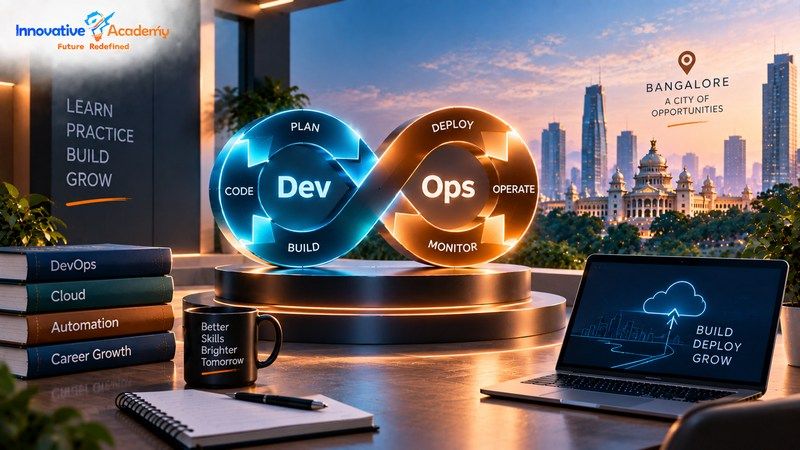

The Best DevOps Bootcamp Course in Bangalore
Table of Contents
- Why a DevOps Bootcamp, Specifically?
- DevOps in One Paragraph
- The Ideas That Hold DevOps Together
- The DevOps Toolbox
- Picking a Specialization: Networking, Linux, or AWS
- What a Good Curriculum Actually Looks Like
- What to Check Before You Enroll
- FAQs
A DevOps bootcamp can help learners build practical skills across development, operations, automation, cloud computing, and infrastructure. Instead of learning individual tools separately, a structured DevOps bootcamp connects technologies such as Git, Jenkins, Docker, Kubernetes, Ansible, Terraform, Linux, and AWS into practical workflows.
For learners looking for a DevOps Bootcamp Course in Bangalore, it is important to evaluate the curriculum, hands-on projects, trainers, specialization options, career support, and overall learning approach before enrolling.
1. Why a DevOps Bootcamp, Specifically?
Plenty of people learn individual DevOps tools on their own—a Docker tutorial here, a Jenkins crash course there. What a bootcamp can provide that scattered self-study often does not is the connective understanding between those technologies.
A structured program can explain why different tools exist, how they fit together in a real CI/CD pipeline, and how DevOps practices influence the way development and operations teams work together.
A good bootcamp can also introduce learners to modern practices such as DevSecOps, GitOps, Infrastructure as Code, containerization, monitoring, and automated deployment. These concepts help learners understand DevOps as a complete workflow rather than simply a collection of tools.
For learners comparing options, the DevOps Bootcamp Training in Bangalore at Innovative Academy is designed around practical technologies and project-based learning.
2. DevOps in One Paragraph
At its core, DevOps is a combination of culture, processes, practices, and technology designed to bring software development and IT operations teams closer together. The objective is not automation for its own sake. Instead, DevOps uses automation, collaboration, continuous integration, continuous delivery, monitoring, and feedback to help teams release software more efficiently and reliably.
Rather than treating development and operations as completely separate functions, DevOps encourages shared responsibility throughout the software lifecycle—from writing and testing code to deploying, monitoring, and improving applications.
3. The Ideas That Hold DevOps Together
Strip away the individual tools, and DevOps rests on several fundamental ideas.
Collaboration
Collaboration is central to DevOps. Development and operations teams work together instead of passing work between isolated teams. This shared approach can reduce communication gaps and improve accountability throughout the software lifecycle.
Automation
Automation is another major component of DevOps. Repetitive tasks such as building applications, running tests, provisioning infrastructure, and deploying software can be automated to reduce manual effort and improve consistency.
Continuous Integration
Continuous Integration, commonly called CI, involves regularly integrating code into a shared repository. Automated builds and tests can identify integration problems earlier in the development process.
Continuous Delivery and Deployment
Continuous Delivery extends automation into the software release process. Depending on the workflow, approved changes can be automatically prepared for release or deployed to staging and production environments.
Infrastructure as Code
Infrastructure as Code, or IaC, treats infrastructure configuration and provisioning as code that can be version-controlled, reviewed, and reproduced. Tools such as Terraform and Ansible are commonly used in infrastructure automation workflows.
Monitoring and Feedback
Monitoring helps teams understand application and infrastructure performance after deployment. Logging, metrics, alerts, and tracing can provide feedback that helps teams identify problems and improve future releases.
Microservices
DevOps can work particularly well with microservices architectures because independently deployable services can allow teams to develop, test, and release components separately.
DevSecOps
Security is increasingly incorporated throughout the software development lifecycle rather than being treated as a final-stage activity. This approach is commonly referred to as DevSecOps.
4. The DevOps Toolbox
Different organizations use different DevOps toolchains, but several technologies appear frequently in DevOps workflows.
- Git: Version control and source-code collaboration.
- Jenkins: Continuous integration and automation.
- Docker: Application containerization.
- Kubernetes: Container orchestration.
- Ansible: Configuration management and automation.
- Terraform: Infrastructure as Code and infrastructure provisioning.
- Prometheus: Monitoring and metrics collection.
- AWS: Cloud infrastructure and application services.
Learning these tools individually is useful, but understanding how they connect is equally important. A practical DevOps workflow might involve Git for source control, Jenkins for CI/CD, Docker for containerization, Kubernetes for orchestration, Terraform for infrastructure provisioning, and monitoring tools for operational visibility.
5. Picking a Specialization: Networking, Linux, or AWS
Some DevOps learning paths allow students to combine core DevOps skills with a deeper specialization. Networking, Linux, and AWS are three areas that can complement DevOps training.
Networking-Focused DevOps
A networking-focused path can introduce automation for network infrastructure using technologies such as Terraform and Ansible. Learners may explore automated router and firewall configuration, load balancing, network security, service discovery, and infrastructure automation.
This approach can be useful for networking and infrastructure professionals who want to expand their existing skills into DevOps.
Those starting with networking fundamentals can also explore the Networking Fundamentals Training in Bangalore offered by Innovative Academy.
Linux-Focused DevOps
Linux plays an important role across many DevOps environments. A Linux-focused learning path can cover command-line administration, file systems, permissions, shell scripting, Bash, Python scripting, configuration management, automation, and CI/CD environments.
For learners interested in strengthening their Linux foundation, Innovative Academy also provides Linux Administration Training in Bangalore.
AWS-Focused DevOps
An AWS-focused DevOps path combines DevOps practices with cloud services. Common topics can include EC2, S3, RDS, CloudFormation, Terraform, CodePipeline, CodeBuild, CodeDeploy, EKS, Lambda, CloudWatch, and other AWS services.
This combination can be useful for learners who want to work with cloud-based infrastructure and deployment environments.
Learn more about AWS DevOps Training in Bangalore to explore how cloud and DevOps skills can be combined in a structured learning path.
How the Three Specializations Connect
Networking, Linux, and AWS provide different technical foundations, but they can all connect to the broader DevOps approach. Automation, collaboration, infrastructure management, continuous delivery, monitoring, and security remain important regardless of the specialization.
6. What a Good Curriculum Actually Looks Like
A well-structured DevOps bootcamp should go beyond introducing individual tools. The curriculum should connect concepts, technologies, automation practices, and hands-on projects.
DevOps Fundamentals
Students should understand what DevOps means, why organizations adopt it, and how development and operations practices work together.
Agile and Lean Practices
Agile and Lean approaches can help learners understand iterative development, continuous improvement, collaboration, and efficient delivery.
CI/CD Pipeline Automation
A practical curriculum should demonstrate how source code moves through build, testing, deployment, and monitoring stages.
Git and Version Control
Git skills are essential for working with modern software development workflows. Learners should understand repositories, branches, commits, merges, pull requests, and collaborative workflows.
Automated Testing
DevOps pipelines can incorporate different levels of automated testing, including unit, integration, and regression testing.
Infrastructure as Code
Students should gain practical exposure to infrastructure automation rather than learning IaC only as a theoretical concept. Terraform and configuration-management tools such as Ansible are commonly used for this purpose.
Containers and Orchestration
Docker and Kubernetes are important technologies for understanding modern containerized application environments. A practical bootcamp should demonstrate how containers are created, managed, deployed, and monitored.
Monitoring and Logging
Monitoring and logging help DevOps teams understand system performance and troubleshoot operational problems. Learners should understand metrics, logs, alerts, and basic observability concepts.
Security
Security should be incorporated throughout the DevOps lifecycle. A modern curriculum can introduce DevSecOps concepts, secure development practices, vulnerability management, and security checks within CI/CD pipelines.
Projects and Case Studies
Hands-on projects are an important part of DevOps learning. Projects allow students to connect multiple tools and concepts instead of learning each technology independently.
For learners interested in a broader project-oriented learning path, Innovative Academy's DevOps Bootcamp Course covers technologies including Linux, Git, Jenkins, Docker, Kubernetes, Ansible, Terraform, AWS, and DevOps practices.
7. What to Check Before You Enroll
DevOps bootcamps can differ significantly in duration, curriculum, teaching style, and practical exposure. Before enrolling, review the program carefully instead of relying only on promotional claims.
Check the Curriculum
Look for a curriculum that covers fundamentals as well as practical technologies such as Git, CI/CD, Docker, Kubernetes, Linux, cloud platforms, Infrastructure as Code, monitoring, and security.
Check the Trainers
Review the instructors' professional background and technical experience. Trainers with practical industry exposure can provide useful context around how DevOps tools are used in real environments.
Check Hands-On Training
Find out how much of the program involves practical labs, projects, assignments, and troubleshooting rather than only classroom explanations.
Check Career Support
If your goal is to transition into a DevOps career, check whether the institute provides services such as resume guidance, mock interviews, interview preparation, and placement assistance.
Check Learning Flexibility
For working professionals and students, online and classroom options, recorded sessions, and flexible schedules can make a difference to the overall learning experience.
Check Certification and Course Completion
Understand whether the program provides a certificate, what it represents, and whether the curriculum provides practical skills alongside course completion credentials.
A program that focuses heavily on theory without sufficient project work may leave learners familiar with DevOps terminology but less prepared to apply those concepts in practical situations.
8. FAQs
1. Which institute in Bangalore offers a DevOps bootcamp course?
Innovative Academy offers a DevOps Bootcamp in Bangalore with online and classroom learning options, practical training, project exposure, and placement assistance.
2. Can I get a job after completing a DevOps bootcamp?
Completing a DevOps bootcamp does not by itself guarantee employment. Career outcomes depend on factors such as technical skills, project experience, interview performance, prior experience, and the requirements of individual employers.
A bootcamp can support career preparation by helping learners build practical skills and providing services such as resume guidance, mock interviews, technical interview preparation, and placement assistance.
3. What tools should I learn in a DevOps bootcamp?
Common tools include Git, Jenkins, Docker, Kubernetes, Ansible, Terraform, monitoring platforms, Linux, and cloud services such as AWS. The exact toolset can vary depending on the curriculum and the target job role.
4. Is Linux important for DevOps?
Yes. Linux is widely used in server and cloud environments, making Linux administration, command-line skills, shell scripting, permissions, networking, and system troubleshooting useful foundations for DevOps professionals.
5. Is AWS useful for a DevOps career?
AWS can be useful for DevOps roles involving cloud infrastructure, application deployment, automation, containers, serverless computing, monitoring, and infrastructure management. AWS skills can be combined with tools such as Terraform, Jenkins, Docker, and Kubernetes.
6. Does a DevOps bootcamp include placement assistance?
Placement support depends on the institute and program. Prospective students should check exactly what is included, such as resume preparation, mock interviews, career guidance, interview opportunities, and placement assistance.
Conclusion
A DevOps bootcamp can provide a structured path for learning automation, CI/CD, cloud computing, infrastructure management, containers, monitoring, and DevSecOps practices. The most important factor is not simply the number of tools listed in a syllabus, but whether the program teaches learners how those technologies work together through practical projects.
If you are looking for a DevOps Bootcamp Course in Bangalore, compare the curriculum, trainers, hands-on projects, specialization options, learning format, and career support before making your decision.
Explore DevOps Bootcamp Training in Bangalore at Innovative Academy.