
The AWS Solutions Architect Associate Certification: A Straight Answer for 2026
The AWS Solutions Architect Associate certification remains one of the most recognizable entry-to-mid-level cloud credentials for professionals who want to understand how applications and infrastructure are designed on Amazon Web Services. But before committing time and money to it in 2026, it is worth understanding exactly what the current exam tests, who it suits, and what comes after the certification.
1. Start With the Number That's Changed
Sit for this exam today, and you're taking SAA-C03: one sitting, 65 questions split between pick-one and pick-several formats, a 130-minute window, and a $150 USD fee.
Pass it, and the credential holds for three years before you're due to requalify—either by sitting the current version again or by climbing straight to the Professional tier instead.
None of that is dramatic information, but it's precisely the kind of detail that quietly goes stale in older blog posts, so it's worth stating plainly before anything else.
2. What You're Actually Signing Up to Prove
Strip away the exam-prep marketing, and the certification is testing one specific muscle: can you take a business constraint and turn it into a defensible set of AWS choices?
Given a requirement like "the system needs to survive losing an entire data center" or "this needs to run for a third of what it currently costs," can you pick the right combination of compute, storage, database, and networking services to satisfy it—and explain why you didn't pick the more expensive or more complicated alternative?
That's architecture, not engineering. You're not expected to write production code to pass it, though understanding roughly how applications get built and deployed makes the scenario questions considerably easier to reason through.
3. A Day in the Role, Not a Job Description
Forget the blueprint metaphors for a moment. On an actual team, a solutions architect spends a lot of time in rooms or calls translating what a business person wants into something an engineering team can build—and then defending or revising that translation when it turns out to be too expensive, too slow, or too fragile.
A good portion of the job is also migration: taking something that already runs somewhere else and moving it onto AWS without breaking the parts of the business that depend on it working correctly during the move.
And increasingly, the role sits right next to whoever owns deployment automation, because a design that can't actually be provisioned repeatably and safely isn't finished—it's just a diagram.
4. The Case for Doing This Instead of an AI Certification
AI-specific certifications are growing fast, and it's a fair question why anyone would choose architecture over that right now.
The honest answer is that AI workloads still have to run somewhere, on infrastructure that someone still has to design, secure, and keep within budget. Solution architecture isn't competing with AI skills for relevance—it's sitting underneath them.
A genuinely common failure mode right now is a model that shines in a notebook but becomes unusable in production because nobody designed the infrastructure around it properly, and this certification aims to teach how to avoid that.
There's also a shelf-life argument. A certification tied to one specific tool or product ages the moment that tool falls out of favor. This one tests judgment across AWS's core service catalog rather than any single product, and AWS periodically reworks the exam content specifically so it doesn't calcify around patterns nobody uses anymore.
5. Two Honest Warning Signs
There are two situations where the certification may not be the best next move.
Starting With Zero IT or Cloud Experience
If you have zero IT background—never touched a terminal, never worked with any cloud platform in any capacity—this exam assumes more than you currently have.
A foundational cloud certification or introductory cloud training can help build the vocabulary and concepts required before moving into architecture-focused preparation.
Skipping that foundation can mean learning cloud fundamentals and architecture judgment under exam pressure simultaneously, which can make the learning process considerably harder.
A Career That Doesn't Involve Infrastructure
If your actual career goal has nothing to do with infrastructure at all—for example, pure front-end development with no interest in how applications are deployed—this specific certification may not be the most relevant use of your study time.
6. After the Badge
This credential is a doorway, not a destination.
From here, the direct next step up is the Professional-level Solutions Architect certification, which moves toward organization-scale and multi-account complexity.
Plenty of people branch sideways instead, or afterward, into a specialization that actually interests them—security-focused architecture, machine learning infrastructure, networking, or the automation-heavy end of the spectrum that overlaps with DevOps.
Which direction makes sense depends less on certification rankings and more on which part of the actual work you enjoy once you're doing it for real.
7. Choosing Where You'll Actually Learn It
A few honest questions are worth asking any training provider before paying them:
- Is the syllabus actually built around SAA-C03 specifically?
- Is the material aligned with the current exam objectives?
- How much of the schedule involves building something versus watching someone else build it?
- Are practical projects included?
- What does support look like after the exam?
- Does career support continue beyond certification preparation?
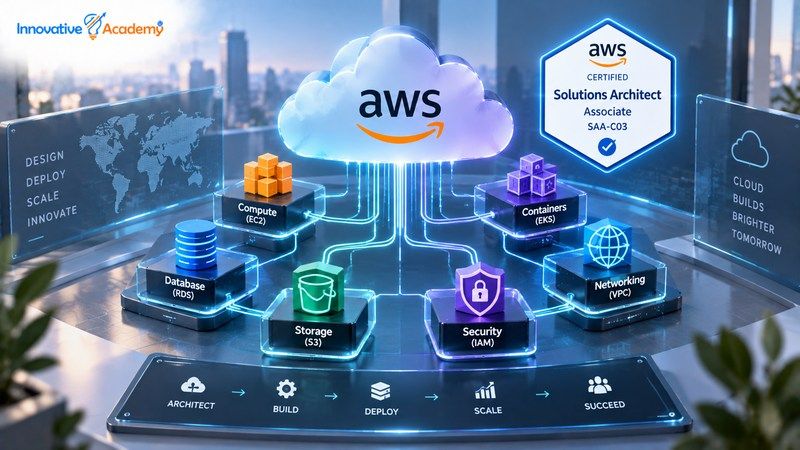
Innovative Academy's AWS training in Bangalore provides a structured learning path covering cloud fundamentals, networking, compute, storage, databases, architecture patterns, and security.
The training approach also incorporates practical project work rather than relying exclusively on lecture-based learning. Students can access classroom and live online learning options, making the program suitable for learners with different schedules and locations.
Career-oriented support can include resume preparation, interview practice, project discussions, and guidance for the job-search process alongside technical learning.
What to Look for in an AWS Training Program
- Current SAA-C03-aligned curriculum
- Hands-on AWS labs and projects
- Coverage of networking, compute, storage, databases, and security
- Architecture-focused scenario practice
- Instructor-led learning and doubt resolution
- Resume and interview support
- Classroom and online learning options
8. Bottom Line
The AWS Solutions Architect Associate certification has stayed relevant for a straightforward reason: it tests a skill that AI and automation haven't removed the need for—designing infrastructure that's cost-aware, secure, and resilient on a cloud platform that continues to expand.
If you already have some grounding in IT or cloud work, it can be a useful next step in 2026. The value of the certification, however, depends heavily on whether you combine exam preparation with practical understanding and hands-on experience.
For learners in Bangalore, choosing a program that follows the current exam objectives and includes practical projects can make the learning experience more relevant than relying on an outdated or lecture-only syllabus.
9. Frequently Asked Questions
1. How much does the AWS Solutions Architect Associate exam cost?
The current AWS Solutions Architect Associate exam is listed at $150 USD. The SAA-C03 exam has 65 questions and a 130-minute testing duration.
2. How long is the AWS Solutions Architect Associate certification valid?
The AWS Solutions Architect Associate certification is valid for three years. Candidates can maintain their certification through AWS's available recertification pathways.
3. Do I need AWS experience before taking the exam?
There is no mandatory experience requirement simply to register for the exam. However, practical AWS or IT experience can make the scenario-based questions easier to understand. Beginners may benefit from learning cloud fundamentals first.
4. Is AWS Solutions Architect Associate suitable for beginners?
It can be suitable for beginners who already have some basic IT knowledge and are prepared to learn AWS fundamentals alongside architecture concepts. Someone completely new to IT and cloud may benefit from starting with foundational cloud concepts first.
5. What does the AWS Solutions Architect Associate certification cover?
The certification focuses on designing solutions using AWS services while considering areas such as security, resilience, performance, and cost. Core AWS areas include compute, storage, databases, networking, and application architecture.
6. What can I do after AWS Solutions Architect Associate?
After earning the certification, learners can deepen their practical AWS experience or move toward areas such as solutions architecture, cloud infrastructure, DevOps, cloud security, networking, or machine learning infrastructure.
7. Where can I learn AWS Solutions Architect Associate in Bangalore?
Innovative Academy offers AWS training in Bangalore with instructor-led learning, practical project work, classroom and online options, and career-oriented support.