
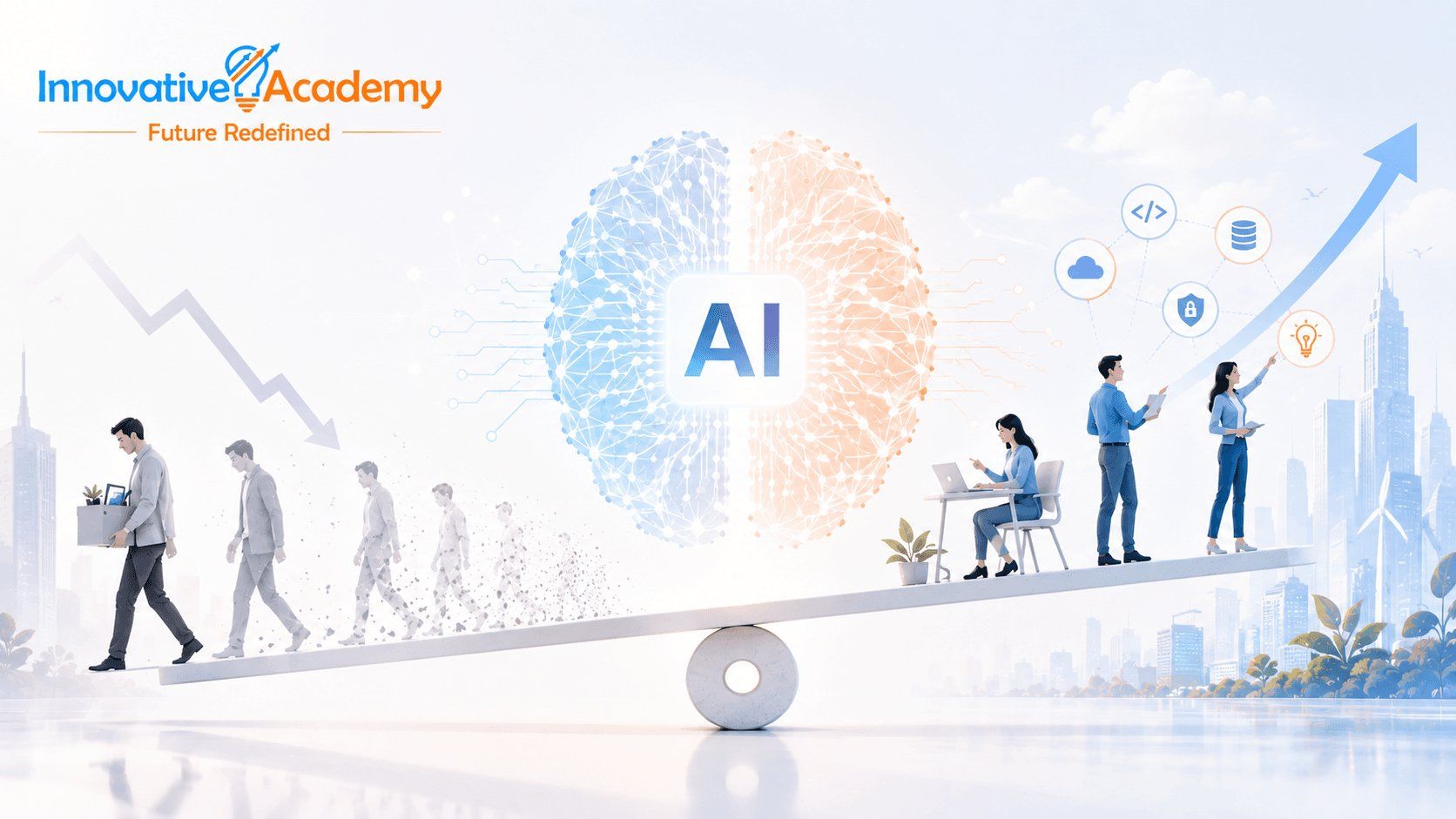

The AI Job Shift: What Oracle's Cuts and Zuckerberg's Vision Tell Us
One side says artificial intelligence will create new opportunities. The other side is looking at a very different reality: thousands of technology workers have already lost their jobs while companies spend billions building AI infrastructure. Both stories are happening at the same time.
Meta CEO Mark Zuckerberg has argued that the AI economy could ultimately create more opportunities, particularly as AI gives individuals and smaller companies the ability to accomplish more with fewer resources. In a recent essay, he suggested that AI could lead to an abundance of jobs even if companies themselves become smaller.
Meanwhile, Oracle has reduced its workforce significantly while investing heavily in AI and cloud infrastructure. Its workforce fell by about 21,000 employees, or 13%, during fiscal 2026, according to Reuters.
So which story should IT professionals believe? The uncomfortable answer is: both.
AI can create new work while simultaneously eliminating, reducing, or reshaping existing jobs — and understanding how that plays out matters a lot more than picking a side.
Why Zuckerberg Sees Opportunity in AI
Zuckerberg's argument rests on what happens when powerful technology becomes widely accessible. AI can let a small team do work that once required a much larger organisation — a developer using AI coding tools, a designer generating prototypes in minutes, a small business automating its own customer support, an entrepreneur using AI to research markets and build products without hiring a full team to do it.
This is the productivity argument for AI: if one person can accomplish the work of several, the economy could produce more products, services, and businesses overall — and that could create new forms of employment.
The catch is that the transition period can be painful, and it's not obvious who benefits first.
What Oracle's Workforce Cuts Reveal
Oracle is a useful counterpoint. The company isn't retreating from technology — it's moving deeper into AI and cloud infrastructure, spending $55.7 billion on capital expenditures in fiscal 2026, much of it tied to expanding AI data-centre capacity. Yet its workforce shrank from about 162,000 to 141,000 over the same period, according to Reuters.
Reports in August suggested Oracle was preparing another round of cuts, with managers asked to identify positions for elimination ahead of September 1. Earlier in the year, some employees reportedly received layoff notifications around 6 A.M. during the March round.
This is the important distinction: AI investment does not automatically mean more employees. A company can spend billions on computing infrastructure while trying to reduce operating costs at the same time.
AI can make teams more productive, automation can cut repetitive work, and cloud systems can run leaner — all of which can mean fewer people are needed for the same output.
Oracle's story doesn't disprove Zuckerberg's argument. It shows what can happen during the transition.
Why AI Growth and Job Cuts Can Coexist
This looks contradictory until you look at how technology actually reshapes labour markets.
Say a company has 100 employees performing a process, and AI automates 30% of that work. The company now has choices: reduce headcount, move people into different roles, increase output without adding staff, expand into new markets, or reinvest the savings elsewhere.
Different companies will make different choices — some will use AI mainly to cut costs, others to expand, others to build entirely new products. The technology is identical; the business strategy isn't.
That's why AI's impact on jobs won't look the same across companies, sectors, or countries.
Which Jobs Face Greater AI Pressure?
AI is especially powerful where work is repetitive, predictable, and based largely on digital information. That doesn't mean these careers vanish overnight — but individual tasks within them are increasingly automatable:
- Basic data entry and routine documentation
- Simple content production
- Basic customer support and administrative workflows
- Repetitive reporting and simple data processing
- Routine code generation and basic software testing
The key distinction is between jobs and tasks. AI may not eliminate an entire occupation, but it can eliminate enough of the tasks that make up that occupation to change how many people a company actually needs.
Where New AI-Driven Roles Are Emerging
At the same time, AI is driving demand in areas that barely existed at scale a few years ago. Someone has to build and maintain the infrastructure behind every AI system: data centres, GPU clusters, cloud platforms, high-speed networks, storage, security, deployment pipelines, monitoring, and data pipelines.
Some of these are new, AI-native roles. Many are traditional IT roles evolving in place:
- Network Engineer → AI Data Centre Networking
- Cloud Engineer → AI Cloud Infrastructure
- DevOps Engineer → AI Deployment and Automation
- Security Engineer → AI and Cloud Security
- Linux Administrator → AI Infrastructure Operations
This is where the AI jobs conversation gets more useful than "learn to prompt."
Why Cloud and Infrastructure Skills Still Matter
There's a tendency to assume the future of AI belongs only to machine-learning engineers. But AI models need somewhere to run — computing resources, networks, storage, operating systems, monitoring, security, automation.
That's an entire infrastructure layer built around AI, and cloud platforms are what make it scalable in the first place.
For people building cloud careers, the real opportunity increasingly lies in understanding how AI workloads actually use cloud infrastructure — not just how to spin up a virtual machine.
For learners interested in building this foundation, AWS training can help develop practical cloud infrastructure skills that connect with modern AI workloads.
How AI Is Reshaping India's IT Workforce
India's IT industry has traditionally leaned on services, software development, and outsourcing. AI is putting pressure on parts of that model: if a global client can automate a task with AI, fewer people may be needed to do it manually.
That's a real concern for entry-level IT workers.
But there's an opportunity on the other side — participating in the ecosystem growing around AI infrastructure, cloud computing, cybersecurity, data engineering, AI application development, networking, DevOps, and AI operations.
The catch is that this opportunity often demands a different, deeper skill profile than a traditional entry-level IT role.
Is IT Still a Good Career Choice?
Yes — but how students prepare needs to change.
Choosing IT because it historically offered a large volume of entry-level jobs isn't enough anymore. What matters now is skill depth and adaptability:
- Networking fundamentals build toward cloud networking and infrastructure
- Linux supports careers in cloud administration and DevOps
- Cloud computing leads toward infrastructure and platform engineering
- Python supports automation and AI application development
- Cybersecurity opens paths into cloud and AI security
The goal isn't predicting which exact job title will exist in five years. It's building skills that stay useful as the tools around them keep changing.
A strong networking foundation can be particularly valuable because networking remains central to cloud platforms, data centres, security, and AI infrastructure. Learners can explore CCNA training to build these core networking skills.
Preparing for the Next IT Job Market
The best strategy isn't competing with AI at tasks it's already good at. It's learning to work with AI and manage the systems around it.
1. Build strong fundamentals
Build strong fundamentals — networking, Linux, cloud computing, databases, programming, cybersecurity. These stay relevant even as specific tools change.
2. Learn automation
Learn automation — Python, Git, CI/CD, Docker, Kubernetes, Infrastructure as Code.
3. Understand AI without needing to become an AI researcher
You don't need to train a model from scratch, but concepts like generative AI, APIs, inference, AI agents, and RAG will help you see how AI connects to the skills you already have.
4. Develop problem-solving skills
AI can generate code, produce documentation, and analyse information — but someone still has to decide what should be built and whether the result actually works.
Critical thinking, troubleshooting, and system design only get more valuable from here.
5. Build practical projects
Certificates show you studied something; projects show you can use it. Cloud deployments, automated infrastructure, security setups, CI/CD pipelines, containerisation, AI applications — the combination of certification and hands-on work is what makes a profile stand out.
Building the Right Skills With Innovative Academy
For students and professionals looking to build this kind of foundation, Innovative Academy offers programs across the areas covered above — AWS, DevOps, CCNA, CCNP, Linux, Azure, cybersecurity, Python, and networking.
A few starting points:
- AWS training for cloud infrastructure
- DevOps training for automation and modern infrastructure
- CCNA training for a networking foundation
The full range of programs is available through Innovative Academy's programs.
The important thing isn't collecting courses randomly — it's choosing a path that builds logically:
- Networking → Cloud → DevOps → Automation → AI Infrastructure
- Programming → Python → Cloud → AI Applications
- Networking → Security → Cloud Security → AI Security
For learners following a cloud and automation path, combining networking fundamentals with cloud and DevOps skills can create a stronger technical foundation. A structured AWS DevOps training path can help connect cloud infrastructure with automation, deployment, and modern development practices.
The Bigger Picture
So who's right — Zuckerberg or Oracle?
Neither story is the whole picture.
Zuckerberg is right that AI can create new economic opportunity. Oracle is showing that companies can cut headcount and invest heavily in AI at the same time.
These aren't contradictions — a company can need fewer people for one kind of work while creating demand for another.
The real question is who gets the new opportunities.
Workers whose skills are tied mainly to repetitive, predictable tasks will likely face more pressure. Workers who can design systems, solve complex problems, manage infrastructure, secure technology, and use AI effectively are the ones finding new openings.
Oracle's cuts show the short-term pressure that automation and cost-optimisation can create. Zuckerberg's vision points to the longer-term possibility that AI hands individuals and small teams capabilities that used to be out of reach.
Both are true at once.
For IT professionals, the lesson isn't to panic — or to assume AI will automatically hand you a job. It's to adapt: build the fundamentals, understand AI, learn automation, get practical experience, and understand how the pieces fit together.
The IT professional who thrives in the AI era probably won't be the person who knows the most about AI — it'll be the person who understands where AI fits into the larger technology ecosystem.
AI may change the jobs. The people who keep learning can change with them.
This article reflects publicly available reporting and industry developments as of August 2026. Workforce numbers, company plans, and AI-related investment strategies can change as organisations adjust their priorities.