
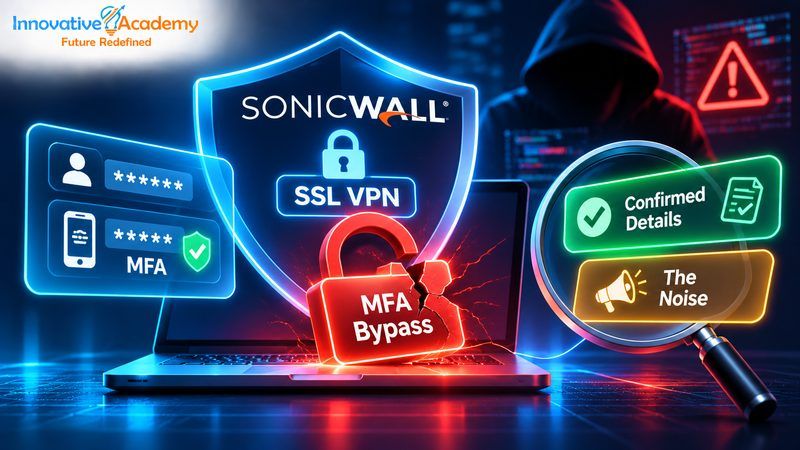

SonicWall's SSL VPN Has a New MFA Bypass — Separating the Confirmed Details From the Noise
Table of Contents
- What's actually been verified so far
- A few terms worth being precise about
- What this flaw doesn't do — and why that distinction matters
- Where the two reports disagree
- The fix, and what to do if you can't apply it today
- Why this is a networking fundamentals story, not just a patch alert
- What we're not claiming
A new SonicWall vulnerability made the rounds this week with headlines boiling it down to "VPN MFA bypass" — technically accurate, but the kind of summary that makes a narrow, authenticated-attacker flaw sound like an open front door. SonicWall disclosed it, CISA added it to its Known Exploited Vulnerabilities catalog within a day, and two separate outlets covered it with slightly different numbers. This piece sorts out what the CVE actually requires an attacker to already have before it does anything, where the two reports' figures diverge, and which unverified detail floating around alongside it is being deliberately left out.
What's actually been verified so far
SonicWall published an advisory for CVE-2026-19868 affecting SonicOS SSL-VPN services configured to use SAML authentication. BleepingComputer, reporting November 6, 2026, says the flaw hits Gen7 firmware versions 7.3.3-7015 and earlier, and Gen8 versions 8.2.2-8015 and earlier, with fixes available in 7.3.4-7013 and 8.2.3-8015. SecurityAffairs' coverage, a day later on November 7, confirms the same CVE number but doesn't repeat the specific version ranges — so if you're checking your own SonicWall deployment, BleepingComputer's version numbers are the more specific figure to verify directly against SonicWall's own advisory (SNWLID-2026-0014) rather than take as final from either news report.
SonicWall's own language, quoted by SecurityAffairs, describes the issue as an authentication enforcement problem: "a user with valid credentials for an alternate authentication method" can bypass SAML authentication controls, and successful exploitation "may also bypass SAML-enforced multi-factor authentication (MFA)." SonicWall says it investigated a report that the vulnerability was being exploited, but hasn't shared further detail about what that exploitation actually looked like. CISA added the CVE to its Known Exploited Vulnerabilities catalog and set a remediation deadline of November 20, 2026 for federal civilian agencies — a signal of real-world exploitation, even without SonicWall's own confirmation of attack specifics.
A few terms worth being precise about
SAML (Security Assertion Markup Language) is a standard that lets a separate identity provider — not the VPN device itself — verify who a user is and hand back a signed assertion saying "yes, this person is authenticated." A lot of enterprise VPNs use SAML specifically so that login, including MFA, is centralized somewhere else rather than handled locally on the VPN appliance.
MFA-enforced via SAML means the multi-factor check isn't happening on the VPN box at all — it's happening upstream, at the identity provider, before SAML ever hands back its assertion. That's relevant here because a flaw that bypasses SAML validation on the VPN side can, in effect, bypass MFA too, even though the MFA system itself was never touched or compromised.
"Alternate authentication method," the phrase SonicWall uses in its own advisory, means this isn't a flaw that lets a completely unauthenticated attacker walk in. It specifically requires the attacker to already hold valid credentials for some other login path the device supports besides SAML — which is a meaningfully different, and smaller, population of attackers than "anyone on the internet."
What this flaw doesn't do — and why that distinction matters
SecurityAffairs' coverage includes a sentence worth repeating precisely because it's the part most likely to get dropped from a shorter summary: "this is not an unauthenticated remote access vulnerability." An attacker needs valid credentials for some alternate authentication method already configured on the device before this flaw does anything useful for them. That doesn't make it minor — stolen or guessed credentials for a secondary auth method are a realistic thing attackers obtain, and once they have them, this flaw lets them route around the SAML-enforced MFA layer that was specifically supposed to be the strong second check. But it does mean the practical risk model is "an attacker who already has some foothold in your credential space" rather than "an attacker with nothing at all" — a distinction worth getting right before this gets repeated as a scarier story than the advisory itself supports.
One detail worth flagging directly: some coverage of SonicWall vulnerabilities this year has framed new flaws as attackers finding a way around an earlier, incomplete patch. For this specific CVE, CVE-2026-19868, neither of the two sources reviewed for this piece describes it that way or names an earlier related CVE — it's reported as a newly disclosed vulnerability, not a bypass of a prior fix. If you see it described elsewhere as a "patch bypass" of something older, that claim isn't supported by SonicWall's own advisory language as reported here, and is worth checking against the primary advisory before repeating.
Where the two reports disagree
Two separate numbers are worth flagging rather than quietly picking one. BleepingComputer lists the CVSS score as 7.1; SecurityAffairs lists it as 7.5. Both are "high" severity under the standard CVSS bands, so the practical urgency doesn't change much either way, but it's the kind of small discrepancy that shows even careful outlets covering the same advisory can end up with slightly different numbers — a good reminder to check a CVE's score against its authoritative record (NVD or the vendor's own advisory) rather than whichever article you read first, especially before it goes into something like a compliance report.
The fix, and what to do if you can't apply it today
SonicWall has shipped fixed firmware — 7.3.4-7013 for Gen7 and 8.2.3-8015 for Gen8, per BleepingComputer's reporting — and both sources reviewed here say there's no workaround available short of updating. That's a meaningfully different situation from vulnerabilities that come with a mitigating configuration change you can apply while you schedule a maintenance window; here, the update itself is the only confirmed fix. If your organization runs SonicWall SSL-VPN with SAML authentication and can't patch immediately, the practical next step is auditing exactly which "alternate authentication methods" are enabled on the device at all — since the flaw specifically depends on one existing — and tightening or disabling any that aren't actually in active use, while treating the firmware update as the real fix rather than a nice-to-have.
Why this is a networking fundamentals story, not just a patch alert
Strip away the specific CVE number and what's left is a genuinely useful lesson for anyone working with enterprise networking and VPN infrastructure: layered authentication is only as strong as the weakest layer an attacker can route around, and "MFA is enforced" doesn't automatically mean MFA is unbypassable if the enforcement point itself has a flaw. Understanding how SAML authentication actually flows between a VPN device and an identity provider — not just that "SAML plus MFA equals secure" as a slogan — is exactly the kind of practical networking and security-adjacent knowledge that separates someone who can configure a VPN from someone who can actually reason about where its trust boundaries are. What Innovative Academy's CCNA & CCNP Networking program actually drills into, for exactly this reason, is reading authentication flows correctly: tracing how trust actually passes between a VPN device and an identity provider during a SAML handshake, working through real vendor advisories rather than secondhand summaries of them, and building the habit of checking a reported CVSS score or affected-version range against the primary source before repeating it anywhere that matters. Contact for course details: 8447712333.
What we're not claiming
CVE-2026-19868 is not an unauthenticated, walk-right-in vulnerability, and this piece hasn't treated it as one — SonicWall's own advisory language explicitly requires an attacker to already hold valid credentials for an alternate authentication method, and SecurityAffairs' coverage states plainly that this is not an unauthenticated remote access flaw. Nor is there confirmation that this is a bypass of some earlier, incomplete SonicWall patch; that framing shows up in some general commentary around SonicWall vulnerabilities this year, but neither source reviewed for this specific CVE supports it, so it's deliberately left out here rather than repeated as an unverified connection. Confirmed across the sources checked: the CVE number, SonicWall's own description of the authentication-bypass mechanism, the CISA KEV addition and November 20, 2026 federal deadline, and the existence of fixed firmware versions. Still worth double-checking yourself: the exact CVSS score, which reads 7.1 in one outlet and 7.5 in another — a gap narrow enough to not change the urgency, but wide enough that it shouldn't be cited without checking the primary advisory first.