
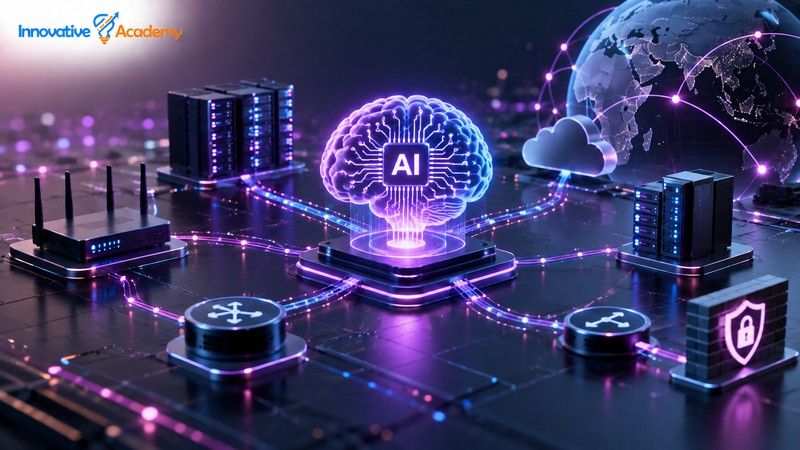

Smart Networks Start Here: Boost Your CCNA with AI Insights
Table of Contents
- Why CCNA Is Still the Right Place to Start
- Where AI Is Actually Showing Up in Networking
- Why a Network Engineer Should Care About AI
- What This Combination Opens Up, Career-Wise
- What This Actually Looks Like on the Job
- Learning CCNA the Right Way at Innovative Academy
- Where Networking Meets the Cloud
- FAQs
- Final Thoughts
Network engineering is quietly getting smarter, and it is happening whether or not individual engineers decide to pay attention to it. Predictive alerts, automated remediation, and AI-assisted threat detection are moving from interesting research into tools that appear in real operations environments.
None of this replaces the fundamentals that CCNA (Cisco Certified Network Associate) has always taught. In fact, it makes understanding those fundamentals even more important. AI-powered networking tools depend on the underlying network being designed, configured, and understood correctly.
This guide explores why CCNA remains a practical starting point, where AI is genuinely changing networking, and what combining networking fundamentals with AI awareness can mean for a modern IT career.
Why CCNA Is Still the Right Place to Start
CCNA earns its reputation as an entry point because it builds the vocabulary and practical skills that more advanced networking and cloud roles commonly expect.
The current CCNA exam, 200-301, covers areas such as network fundamentals, IP addressing, subnetting, switching, VLANs, spanning-tree behavior, IP connectivity, routing, security fundamentals, and automation and programmability concepts.
That last area is increasingly relevant. You cannot effectively build, secure, monitor, or troubleshoot an AI-assisted network without first understanding what the underlying network is doing.
For learners starting their networking journey, a structured CCNA course in Bangalore can provide the foundation needed before moving into automation, cloud, security, or advanced networking.
Where AI Is Actually Showing Up in Networking
AI in networking is not limited to futuristic concepts. Several capabilities are already being incorporated into modern network operations and security platforms.
Predictive Maintenance
Historical performance and failure data can be analyzed to identify patterns associated with potential outages or performance problems. This can help operations teams investigate issues before they become major disruptions.
Traffic Optimization
Intelligent systems can analyze current network conditions and help optimize traffic flows based on factors such as load, performance, and availability.
Threat Detection
Machine-learning-based security systems can establish patterns of normal activity and identify unusual behavior. This provides security teams with another layer of visibility alongside traditional firewalls, access controls, and monitoring systems.
Self-Healing and Automated Response
Some modern platforms can detect defined classes of network problems and trigger predefined remediation actions automatically. The objective is to reduce response time for known problems while keeping human engineers involved in more complex decisions.
As networks become more distributed and data-heavy, intelligent monitoring and automation can help teams manage infrastructure at scale.
Why a Network Engineer Should Care About AI
The practical answer is that AI increasingly operates as a layer around the infrastructure that network engineers already manage.
CCNA teaches how networks are designed, configured, connected, secured, and troubleshot. AI awareness adds an understanding of how modern tools can monitor, analyze, optimize, and respond to activity across that infrastructure.
This does not mean that every network engineer needs to become a machine-learning specialist. Instead, engineers benefit from understanding what AI-enabled networking tools are doing, what data they depend on, and where human troubleshooting and decision-making remain important.
What This Combination Opens Up, Career-Wise
Combining strong networking fundamentals with automation and AI awareness can support several modern infrastructure career paths.
- Network Engineer
- Network Automation Engineer
- Network Support Engineer
- Infrastructure Analyst
- Cloud Network Engineer
- Network Security Analyst
- Infrastructure and Operations Engineer
The specific requirements vary by employer and role. However, networking professionals increasingly encounter automation, scripting, intelligent monitoring, cloud infrastructure, and security technologies alongside traditional routing and switching.
What This Actually Looks Like on the Job
Smart Troubleshooting
A traditional troubleshooting process might involve checking IP addressing, connectivity, routing tables, interfaces, logs, and configuration manually.
AI-assisted tooling can add another layer by analyzing large volumes of telemetry and highlighting potential causes or unusual behavior. The engineer still needs networking knowledge to validate the findings and determine the appropriate response.
Machine-Learning-Backed Monitoring
SNMP and Syslog remain important sources of network visibility. Modern management platforms can combine infrastructure telemetry with analytics to identify deviations from expected behavior and highlight potential problems.
This creates a useful relationship between traditional network knowledge and intelligent monitoring: the tools analyze the data, while engineers need enough technical understanding to interpret what the data actually means.
Faster Security Response
Network professionals already work with technologies such as ACLs, firewalls, VPNs, and segmentation. Modern security platforms can add automated analysis and response capabilities to help identify and contain suspicious activity more quickly.
This makes networking fundamentals increasingly relevant to security operations rather than less important.
Learning CCNA the Right Way at Innovative Academy
Innovative Academy offers a dedicated CCNA training program in Bangalore focused on building practical networking knowledge rather than treating the certification as a purely theoretical objective.
The program covers core networking fundamentals, Cisco routing and switching concepts, security topics, routing scenarios, network design, exam preparation, and hands-on lab practice.
The learning experience also incorporates AI-supported educational features such as automatically generated class notes, AI-curated practice questions, and AI-assisted mock interview activities.
It is important to distinguish this learning support from a dedicated network-automation curriculum. Topics such as Python scripting, Ansible, and DevOps automation are better approached through specialized automation or DevOps training rather than assuming they are all part of a standard CCNA course.
Learners interested in building broader infrastructure skills can explore DevOps Bootcamp training in Bangalore after establishing their networking foundation.
Those looking specifically toward cloud infrastructure can also explore AWS training in Bangalore and build on their networking knowledge with cloud-focused skills.
Where Networking Meets the Cloud
Network infrastructure is no longer limited to physical routers and switches inside traditional server rooms. Modern infrastructure increasingly includes virtual networks, cloud-hosted workloads, software-defined networking, and automated management.
The major cloud platforms include AWS, Microsoft Azure, and Google Cloud. Each provides monitoring, networking, security, automation, and machine-learning-related capabilities that can be used across cloud environments.
Networking Principles Still Matter in the Cloud
Cloud networking changes the environment, but many fundamental concepts remain important. IP addressing, routing, DNS, security controls, connectivity, segmentation, and troubleshooting continue to matter when infrastructure moves into cloud platforms.
This is why networking fundamentals can provide a strong base for professionals moving toward cloud engineering.
CCNA to Advanced Networking and Cloud
Professionals who want to deepen their traditional Cisco networking knowledge can consider CCNP, which sits above CCNA in Cisco's certification pathway.
Others may choose to move toward cloud networking, DevOps, cybersecurity, or network automation. The appropriate next step depends on the role and technical direction they want to pursue.
FAQs
Can someone realistically learn CCNA and AI concepts in parallel?
It is possible to become familiar with both, but CCNA should provide the networking foundation. AI concepts become more useful when learners can connect them to real networking problems and operational scenarios.
You do not need to become a machine-learning specialist to work productively with AI-assisted network tools. A working understanding of networking, automation, data, and intelligent monitoring is often more relevant.
Do I need programming skills to benefit from networking and AI?
Programming is not a prerequisite for starting CCNA. However, basic scripting knowledge, particularly Python, becomes increasingly useful when moving toward network automation and infrastructure engineering.
Learners interested in this area can combine networking fundamentals with dedicated automation or DevOps training.
Will AI awareness help with networking career opportunities?
AI awareness can complement networking skills, particularly as infrastructure teams adopt more automation, analytics, intelligent monitoring, and security tooling.
However, AI knowledge should not be viewed as a replacement for networking fundamentals. Strong understanding of routing, switching, IP addressing, security, and troubleshooting remains essential.
Is CCNA useful for cloud networking?
Yes. CCNA covers networking concepts that remain relevant when infrastructure is deployed in cloud environments. Professionals can build on those fundamentals with AWS, Azure, Google Cloud, or other cloud-focused training.
Final Thoughts
Network engineering is becoming more automated and increasingly data-driven, but the fundamentals have not disappeared.
A network engineer working with AI-assisted monitoring or automated remediation still needs to understand IP addressing, routing, switching, security, connectivity, and troubleshooting. AI can provide another layer of analysis and automation, but it does not remove the need to understand the infrastructure underneath.
For someone starting a networking career, CCNA remains a practical foundation. From there, AI literacy, Python, network automation, cloud networking, cybersecurity, and DevOps can be added according to the direction of the individual's career.
The smarter approach is therefore not to choose between networking and AI. Build the networking foundation first, then learn how intelligent tools are changing the way modern networks are operated.