
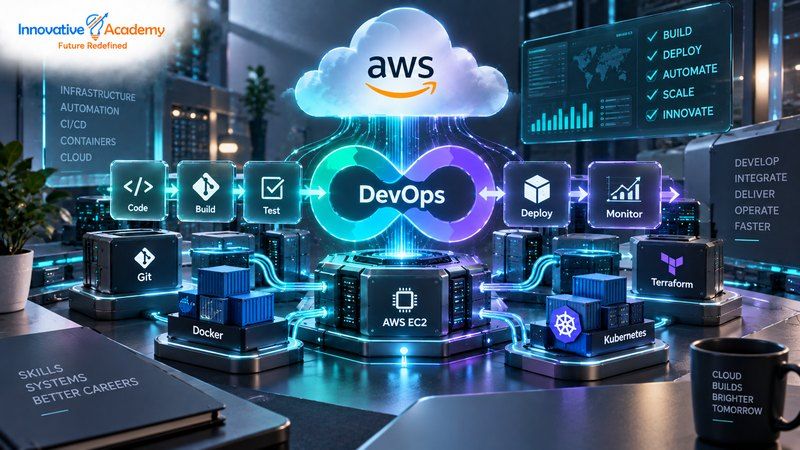

Should You Take an AWS DevOps Course? The Case For and Against
Table of Contents
- 1. Introduction
- 2. The Case For an AWS DevOps Course
- 3. The Case Against an AWS DevOps Course
- 4. Who This Actually Fits
- 5. The AWS DevOps Certification, Plainly
- 6. Choosing an AWS DevOps Program
- 7. Verdict
- 8. FAQs
Not every certification deserves the marketing enthusiasm attached to it, so it is worth treating "Should I take an AWS DevOps course?" as a genuine question rather than a foregone conclusion.
An AWS DevOps career can combine cloud infrastructure, automation, continuous integration, continuous delivery, monitoring, security, and software development practices. But that does not automatically mean the certification is the right choice for everyone.
Below are both sides of the argument, followed by who this path actually suits, what the certification involves, and how to choose an AWS DevOps training program that provides meaningful practical experience.
1. Introduction
Not every certification deserves the marketing enthusiasm attached to it, so it is worth treating "should I take an AWS DevOps course" as a genuine question rather than a foregone conclusion.
AWS DevOps combines cloud computing with automation, deployment, infrastructure management, monitoring, security, and software delivery practices. These skills can be useful for professionals who want to work with modern cloud environments and automated deployment workflows.
However, the learning path also has limitations. It is not necessarily the right starting point for someone with no cloud, programming, Linux, or systems experience.
The right decision therefore depends largely on your existing skills, career direction, and willingness to gain hands-on experience.
2. The Case For an AWS DevOps Course
Growing Demand for Cloud and Automation Skills
Organizations running production workloads on AWS need professionals who can automate deployment pipelines, manage infrastructure as code, monitor systems, and maintain reliable cloud environments.
As organizations continue adopting cloud infrastructure and automation, professionals who understand both AWS and DevOps practices can work across several areas of the software delivery lifecycle.
A Combination of Two Skill Sets
DevOps knowledge on its own is valuable, and AWS knowledge on its own is valuable. Combining the two can provide a broader technical foundation.
Modern DevOps workflows frequently interact with cloud infrastructure, which means professionals may need to understand services such as compute, storage, networking, identity, monitoring, containers, databases, and deployment automation.
Automation Has Practical Value
AWS provides services and tools that can reduce repetitive manual work across infrastructure and application deployment.
Automation can help teams provision resources consistently, build deployment pipelines, respond to changes in demand, and monitor production environments.
Services such as Amazon CloudWatch and AWS CloudTrail can also provide visibility into application and infrastructure activity.
A Continuously Evolving Skill Set
AWS regularly introduces new services and capabilities across areas such as automation, security, containers, observability, infrastructure management, and application delivery.
This means AWS DevOps professionals need to continue learning rather than relying permanently on a single set of tools or techniques.
3. The Case Against an AWS DevOps Course
It May Not Be the Best First Certification
An AWS DevOps professional-level certification is not designed as an entry-level introduction to cloud computing.
Someone starting from zero may find the concepts difficult without prior exposure to AWS, Linux, programming, networking, or system administration.
For complete beginners, a foundational AWS learning path can provide a more appropriate starting point before progressing into advanced DevOps concepts.
The Exam Requires Practical Judgment
AWS DevOps certification preparation is not simply about memorizing definitions.
Scenario-based questions require learners to understand how different AWS services and DevOps practices can be applied to realistic operational situations.
That makes hands-on labs and practical projects particularly important during preparation.
Training Quality Matters
Not every AWS DevOps training program provides the same level of practical exposure.
A program that relies primarily on slides and theoretical lectures may not provide enough experience with deployment pipelines, cloud infrastructure, automation, monitoring, containers, and infrastructure as code.
The goal should be to develop skills that can be demonstrated in practical environments, not simply to collect a certificate.
It Is a Specialized Career Path
AWS DevOps is particularly relevant to careers involving cloud infrastructure, software delivery, automation, system administration, platform engineering, and related technical roles.
If your career direction is entirely outside cloud infrastructure or software delivery, an AWS DevOps certification may not align closely with your immediate goals.
4. Who This Actually Fits
Considering both the advantages and limitations, an AWS DevOps course tends to be more suitable for learners who already have some technical foundation.
Software Developers
Developers who already write code and want to understand deployment automation, CI/CD, cloud infrastructure, and production environments can benefit from learning DevOps practices on AWS.
System Administrators
System administrators with experience managing infrastructure can expand their skill set by learning cloud automation, infrastructure as code, monitoring, deployment pipelines, and AWS services.
Cloud Professionals
Cloud engineers and solutions architects can use DevOps knowledge to better understand automated software delivery and operational workflows within AWS environments.
Professionals With Programming or Scripting Experience
Basic programming and scripting familiarity can make it easier to understand automation, configuration management, CI/CD pipelines, and infrastructure-as-code concepts.
5. The AWS DevOps Certification, Plainly
The professional-level certification associated with this career path is the AWS Certified DevOps Engineer – Professional certification, currently associated with exam code DOP-C02.
There is no mandatory prerequisite AWS certification required to sit for the exam. However, AWS positions the certification toward professionals with substantial hands-on experience working with AWS environments.
The certification is intended for people who understand areas such as provisioning and operating AWS environments, continuous integration and continuous delivery, automation, monitoring, security, and software development practices.
What the Exam Tests
- Continuous integration and continuous delivery
- Infrastructure as code
- Monitoring and logging
- Security and compliance
- Resilient and reliable systems
- Deployment automation
- Incident response and troubleshooting
- AWS infrastructure and services
The exam uses scenario-based questions, making practical AWS experience particularly valuable during preparation.
6. Choosing an AWS DevOps Program That Won't Waste Your Time
Before enrolling in an AWS DevOps course, evaluate the actual learning experience rather than relying only on the course title or certification claims.
Look for Hands-On Labs
Check whether students actually work with AWS environments, deployment pipelines, Linux, Git, containers, infrastructure as code, monitoring, and automation tools.
Check the Instructor's Practical Experience
Instructors should be able to explain not only what a service does, but also how and why it is used in real-world cloud and DevOps environments.
Look for a Logical Curriculum
A good learning path should build from cloud and DevOps fundamentals toward more advanced topics rather than introducing complex tools without explaining their underlying concepts.
Include Scenario-Based Exam Preparation
Certification preparation should go beyond simply covering the syllabus. Learners should also become comfortable interpreting scenario-based questions and selecting appropriate AWS solutions.
Consider Career and Placement Support
For learners preparing for a career transition, additional support such as resume guidance, interview preparation, mock interviews, and placement assistance can be useful alongside technical training.
Explore AWS DevOps Training in Bangalore at Innovative Academy to learn more about the program, curriculum, and available training formats.
Innovative Academy in Bangalore offers AWS DevOps training with hands-on learning, experienced trainers, structured technical coverage, exam preparation, and placement assistance. Training is available through both online and classroom formats.
7. Verdict
For someone with an existing foundation in AWS, development, Linux, systems administration, or cloud infrastructure, an AWS DevOps course can provide a valuable way to develop more advanced automation and cloud delivery skills.
For a complete beginner with no cloud or programming exposure, it may be more appropriate to establish those fundamentals first.
The important question is therefore not simply whether AWS DevOps is valuable. The more useful question is whether your current skills and career direction match what the AWS DevOps learning path expects.
8. Frequently Asked Questions
1. Which institute in Bangalore offers AWS DevOps training?
Innovative Academy offers AWS DevOps training in Bangalore with online and classroom learning options, practical training, structured curriculum, and placement assistance.
2. Is there an eligibility requirement for an AWS DevOps course?
There is no mandatory prerequisite certification for the AWS Certified DevOps Engineer – Professional exam. However, the certification is intended for experienced professionals, and prior AWS, programming, Linux, or systems experience can make the learning path significantly more manageable.
3. Is AWS DevOps suitable for beginners?
AWS DevOps can be learned by beginners, but professional-level AWS DevOps certification content is not designed as a basic introduction to cloud computing. Beginners may benefit from first learning AWS, Linux, networking, and programming fundamentals.
4. Is AWS DevOps certification enough to get a job?
A certification can demonstrate knowledge, but it does not replace practical experience. Employers may also evaluate hands-on AWS skills, DevOps projects, scripting, troubleshooting ability, communication, and understanding of CI/CD workflows.
5. What should an AWS DevOps course include?
A comprehensive course should ideally cover AWS fundamentals, Linux, Git, CI/CD, infrastructure as code, containers, automation, monitoring, security, deployment strategies, troubleshooting, practical projects, and certification preparation.
6. Should I choose AWS DevOps or start with AWS fundamentals?
If you already have practical AWS or technical experience, you may be ready for advanced DevOps learning. If you are starting from zero, building foundational AWS and technical skills first can provide a stronger base.