

Red Hat's 2026 Certification Shake-Up, Explained for Whoever It Actually Affects
Table of Contents
- Introduction
- The Short Version
- If You Already Hold RHCE
- If You're Mid-Study Right Now
- If You're Starting From Zero
- If You're Hiring, Not Studying
- Inside the New Five-Track Structure
- The Part That Didn't Change
- Why Red Hat Did This Now
- Where to Build the Skills Underneath Any of This
- Conclusion
- FAQs
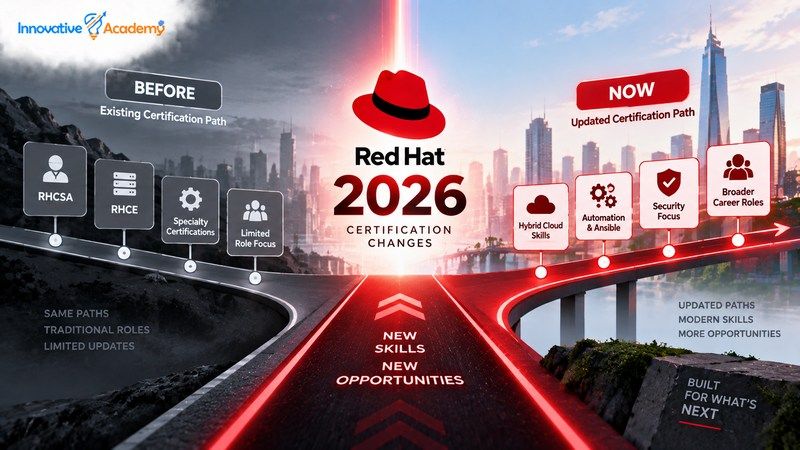
Red Hat quietly rewrote its certification map in 2026, changing how several of its credentials are organized and presented. The change has led to confusion around the future of RHCE, the role of RHCSA, and what professionals currently studying for Red Hat certifications should do next.
Rather than treating the announcement as a single change that affects everyone equally, it is more useful to look at what it means for existing certification holders, people currently preparing for an exam, beginners, and employers.
1. Introduction
Red Hat's certification structure changed in 2026, and the way the news has been discussed has varied considerably. Some coverage has described the development as the end of RHCE, while other explanations have focused on broad certification modernization.
The more useful way to understand the change is to look at what actually changed and, more importantly, which parts affect you.
For professionals already holding RHCE, people currently preparing for an exam, beginners starting with Linux, and employers evaluating candidates, the practical implications are different.
2. The Short Version
The key point is that Red Hat did not simply delete its existing certification system.
The traditional generic RHCE structure has been reorganized into more specific, technology-focused certification tracks. At the same time, RHCSA remains the foundational Red Hat certification for Linux administration.
RHCSA continues to use exam code EX200 and remains an important starting point for professionals building a Red Hat certification pathway.
The major change is therefore the structure surrounding the foundational certification rather than the removal of RHCSA.
3. If You Already Hold RHCE
If you already hold an RHCE certification, the restructuring does not mean that your existing credential suddenly becomes invalid.
Existing certifications continue to follow their applicable certification and renewal timelines. You are not automatically required to take a new examination simply because Red Hat has reorganized the certification structure.
Red Hat describes the options available to certification holders around continuing, advancing, or moving into a more specialized pathway.
The important point for existing RHCE holders is to distinguish between a change in certification structure and the expiration or renewal of an existing credential. Those are separate issues.
4. If You're Mid-Study Right Now
If you are already preparing for a Red Hat certification exam, there is no reason to abandon your preparation simply because the certification structure has changed.
Red Hat has indicated that exams that have been renamed or reorganized are not necessarily being transformed into completely different examinations. Candidates should nevertheless check the current Red Hat certification pages before booking an exam so they understand the current exam name, code, objectives, and certification pathway.
This is particularly important because certification pages and older references can sometimes use different terminology during a transition period.
Before registering, verify the examination information directly with Red Hat and make sure the exam code and certification title match the qualification you intend to pursue.
5. If You're Starting From Zero
For someone beginning a Red Hat certification journey from scratch, the foundation remains straightforward.
The RHCSA examination, EX200, continues to represent the foundational administration level. From there, the newer structure provides more specialized directions instead of treating advanced Linux and technology skills as a single broad pathway.
Depending on your career interests, the broader structure includes areas such as:
- Enterprise Linux
- Ansible automation
- OpenShift
- Cloud-native application development
- Artificial intelligence
This means someone beginning their journey should think beyond the certification name itself. The more important question is which technical area they want to develop after establishing a strong Linux administration foundation.
6. If You're Hiring, Not Studying
The move toward more specific certification tracks can provide additional context when employers evaluate technical candidates.
A traditional RHCE credential communicated that a candidate had achieved the applicable RHCE standard. More specialized credentials can provide additional information about the technology area in which the candidate has been evaluated.
For employers hiring for roles involving automation, OpenShift, enterprise Linux, cloud-native development, or other specific technologies, that additional context can be useful alongside practical experience, projects, technical interviews, and other qualifications.
A certification should therefore be considered as one part of a candidate's technical profile rather than as a substitute for hands-on experience.
7. Inside the New Five-Track Structure
The easiest way to understand the newer structure is to think of it as a grid rather than a single certification ladder.
The five broad subject areas include:
- Enterprise Linux
- Ansible automation
- OpenShift
- Cloud-native application development
- Artificial intelligence
These subject areas can then be viewed across different levels of professional depth.
The structure includes entry-level Technologist options, Administrator or Developer-level certifications, Engineer-level credentials, Specialist certifications for narrower areas of expertise, and Architect-level recognition.
RHCSA continues to occupy the foundational administrator position, while the RHCE level is increasingly associated with specific technology tracks rather than one generic advanced certification identity.
The AI pathway is also notable because it introduces Red Hat certification into an area that has become increasingly relevant to modern application development and enterprise technology environments.
8. The Part That Didn't Change
One of the easiest details to overlook is that RHCSA itself remains the foundational certification.
The certification continues to use EX200, and its role as a core Linux administration credential remains important for professionals building Red Hat-related skills.
If your immediate goal is to develop Linux administration knowledge and prepare for RHCSA, the broader restructuring does not fundamentally change that starting point.
That makes Linux administration knowledge particularly important regardless of which specialized technology direction you eventually choose.
9. Why Red Hat Did This Now
Red Hat has explained the restructuring in terms of hands-on evaluation and alignment with real-world technologies and professional tasks.
The broader industry context also helps explain why specialization matters. Enterprise Linux administration, Ansible automation, OpenShift platform engineering, cloud-native development, and AI-focused development involve different tools and workflows.
A certification structure that separates these areas can communicate technical specialization more clearly than a single broad credential covering multiple technology directions.
For learners, this also means that choosing a certification should ideally be connected to the type of technical work they want to perform.
10. Where to Build the Skills Underneath Any of This
Regardless of which Red Hat certification pathway you eventually choose, Linux administration remains an important technical foundation.
Before moving into advanced automation, containers, cloud-native technologies, or other specialized areas, learners benefit from understanding Linux fundamentals, users and permissions, storage, networking, services, security, troubleshooting, and system administration.
For learners looking for structured Linux training in Bangalore, Innovative Academy's Linux Administration Training in Bangalore covers core Linux administration concepts through a hands-on, job-oriented learning approach.
The training can help learners build practical Linux skills that complement further study toward certifications and Linux-focused roles.
Innovative Academy also provides IT training programs across networking, cloud, DevOps, programming, and related technology domains for learners looking to build broader technical skills.
11. Conclusion
The idea that "RHCE is dead" does not accurately describe the broader certification restructuring.
The more precise explanation is that Red Hat has reorganized its certification portfolio around specific technology areas while maintaining RHCSA as a foundational Linux administration credential.
For existing RHCE holders, the change does not automatically invalidate their certification. For people already studying, the practical step is to verify the current exam information before registration. For beginners, RHCSA remains a logical foundation before choosing a more specialized technical direction.
The underlying lesson is simple: certification names may change, but practical Linux administration skills remain valuable across multiple technology paths.
12. FAQs
1. My RHCE was earned years before this change. Do I need to do anything right now?
No immediate action is required simply because Red Hat has changed the structure of its certifications. Existing certifications continue to follow their applicable validity and renewal requirements. Check your Red Hat certification account for the specific status and renewal information associated with your credential.
2. Does the restructuring mean RHCE has been completely discontinued?
The change is better understood as a restructuring of the RHCE-level certification pathway into more specific technology tracks rather than the simple disappearance of the advanced certification level.
3. Has RHCSA changed?
RHCSA remains the foundational Red Hat administrator certification and continues to use exam code EX200.
4. Does this change affect RHCSA exam preparation?
If you are preparing specifically for RHCSA, the broader restructuring does not change the importance of building strong Linux administration skills. Always check Red Hat's current exam objectives before booking an examination.
5. What should someone learn before pursuing advanced Red Hat certifications?
A strong foundation in Linux administration is useful. Important areas include command-line administration, users and permissions, storage, networking, services, security, troubleshooting, and system management.
6. Where can I build Linux administration skills in Bangalore?
Innovative Academy's Linux Administration Training in Bangalore provides structured training focused on practical Linux administration skills. The program is designed for learners who want to build a foundation for Linux, cloud, networking, and DevOps-related career paths.