
Python for Data Science: The Libraries That Actually Matter in 2027, and Where Python's Role Ends
Table of Contents
- 1. Introduction
- 2. Why Python Specifically, Rather Than R or Something Else
- 3. The Foundation: NumPy
- 4. The Workhorse: Pandas
- 5. The New Challenger: Polars
- 6. Modeling: Scikit-Learn and the Gradient-Boosting Trio
- 7. Explaining What a Model Actually Did: SHAP
- 8. Where Python Hands Off to Something Else
- 9. A Realistic First Stack for Someone Starting Today
- 10. Learning the Python Foundation at Innovative Academy
- 11. FAQs
- 12. Final Thoughts
1. Introduction
"Python for data science" is such a common phrase that it's easy to forget it's actually shorthand for a dozen different libraries doing very different jobs, bolted together under one language.
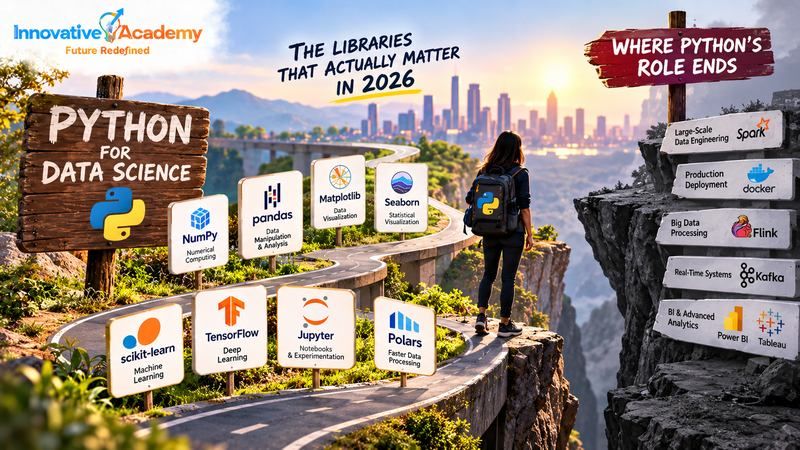
This walks through what each major piece of that stack actually does, what's genuinely new in 2027 specifically, and where Python's role in a data science workflow actually ends — because it doesn't cover the whole job on its own, whatever a course title might imply.
2. Why Python Specifically, Rather Than R or Something Else
Python's dominance in data science isn't an accident of popularity alone — it's that the same language can plausibly cover data cleaning, statistical analysis, machine learning, and eventually shipping a model into a production system, without switching tools at each stage.
R remains genuinely strong for pure statistical analysis and has a loyal academic and biostatistics following, but Python's broader ecosystem, from web frameworks to deployment tooling, means a Python-based data science skill set connects more directly to the rest of a typical engineering organization's stack.
3. The Foundation: NumPy
Underneath nearly everything else in this list sits NumPy, which provides the ndarray — a fast, fixed-type array structure that makes numerical operations across large datasets dramatically faster than Python's native lists.
Pandas stores its own data in NumPy arrays internally, scikit-learn expects NumPy arrays as input, and most of the deep learning frameworks interoperate with NumPy's array format directly.
Learning NumPy first isn't optional groundwork to rush past — the mental model it teaches, thinking in terms of vectorized array operations rather than row-by-row loops, is the same mental model every library built on top of it assumes already makes sense.
4. The Workhorse: Pandas
Pandas is where most practical data science work actually happens day to day: loading a CSV or database table into a DataFrame, cleaning missing or malformed values, filtering and grouping rows, joining multiple tables together, and reshaping data into whatever format the next step in a pipeline needs.
It remains, by a wide margin, the most-used data manipulation library in the Python ecosystem — current download figures put pandas at roughly 18.5 million weekly installs against a few million for its newer challenger below.
For most exploratory analysis, and for any workflow that leans on the broader scientific Python ecosystem (statsmodels, SciPy, most plotting libraries), pandas is still the right default.
5. The New Challenger: Polars
The genuinely new development in this space heading into 2027 is Polars, a DataFrame library built in Rust on top of the Apache Arrow memory format.
Where pandas executes operations eagerly and largely on a single thread, Polars uses a lazy execution model that plans and optimizes an entire query before running it, and spreads the work across all available CPU cores by default.
Benchmark results vary by source and hardware, but independent testing has generally found Polars somewhere in the range of 2x to 15x faster than pandas on operations like group-bys and joins, with the gap widening considerably on datasets that no longer comfortably fit in memory.
The honest framing isn't that Polars is replacing pandas — weekly download numbers alone show pandas still dominates by a wide margin — it's that Polars has become the sensible default specifically for large-scale data processing (roughly double-digit gigabytes and up), while pandas keeps its place for exploratory work and anything that depends on the wider SciPy-adjacent ecosystem.
6. Modeling: Scikit-Learn and the Gradient-Boosting Trio
Scikit-learn is where most people's first real machine learning model gets built: it offers a large, consistent library of algorithms, all sharing the same fit, predict, and transform interface, which means switching from a logistic regression to a random forest is often a one-line change rather than a rewrite.
For structured, tabular business data specifically, three gradient-boosting libraries, XGBoost, LightGBM, and CatBoost, routinely outperform both scikit-learn's simpler models and full neural networks.
That's part of why deep learning frameworks like TensorFlow and PyTorch tend to earn their place on unstructured data (images, text, audio) rather than being the default choice for a typical spreadsheet-shaped business dataset.
7. Explaining What a Model Actually Did: SHAP
A model that predicts well but can't explain why is a genuine liability in any setting where a human has to act on, or justify, its output, whether that's a loan approval, a medical risk score, or a churn prediction a sales team is expected to trust.
SHAP (SHapley Additive exPlanations) addresses that directly by quantifying how much each individual feature contributed to a specific prediction, turning a model's internal reasoning into something that can actually be shown to a stakeholder who isn't going to read the underlying code.
This kind of explainability tooling has moved from a nice-to-have research topic to something closer to standard practice in any data science role that touches decisions affecting real people.
8. Where Python Hands Off to Something Else
Python's role in a typical data science project has real limits, and being clear-eyed about them is part of actually understanding the field rather than oversimplifying it.
- SQL: SQL, not Python, is usually how data actually gets pulled out of the production databases a company runs on in the first place.
- Statistics: The underlying statistics and probability theory behind every one of these libraries has to be understood independently of the code that implements it, or the results produced are just numbers without judgment behind them.
- MLOps: Once a model is trained, getting it running reliably in production, served behind an API, monitored for performance drift, retrained on a schedule, is its own discipline that borrows more from software engineering and DevOps practice than from anything specific to Python's data libraries.
Anyone describing themselves as "doing data science with Python" is really describing one well-developed piece of a considerably larger skill set.
9. A Realistic First Stack for Someone Starting Today
For someone starting from scratch in 2027, a sensible first stack, in the order it's actually useful to learn:
- Python fundamentals and NumPy, since everything else assumes comfort with array-based thinking.
- Pandas, for the data manipulation work that makes up the bulk of real projects.
- Matplotlib or a similar plotting library, so results can actually be communicated rather than just computed.
- Scikit-learn for a first real modeling project.
- Polars, only once a project's data genuinely outgrows comfortable pandas performance.
Reaching for Polars before pandas is solid is optimizing for a performance problem most beginners don't actually have yet.
10. Learning the Python Foundation at Innovative Academy
Innovative Academy's Python program in Bangalore doesn't run as a dedicated data science bootcamp, and it's worth being direct about that rather than implying otherwise. What it does teach, 40 hours covering core language fundamentals, data structures, and object-oriented programming through real projects, is precisely the foundation every library in this article is built on top of.
Someone who's genuinely comfortable with Python itself picks up pandas or scikit-learn considerably faster than someone trying to learn both the language and the library simultaneously, which is exactly why that foundation is worth getting solid first rather than skipped toward a library tutorial.
Interested in learning Python? Explore the Python Training Course in Bangalore at Innovative Academy, or call 8447712333 for course details.
11. FAQs
1. Do I need to learn Polars, or is pandas still enough?
For most learning projects and small-to-medium real datasets, pandas is still enough. Polars earns its place specifically once data volume or processing speed becomes a genuine bottleneck, not as a default starting point.
2. Is scikit-learn enough for machine learning, or do I need TensorFlow or PyTorch too?
For structured, tabular data, which covers a large share of real business use cases, scikit-learn plus the gradient-boosting libraries (XGBoost, LightGBM, CatBoost) is often enough on its own. TensorFlow and PyTorch earn their place specifically for unstructured data like images, audio, or text.
3. Is Python alone enough to call yourself a data scientist?
No. Python is the implementation layer for a role that also requires statistics, domain judgment about what a result actually means, and increasingly some understanding of how a model gets deployed and maintained in production. Fluency in the libraries without the underlying statistical reasoning produces output that looks sophisticated but can't be trusted.
4. What's the single most important library to get genuinely comfortable with first?
Pandas, by a wide margin. It's where the actual day-to-day work of cleaning, filtering, and reshaping data happens, and weak pandas skills slow down every later stage of a project far more than weak skills in any single modeling library.
5. Is SQL really necessary if I already know Python and pandas?
Yes, in almost any real job. Production data overwhelmingly lives in databases that get queried with SQL first, with Python and pandas picking up the analysis from there. Treating SQL as optional because pandas can technically also filter and join data is a gap that shows up quickly in an actual workplace.
12. Final Thoughts
"Python for data science" is really a stack of specialized tools, each solving a different part of the problem, with Python as the language gluing them together rather than a single monolithic skill to master.
Getting the order right, solid fundamentals, then NumPy, then pandas, then a first modeling library, matters more than rushing toward whichever tool is generating the most buzz at any given moment, Polars included.