
Python Career Paths in Bangalore, Fact-Checked: What Each Role Actually Pays
1. Introduction
A lot of Python course pitches follow the same template: a list of companies said to be hiring, a claim about explosive job growth, a long list of career paths the language supposedly unlocks, and a salary table with a number attached to each one.
Some of that holds up under closer examination. Some of it does not survive contact with real, sourced data—especially salary tables that combine entry-level roles with positions normally requiring several years of additional experience.
This guide looks at each claim individually rather than accepting the entire package at face value. The goal is to distinguish between careers that Python can directly support at entry level and career paths that require Python plus another substantial area of expertise.
2. The Company List: What "High Demand" Actually Means Here
Naming Google, Infosys, TCS, Accenture, Wipro, Amazon, Flipkart, Zoho, and Swiggy alongside a Python course can easily sound like a specific claim that these companies are hiring Python students from that particular program.
That is a much stronger statement than the claim that can actually be defended: Bangalore has a large technology ecosystem where Python is used across product development, backend engineering, data work, automation, testing, and cloud-related environments.
Unless a training provider has a documented hiring relationship with a particular employer, a company list should not be presented as a guarantee of interviews or employment with those companies.
The same principle applies to claims such as "Python jobs have grown 300% in the last few years." Precise growth figures need a traceable source and a clearly defined methodology. Without that, repeating the number as fact can create a misleading impression.
A more defensible observation is that Python continues to have strong relevance across several technology domains, including backend development, data analysis, machine learning, automation, testing, and scripting.
3. Checking the Eight-Role Career List Against Reality
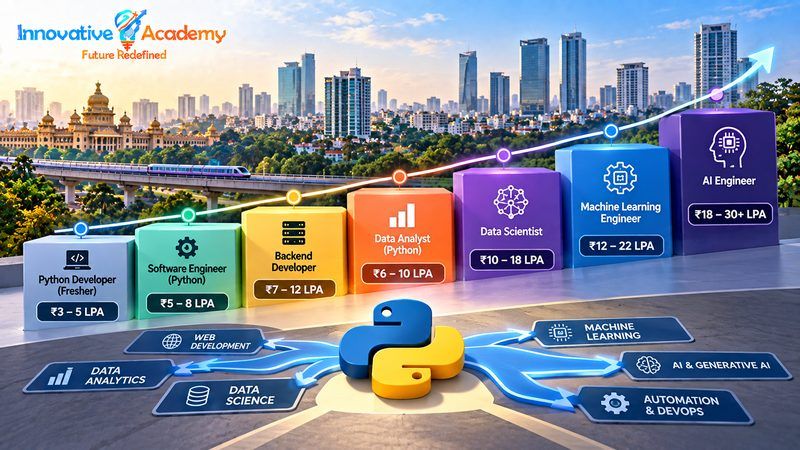
A typical Python career list may include Python Developer, Data Analyst, Data Scientist, Automation Engineer, Machine Learning Engineer, Web Developer, Cloud Engineer, Cybersecurity Analyst, and Network Automation Engineer.
These roles should not all be presented as equally accessible immediately after completing a Python course.
Python Developer
Python Developer is one of the most direct career paths from a strong Python foundation. Employers may expect knowledge of Python programming, object-oriented programming, databases, APIs, version control, frameworks, testing, and practical project experience.
Automation Engineer
Automation is another practical application of Python. Python can be used for scripting repetitive tasks, test automation, system operations, file processing, API interaction, and workflow automation.
Web Developer
Python can support web development through frameworks such as Django and Flask. However, learners also need to understand databases, HTTP, APIs, HTML, CSS, JavaScript fundamentals, deployment, and application architecture as their responsibilities grow.
Data Analyst
Data Analyst can be a realistic entry-level direction for learners who combine Python with SQL, spreadsheets, statistics, data visualization, and tools used for reporting and analysis.
Data Scientist
Data Scientist is a different proposition. Python is important, but the role usually requires deeper statistics, machine learning, data preparation, experimentation, model evaluation, and domain knowledge. It should therefore not be presented as an automatic first job after learning Python.
Machine Learning Engineer
Machine Learning Engineer is another specialization that builds on Python rather than simply following from it. Learners need additional knowledge of machine learning algorithms, model development, data pipelines, deployment, and relevant frameworks and infrastructure.
Cloud Engineer
Python can be useful in cloud environments for automation, infrastructure tooling, APIs, and deployment workflows. However, a Cloud Engineer also needs substantial knowledge of platforms such as AWS or Azure, networking, security, infrastructure, and cloud architecture.
Cybersecurity Analyst
Python is useful for security automation, scripting, analysis, and tooling. It is not, by itself, a cybersecurity qualification. Security fundamentals, networking, operating systems, security tools, monitoring, and incident-response concepts are also important.
Network Automation Engineer
Network automation combines Python with networking knowledge. Concepts such as routing, switching, network protocols, APIs, automation frameworks, and networking certifications can become important depending on the role.
The distinction is therefore straightforward: Python Developer, Automation Engineer, Web Developer, and Data Analyst can be realistic near-term directions from a practical Python program. Machine Learning Engineer, Cloud Engineer, Cybersecurity Analyst, and Network Automation Engineer are better understood as additional career paths that require Python plus another technical specialization.
4. The Salary Table, Rebuilt With Sourced Numbers
Salary figures need to be interpreted carefully because job title, location, experience, employer, technical depth, and project experience can substantially change compensation.
Python Developer
Salary survey data for Python Developers in India provides a more useful starting point than a broad range that combines freshers and experienced professionals. One cited Glassdoor figure places average annual pay at approximately ₹4.5 lakh, while reported salaries vary considerably by experience and employer.
For a fresher, the more useful benchmark is the compensation associated with genuine entry-level Python or junior software development positions rather than the upper end of an experienced developer's salary range.
Machine Learning Engineer
Machine Learning Engineer compensation can also vary significantly. Salary data may show averages that include professionals with substantial experience, so those figures should not automatically be treated as fresher expectations.
Candidates entering this field should evaluate the specific job description, required machine learning skills, portfolio depth, internship experience, and employer rather than relying on one national average.
Automation Engineer
Automation-focused roles can overlap with software development, QA automation, infrastructure automation, and DevOps. As a result, there is no single salary number that accurately represents every Python automation position.
Entry-level compensation should be assessed against the exact job title and responsibilities rather than assuming that every automation position commands experienced DevOps-level compensation.
Django Developer
Django Developer is generally a Python development specialization. Compensation can therefore overlap substantially with Python Developer and backend developer positions, depending on the technology stack and experience level.
Cloud and DevOps Roles
Python can contribute to cloud and DevOps work, particularly through scripting and automation. However, salaries for these roles should not be attributed to Python alone because employers may also require Linux, networking, CI/CD, containers, infrastructure as code, cloud platforms, and monitoring skills.
The key lesson is that salary tables should separate entry-level expectations from experienced-career outcomes. A single range covering both can make an entry-level learner believe that a higher number is immediately attainable when the role itself may require years of additional experience.
5. Why the Data Scientist Number Is Misleading for a Fresher
Data Scientist deserves separate treatment because salary averages for this title can look substantially higher than those for entry-level Python development roles.
The problem is not necessarily that the published salary figure is inaccurate. The problem is applying an experienced-role average to someone completing an entry-level Python course.
Data Scientist positions commonly require more than Python programming. Statistics, SQL, data preparation, machine learning, experimentation, model evaluation, visualization, and domain knowledge can all become important.
For many fresh graduates, Data Analyst or Junior Data Analyst can be a more realistic first target. After developing experience and adding statistics and machine learning skills, a learner can work toward more specialized data science roles.
A salary figure associated with an experienced Data Scientist should therefore be treated as a potential longer-term career benchmark rather than an automatic starting salary after a Python course.
6. What the Real Curriculum Covers, Versus a Ten-Module Wishlist
A useful Python curriculum should cover the fundamentals before moving into frameworks, databases, automation, and projects. A typical progression includes syntax and data types, control flow, data structures, functions, modules, object-oriented programming, file handling, exception handling, automation, databases, web frameworks, and project work.
The important factor is not simply the number of modules. Structure and practice matter because learners need enough time to understand each concept and apply it before moving to more advanced material.
Core Python Fundamentals
Learners should become comfortable with variables, data types, operators, conditional statements, loops, functions, modules, and basic problem solving.
Data Structures and Object-Oriented Programming
Lists, dictionaries, tuples, sets, classes, objects, inheritance, encapsulation, and related concepts form an important foundation for building maintainable Python applications.
Files and Exception Handling
Practical Python development requires the ability to read and write files, work with structured data, handle errors, and create programs that behave predictably when something goes wrong.
Automation and Application Development
Automation projects provide an opportunity to apply Python to real tasks. Depending on the program, learners may also be introduced to databases, APIs, Django, Flask, or related technologies.
Projects and Career Preparation
Projects are important because employers need evidence that a learner can apply programming concepts rather than simply recall syntax. Resume preparation, interview practice, and the ability to explain project decisions are also useful parts of career preparation.
7. Learning Python at Innovative Academy
Innovative Academy offers Python training in Bangalore with a practical learning structure focused on programming fundamentals, projects, automation, and career preparation.
The Python Development course is structured around approximately 40 hours of learning over about eight weeks. The curriculum progresses from Python fundamentals into object-oriented programming, data structures, files and exceptions, automation, application development, and project work.
The course also emphasizes practical application rather than treating Python as a purely theoretical subject. Learners work through projects that can help demonstrate their ability to apply programming concepts.
For more information, explore the Python Training in Bangalore program at Innovative Academy.
Career-support activities can include resume preparation, mock interviews, doubt clarification, and guidance on presenting technical projects during the job-search process.
8. FAQs
Is it dishonest for a Python course to mention Machine Learning Engineer or Cloud Engineer as possible outcomes?
Not necessarily, but the distinction needs to be clear. Python is useful groundwork for both paths, but neither career normally depends on Python alone. Machine learning requires additional ML and statistical knowledge, while cloud engineering requires cloud, networking, infrastructure, security, and automation skills.
Why does the Data Scientist salary figure look so much higher than the Python Developer figure if both start with Python?
Because the job titles represent different levels and skill requirements. Data Scientist positions commonly involve additional statistics, machine learning, data analysis, and industry experience. A salary average for experienced Data Scientists should not automatically be interpreted as the expected salary of a Python fresher.
Should I avoid career-path lists because some of the roles need additional training?
No. Career-path lists can be useful when they clearly distinguish between immediate opportunities and longer-term specializations. Python Developer, Automation Engineer, Web Developer, and Data Analyst can be realistic directions for learners with the appropriate foundation, while other roles require additional specialization.
Can Python alone get me a job?
Python is an important skill, but employability usually depends on more than one programming language. Projects, problem-solving ability, databases, Git, APIs, communication skills, interview preparation, and role-specific technologies can all influence hiring decisions.
Is Python useful for non-developer careers?
Yes. Python is widely applicable to data analysis, automation, testing, scripting, machine learning, scientific computing, and several cloud and infrastructure workflows. The additional skills required depend on the specific career path.
9. Final Thoughts
The strongest argument for learning Python does not require exaggerated salary claims or an oversized list of employers. Python genuinely supports a wide range of technology careers, and a structured program can provide a useful foundation for entering several of them.
The important distinction is between what Python can help someone pursue immediately and what requires additional specialization. Python Developer, Automation Engineer, Web Developer, and Data Analyst can be reasonable near-term directions depending on the learner's skills and portfolio.
Machine Learning Engineer, Cloud Engineer, Cybersecurity Analyst, Network Automation Engineer, and Data Scientist can be viewed as longer-term directions where Python forms one part of a broader technical skill set.
Salary figures should be treated in the same way. A published average can provide context, but it should not be presented as a guaranteed fresher salary. Experience, employer, location, specialization, projects, and interview performance all influence actual compensation.
Ultimately, a more useful Python career plan is one that connects the programming foundation to a specific job target, identifies the additional skills that target requires, and builds demonstrable projects along the way.