
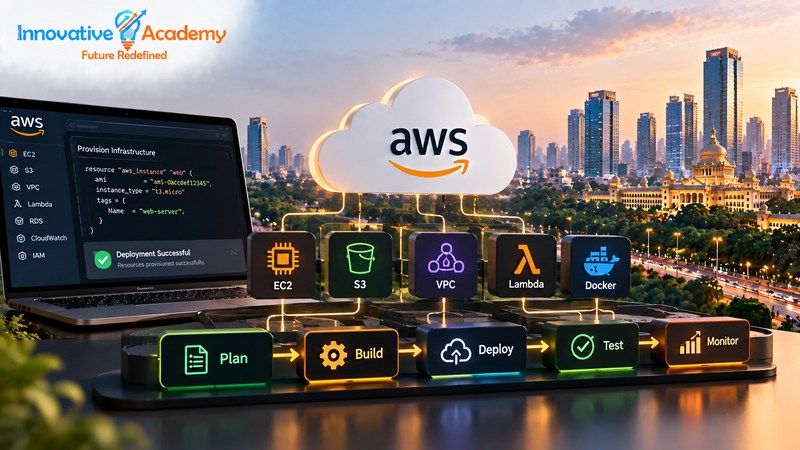

Project-Based AWS Training in Bangalore: Why "Learn by Doing" Actually Works
1. Introduction
There's a specific, recognizable failure mode in cloud training: someone finishes a course able to define what EC2 and S3 do but freezes the first time they're actually asked to stand up a working system from scratch.
```Project-based training exists specifically to prevent that gap. Instead of stopping at definitions and demonstrations, it gives learners opportunities to configure services, troubleshoot failures, connect components, and build working cloud environments.
This guide explains what genuinely separates project-based AWS training from a theory-heavy alternative, what a practical curriculum should cover, which projects are worth building, and what the learning path can realistically lead to.
```2. Why AWS Specifically
```AWS remains one of the largest cloud platforms in the world. Current cloud infrastructure market data continues to show AWS holding the largest individual share of global cloud infrastructure spending, with Microsoft Azure and Google Cloud following behind.
The platform's scale is also reflected in its broad service portfolio covering compute, storage, databases, networking, security, analytics, artificial intelligence, and application development.
That breadth is one reason AWS skills are useful across different technology environments. A learner can start with foundational services such as EC2 and S3 and gradually move toward networking, databases, security, automation, monitoring, and architecture.
For beginners, however, the size of the AWS ecosystem can also be overwhelming. This makes structured, hands-on learning particularly valuable.
```3. Why Project-Based Training Beats Theory-First Training
```The core problem with theory-only cloud education is that AWS's console, permissions model, networking layer, and service interactions have genuine practical complexity that a slide deck cannot fully reproduce.
There is a major difference between reading about a security group and actually configuring one, testing connectivity, discovering that traffic is blocked, identifying the rule responsible, and fixing it.
Project-based training closes that gap directly. Instead of learning about EC2 and S3 only as abstract concepts, learners launch instances, configure storage, connect services, work with permissions, and observe how a working cloud environment behaves.
The mistakes are part of the learning process. Debugging a broken security group, troubleshooting a routing problem, or correcting an incorrectly configured service can teach practical concepts that are difficult to understand from diagrams alone.
That experience also creates useful interview material because candidates can explain what they built, what went wrong, how they investigated the problem, and how they solved it.
```4. Why Bangalore, Concretely
```Bangalore is one of India's major technology and IT services hubs, with companies working across software development, cloud computing, infrastructure, cybersecurity, SaaS, fintech, and other technology sectors.
For someone learning AWS, being in a large technology market can provide access to training providers, technology communities, professional networking opportunities, workshops, and organizations using cloud technologies in production.
However, location alone does not guarantee the quality of training. A Bangalore-based AWS course should still be evaluated based on its curriculum, trainer experience, lab access, project depth, certification preparation, and career support.
The practical question is not simply whether an institute is located in Bangalore. It is whether the program gives students enough opportunities to work with real AWS services and explain what they built.
```5. What a Real Project-Based Curriculum Covers
```A genuinely practical AWS curriculum should move from cloud fundamentals into progressively more complex infrastructure.
Cloud Fundamentals
The foundation should cover AWS's global infrastructure, including regions and availability zones, along with account setup, identity basics, billing awareness, and responsible use of free-tier resources.
Compute, Storage, and Databases
Core services should be configured rather than simply discussed. This can include launching and managing EC2 instances, working with S3 storage, and setting up an RDS database that connects to an application or other AWS resources.
Networking and Security
Networking is one of the most important parts of practical AWS learning. A project-based curriculum should cover VPCs, subnets, route tables, gateways, security groups, network access concepts, and load balancing.
This is also where many beginners discover that understanding how traffic actually moves between resources is more useful than memorizing a networking diagram.
Infrastructure as Code
CloudFormation provides an introduction to infrastructure as code. Instead of configuring everything manually, learners can understand how infrastructure definitions can be represented as code and deployed repeatedly.
Serverless Computing
A practical introduction to Lambda helps learners understand event-driven and serverless architectures without requiring every workload to run continuously on a traditional server.
Monitoring and Deployment
CloudWatch introduces monitoring and observability, while a basic CI/CD workflow demonstrates how application changes can move toward automated deployment.
These components help turn AWS learning from a list of services into an understanding of how cloud infrastructure works as a connected system.
```6. The Projects Worth Actually Building
```Four project categories cover many of the practical concepts an AWS beginner should be able to demonstrate.
Project 1: Static Website with S3 and CloudFront
A static website hosted using S3 and delivered through CloudFront is an approachable first project. It introduces storage, content delivery, permissions, and the idea of serving content across geographically distributed infrastructure.
Project 2: Load-Balanced EC2 Application
A multi-instance web application behind a load balancer introduces concepts such as scalability, availability, traffic distribution, and reducing dependence on a single server.
Project 3: Custom VPC Design
Building a VPC with subnets, gateways, route tables, and security controls provides practical networking experience. This is particularly useful for learners who want to move beyond simply launching resources using default settings.
Project 4: RDS Database Deployment
An RDS project can introduce database connectivity, backups, availability considerations, and basic recovery planning. It also helps learners understand why data management is an important part of cloud architecture.
Together, these projects give learners concrete examples to discuss during interviews rather than relying only on a resume statement such as "familiar with AWS."
```7. Who This Path Fits
```Freshers and Graduates
Freshers can use project-based learning to build practical exposure alongside foundational cloud knowledge. A structured project can also give them something specific to discuss during technical interviews.
System and Network Administrators
Professionals who already understand servers, networking, operating systems, or infrastructure can transfer many of those concepts into AWS and build cloud-specific skills.
Developers
Developers can benefit from learning how applications are deployed, monitored, secured, and scaled in cloud environments.
Career Changers
For someone moving into IT from another field, projects can provide practical evidence of learning. Being able to demonstrate a working environment can make technical discussions more concrete.
```8. The Certification This Actually Leads To
```A project-heavy AWS course is commonly aligned with the AWS Certified Solutions Architect – Associate pathway. The certification requires candidates to understand how AWS services can be combined to design solutions, rather than simply recognizing individual service names.
This is a different level of preparation from the entry-level AWS Certified Cloud Practitioner certification.
Before enrolling in a course, learners should confirm exactly which certification the curriculum is designed to support. A course covering real architecture, networking, security, compute, storage, and deployment should clearly explain its intended certification pathway.
```9. Career Outcomes and Honest Salary Numbers
```Practical AWS experience can support career paths in areas such as cloud engineering, cloud administration, DevOps, infrastructure, and solutions architecture.
Salary figures vary considerably by location, experience, organization, technology stack, and job responsibilities. Public salary platforms should therefore be treated as broad market indicators rather than guaranteed outcomes.
Cloud Administration
Cloud administrator compensation in India varies substantially between entry-level and experienced professionals. Responsibilities can include resource management, monitoring, access control, troubleshooting, and operational support.
AWS Solutions Architecture
Solutions architecture roles generally require broader knowledge across networking, compute, storage, security, databases, availability, and cost considerations.
DevOps Engineering
DevOps roles typically combine cloud infrastructure with automation, CI/CD, containers, monitoring, configuration management, and software delivery practices.
Site Reliability Engineering
SRE is another potential direction for people who build strong foundations in cloud infrastructure, automation, monitoring, reliability, and production operations. Compensation can vary widely because SRE responsibilities and seniority differ significantly between organizations.
The key point is that a certification alone does not determine salary. Practical ability, project depth, experience, interview performance, and the requirements of the employer all influence career outcomes.
```10. Project-Based AWS Training at Innovative Academy
```Innovative Academy offers AWS training in Bangalore with a practical learning approach that combines cloud fundamentals, AWS services, networking, compute, storage, monitoring, security, architecture, and hands-on project work.
The program is structured around approximately 40 hours of learning across four weeks, with practical activities progressing from cloud foundations into core AWS infrastructure and architecture concepts.
The training includes hands-on project work designed to give learners experience beyond simply watching demonstrations. Projects can help students understand how different AWS services work together and provide practical examples they can discuss during technical interviews.
The program is positioned toward the AWS Solutions Architect Associate level and is intended for learners who want structured AWS training combined with practical exposure.
Innovative Academy also provides career-oriented support, including resume preparation, mock interviews, and placement assistance for eligible students.
For more information about AWS training and other IT programs, visit Innovative Academy.
```11. FAQs
```Is project-based AWS training actually better than a cheaper theory-only course?
Project-based and theory-first approaches develop different types of learning. Projects provide direct practice with configuration, troubleshooting, deployment, and infrastructure decisions. Theory remains important because learners need to understand why a particular architecture or configuration works.
Do I need coding experience before starting AWS training?
No formal coding background is required to begin learning core AWS services. Basic scripting becomes increasingly useful as you move toward automation, infrastructure as code, and DevOps practices, but it is not a prerequisite for learning AWS fundamentals.
Which certification should a project-based AWS course prepare me for?
It depends on the depth of the course. AWS Cloud Practitioner is an entry-level certification, while AWS Solutions Architect – Associate requires deeper understanding of AWS architecture and service integration. A project-oriented course covering architecture, networking, security, compute, storage, and deployment may align more closely with the Associate pathway.
How many AWS projects should a beginner build?
There is no fixed number. A small number of well-documented projects is generally more useful than a long list of projects that were copied from tutorials without understanding. Each project should demonstrate what was built, why specific services were selected, and how problems were solved.
Can AWS projects help in interviews?
Yes. Projects give candidates concrete examples to discuss. Interviewers can ask about architecture choices, security, networking, troubleshooting, cost considerations, and deployment, allowing candidates to demonstrate practical understanding.
```12. Final Thoughts
```"Learn cloud by doing" is more than a training slogan when the program actually provides meaningful opportunities to build and troubleshoot infrastructure.
AWS offers a broad ecosystem covering compute, storage, networking, databases, security, monitoring, automation, and application services. Learning those services through connected projects can help learners understand how cloud environments operate as systems rather than isolated products.
The most useful outcome of project-based AWS training is not simply being able to say, "I studied AWS." It is being able to explain what you built, why you designed it that way, what failed, how you fixed it, and what you would change in a production environment.
For learners considering AWS training in Bangalore, that practical distinction is worth checking before choosing a course.
```