
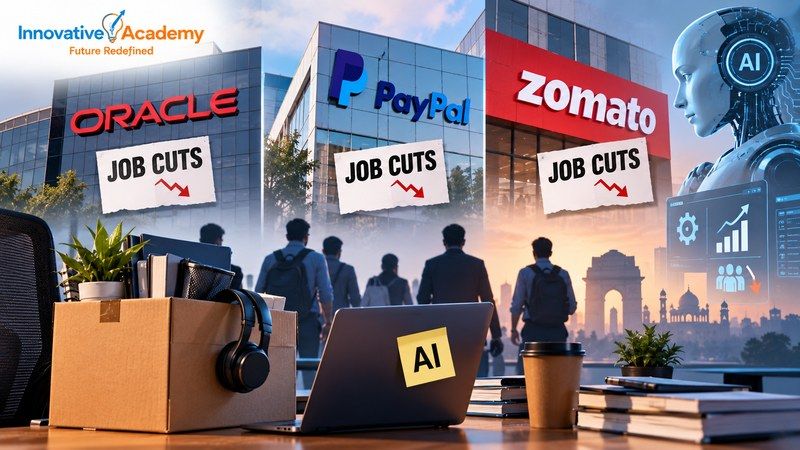

Oracle, PayPal, and Zomato All Cut Indian Jobs This September—Here's What "AI" Actually Meant in Each Case
Table of Contents
- 1. Introduction
- 2. Oracle: ~3,000 Jobs, Tied to a Massive AI Infrastructure Bet
- 3. PayPal: 220 Jobs, Framed as Ongoing Restructuring
- 4. Zomato: 250 Jobs, Where AI Actually Did the Displacing
- 5. Three Companies, Three Different Relationships to AI
- 6. The Number That Puts These Three in Context
- 7. What This Means for Someone Building a Career Right Now
- 8. Learning DevOps and Cloud at Innovative Academy
- 9. FAQs
- 10. Final Thoughts
Three Indian job-cut announcements involving Oracle, PayPal, and Zomato drew attention in September 2026, and all three were discussed in connection with artificial intelligence. But the role AI played in each case was very different.
One involved AI and automation directly absorbing customer-support work. Another involved a major shift toward AI infrastructure alongside workforce reductions. The third was presented by the company as part of a broader restructuring program rather than as an AI-driven layoff.
That distinction matters for anyone trying to understand IT layoffs in India in 2026 and what they mean for building a technology career.
1. Introduction
Three unrelated Indian job-cut announcements landed around the same period in September 2026—Oracle, PayPal, and Zomato—and all three became associated with the word "AI" in subsequent reporting and commentary.
However, the word is doing very different work in each story.
In one case, AI and automation were explicitly connected to the work being removed. In another, workforce reductions happened alongside a major increase in spending on AI infrastructure. In the third, the company's own explanation centered on a previously announced transformation rather than artificial intelligence.
That makes these cases useful for understanding the difference between AI-driven job displacement, AI-related investment decisions, and ordinary corporate restructuring.
2. Oracle: ~3,000 Jobs, Tied to a Massive AI Infrastructure Bet
Reports from Indian business media in early September put the number of affected Oracle employees in India at approximately 3,000, or around 10% of an estimated 30,000-person Indian workforce.
There is an important qualification: the approximately 3,000 figure was attributed to unnamed sources and was not officially confirmed by Oracle. The precise teams and functions affected were also not publicly established in the reporting.
What can be established separately is the scale of Oracle's infrastructure spending. Oracle's capital expenditure reached approximately $55.7 billion in fiscal 2026, compared with $21.2 billion in fiscal 2025, with a substantial portion directed toward data-center infrastructure supporting AI-related demand.
Oracle had also announced significant workforce reductions earlier in 2026, with AI and automation featuring in the surrounding discussion.
The important distinction is that increased investment in AI infrastructure does not automatically demonstrate that AI software directly replaced the employees affected by a particular workforce reduction.
In other words, the Oracle story is better understood as large-scale capital reallocation toward AI infrastructure occurring alongside workforce reductions, rather than as clear evidence that AI systems directly performed the jobs eliminated.
3. PayPal: 220 Jobs, Framed as Ongoing Restructuring
PayPal's September workforce reduction in India was considerably smaller. Reports put the number of affected employees at 220, representing roughly 4% of the company's Indian workforce, with Bengaluru among the locations affected.
The most important detail is PayPal's own description of the decision. The company characterized the staffing changes as part of its previously announced multi-year transformation.
Other reports citing unnamed sources suggested a considerably higher figure of around 600 jobs. Because the 220 figure was associated with a company statement rather than anonymous sourcing, it provides a more clearly attributable number, although the discrepancy between reports is worth noting.
PayPal's own explanation did not identify AI as the direct reason for the September job cuts.
That makes this case different from a straightforward AI-displacement story. The available company explanation places the workforce reduction within a broader organizational transformation and restructuring process.
4. Zomato: 250 Jobs, Where AI Actually Did the Displacing
Zomato provides the clearest example among these three cases of AI and automation being connected directly to the work affected.
The company informed employees that it was shutting its Hyderabad customer-support center, affecting approximately 250 jobs, while consolidating support operations into its Gurugram headquarters.
The company had increasingly outsourced customer-care operations to external partners, while automation and AI tools were handling a growing portion of the work previously performed by in-house support employees.
The affected employees were reportedly provided salary for August, severance covering the applicable notice period and ex gratia payment, along with medical insurance and counseling support extending into 2027.
This case is materially different from the Oracle and PayPal examples because automation and AI were connected to the specific category of work being reduced.
It therefore provides a concrete example of how routine, structured customer-support tasks can become candidates for automation.
5. Three Companies, Three Different Relationships to AI
Putting the three cases side by side reveals three different relationships between AI and workforce reductions.
| Company | Reported Jobs Affected | Relationship to AI |
|---|---|---|
| Oracle | ~3,000 reported | Major AI infrastructure investment alongside workforce reductions; direct causation was not officially established. |
| PayPal | 220 company-linked figure | Company described the cuts as part of a previously announced multi-year transformation. |
| Zomato | ~250 | AI, automation, and outsourcing were directly connected to the reduction of routine customer-support work. |
Calling all three examples simply "AI layoffs" removes an important distinction.
Zomato illustrates direct automation pressure on a particular category of work. Oracle illustrates the simultaneous expansion of AI infrastructure investment and workforce reductions, without establishing that AI directly replaced the affected employees. PayPal illustrates restructuring in which the company's stated explanation did not identify AI as the specific cause.
6. The Number That Puts These Three in Context
These individual announcements also sit within a broader 2026 layoff environment.
Independent layoff tracking during the year recorded hundreds of global layoff events affecting hundreds of thousands of workers. A substantial portion of those events were associated with AI or automation in company statements or reporting, but that does not mean AI was the sole cause of every affected job reduction.
Companies also reduce headcount because of restructuring, cost control, changing business strategies, mergers, outsourcing, changes in demand, and shifts in investment priorities.
That broader context is important when interpreting headlines about tech layoffs in September 2026. An AI reference in a news report should not automatically be interpreted as proof that an AI system replaced the employees involved.
7. What This Means for Someone Building a Career Right Now
The practical lesson from these cases is not that every technology job is about to disappear, nor that AI has no effect on employment.
The more useful question is what type of work a particular role involves.
Tasks that are repetitive, highly structured, and governed by predictable rules can be more accessible to automation. Zomato's customer-support example illustrates how this can happen in practice.
At the same time, modern AI systems themselves require infrastructure. Cloud platforms, networking, Linux environments, containers, deployment pipelines, monitoring systems, security controls, and infrastructure automation remain important components of operating modern technology environments.
This does not mean that cloud or DevOps jobs are guaranteed to grow or are immune from automation. It means that career planning should focus on building adaptable technical skills rather than reacting to individual layoff headlines.
For people considering a DevOps course in Bangalore or a cloud computing course in Bangalore, that can mean learning the underlying technologies as well as the automation tools built on top of them.
8. Learning DevOps and Cloud at Innovative Academy
Innovative Academy offers DevOps and cloud-focused training in Bangalore, covering foundational areas such as networking and Linux before moving into modern DevOps and cloud technologies.
The training approach is designed to help learners understand the infrastructure underneath automation rather than learning individual tools in isolation.
For learners exploring DevOps training with placement assistance, the program also includes career-oriented support such as mock interviews, resume guidance, and placement assistance.
Students can explore the institute's DevOps Bootcamp in Bangalore to review the training approach and course details.
9. FAQs
1. Were all three of these layoffs actually caused by AI?
No. The three cases should not be treated as equivalent. Zomato's reduction has the clearest connection between AI, automation, outsourcing, and the specific customer-support work being reduced. Oracle's workforce reduction occurred alongside a major AI infrastructure investment, but a direct causal connection between the investment and the reported job cuts was not officially established. PayPal described its reduction as part of a broader multi-year transformation.
2. Is the Oracle layoff number confirmed?
Not officially. The approximately 3,000 figure was reported by Indian business media based on unnamed sources. Oracle did not publicly confirm the exact number or provide a complete team-by-team breakdown in the reporting described above.
3. Does this mean customer support jobs are disappearing entirely?
No. The Zomato example shows that particular categories of routine customer-support work can be reduced through automation and outsourcing. It does not establish that all customer-support employment will disappear.
4. Is AI responsible for most technology layoffs?
AI and automation are increasingly cited in layoff announcements and reporting, but workforce reductions also result from restructuring, cost-cutting, outsourcing, strategic changes, and other business factors. An AI reference should therefore be examined in the context of the specific company's stated reason for reducing headcount.
5. Should IT professionals avoid careers in cloud and DevOps because of AI?
These cases do not provide evidence that cloud and DevOps careers should be avoided. They do show why learners should build broader technical foundations, including networking, Linux, cloud infrastructure, automation, containers, and deployment practices, rather than relying on one narrowly defined task.
10. Final Thoughts
"AI is cutting jobs in India" describes part of what is happening, but it is not a sufficient explanation for every workforce reduction that gets associated with AI.
Zomato provides a relatively direct example of automation and AI affecting a specific category of customer-support work. Oracle's reported workforce reduction happened alongside a dramatic increase in AI infrastructure spending, but the precise causal relationship between the two remains unclear. PayPal's own explanation placed its cuts within a broader multi-year transformation.
For technology professionals and students, the useful response is to look beyond the headline. Understanding which tasks are being automated, which technologies organizations are investing in, and which technical skills remain necessary to build and operate those systems provides a more useful basis for career planning.