
Oracle Is Cutting Jobs While Spending Billions into AI—What Does This Mean for IT Careers?
Table of Contents
- Oracle's Layoffs Are Only Half the Story
- The Part Most Coverage Leaves Out: This Is a Funding Story, Too
- Is AI Really Taking Away IT Jobs?
- How AI Is Reshaping the Meaning of Working in IT
- Why Is Cloud Computing Important?
- Why Networking Still Matters
- Why DevOps Skills Are in Growing Demand
- Generative AI Is a New Layer of IT Skills Coming
- The New IT Career Skill Stacking
- What Does This Development Mean to Freshers?
- What Should IT Professionals Learn Today?
- AI Generates New Infrastructure Demand
- How Innovative Academy Can Get You Ready
- The Biggest Lesson From Oracle
- Future of IT Is IT + AI
The IT industry is in a weird dilemma in 2026.
Companies are pouring billions into artificial intelligence, cloud infrastructure, and data centers while reshaping teams and cutting parts of their staff.
Oracle's recent actions are a clear example of how the industry is moving.
According to Business Insider, Oracle is set to announce another round of layoffs this month, according to an internal memo and people familiar with the plan. Managers are said to have been asked for the names of affected employees, and double-digit percentage cuts are apparently looming for several teams. The stated goal is to reduce payroll expenses before Sept. 1, the beginning of Oracle's fiscal second quarter. Oracle has declined to comment, and the corporation has not publicly acknowledged the proposal.
This comes after a far larger shift already seen in Oracle's filings. During the fiscal year ended May 31, 2026, the company's personnel shrunk from nearly 162,000 to roughly 141,000—a net loss of about 21,000 people, or 13%. Please take into account that this figure is a net headcount number, not 21,000 verified job cuts. This covers voluntary leavers, performance exits, reorganizations, and involuntary cuts. Clearly, layoffs were a big part of the $1.84 billion in severance and restructuring costs that Oracle booked for the year, up from $374 million a year earlier.
And at the same time, the corporation has been making heavy investments in AI and cloud infrastructure.
Oracle reported $55.7 billion of capital spending in FY2026. Cloud infrastructure revenue surged 77% year over year to $18.1 billion. The company's overall revenue in FY2026 was a record $67.4 billion.
So what's going on?
Is AI just killing IT jobs?
Not quite. And the honest answer is more nuanced than most headlines make it sound.
Oracle's Layoffs Are Only Half the Story
The headline is obvious:
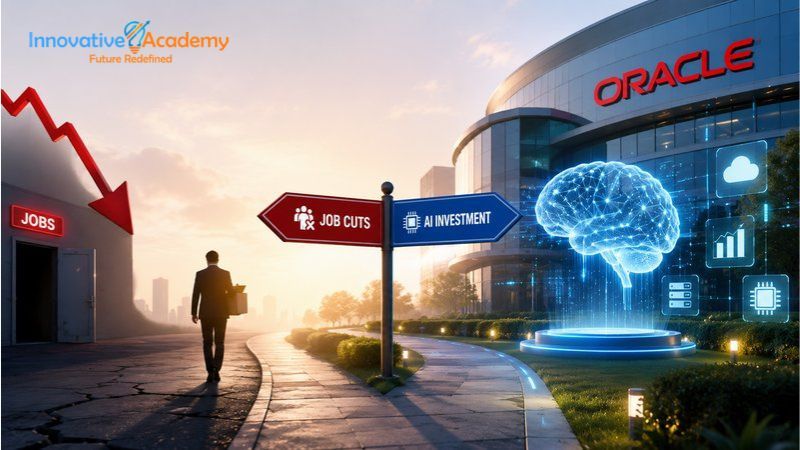
Oracle is laying off staff while pouring billions into AI
But focusing on layoffs alone ignores the bigger shift happening in the tech industry.
Companies are moving investment to technologies that boost automation, cloud capacity, AI capabilities, and operational efficiency.
Oracle's FY2026 earnings reflect this change. Demand for AI workloads helped fuel appreciable growth in its cloud infrastructure business. Its remaining performance obligations—or contracted future income—were $638 billion. Much of it is connected to AI infrastructure investments.
Nor is Oracle an outlier. Salesforce slashed nearly half its support division earlier this year and made significant AI-related cuts in February. Companies are reporting record revenue in the area while cutting employment.
Simultaneously, firms are becoming more choosy in how they deploy employees and technology resources.
This means some traditional jobs could take fewer people, and there's increased demand for individuals who know how to:
- Develop Infrastructure
- App deployment
- Automate the processes
- Managing cloud environments
- Secure systems
- Diagnostics of complicated ecosystems
- Run AI workloads
AI does not operate in isolation from IT infrastructure.
AI requires:
- Cloud computing
- High-performance servers
- Connect
- Storage
- GNU/Linux
- Containers
- Kubernetes
- Automation
- Safety
- Surveillance
- Deploying applications
Simply put:
AI needs IT.
The Part Most Coverage Leaves Out: This Is a Funding Story, Too
It would be easy to suggest that Oracle slashed 21,000 jobs because AI made them redundant. The financial picture suggests that something more particular is happening.
The capital expenditure of $55.7 billion was up from $21.2 billion the previous year. That helped lower Oracle's free cash flow to a negative $23.7 billion for the fiscal year. The corporation raised around $43 billion of debt and $5 billion of equity in FY2026 to finance the deficit and expects another $40 billion or more through borrowing and share issuance in FY2027. Oracle shares are down about 26 percent this year.
Read against those numbers, the August layoffs look less like "AI replaced these people" and more like payroll being turned into capital expenditure—salaries rechanneled toward GPUs, data centers, and server capacity on a deadline imposed by the fiscal calendar.
Why does this difference matter to your career?
This is important because it shows what technology firms are focusing on and where they are spending their money.
Oracle isn't buying $55.7 billion in self-running software. It's putting it on physical and virtual infrastructure that needs planning, deployment, networking, security, monitoring, and maintenance. Oracle said it provided more than 1.2 gigawatts of capacity to customers in fiscal 2026 and intends to deliver close to another gigawatt in a single quarter. That capacity does not function without individuals.
At the same time, Oracle has been clear about the impact AI will have on staffing. The corporation admitted in its annual filing that the use and deployment of artificial intelligence (AI) technologies throughout its business has already cut back the demand for people, and it might keep doing that.
Both are true at the same time. The AI buildout is boosting demand for some types of jobs while making others obsolete. The question is where on that line are your skills?
Is AI Really Taking Away IT Jobs?
AI already automates many tedious chores.
It can write code, summarize information, analyze logs, create documentation, and help debug problems.
But repetitive jobs are only one part of production IT setups.
Someone's got to pick it up:
- What a system does
- Whether it is safe
- How to set up
- If it scales
- Interaction of distinct systems
- What happens if something goes wrong
- How to resolve the problem
An AI tool might, for example, generate a configuration file.
But a good IT expert still has to figure out the following:
- If the arrangement is correct
- Or security threat Whether it causes security risk
- Whether existing infrastructure will be compatible with it
- Whether it can cope with future expansion
- How to monitor
- How to troubleshoot problems when they emerge
This is why the importance of technical basics is not decreasing, but increasing.
The future of IT probably won't be humans vs. AI.
Instead, it is increasingly:
Professionals who can use AI efficiently against professionals who can't.
How AI Is Reshaping the Meaning of Working in IT
For many years, IT jobs were split into various groups.
There were:
- Network engineers
- System Admins
- Cloud engineers
- Software Engineers
- DevOps Engineer
- Data Engineer
Those lines are becoming less distinct now.
"Every cloud engineer should know about AI workloads."
An AI application deployment pipeline may involve a DevOps engineer.
A network engineer might build infrastructure for massive GPU clusters.
Software developers are able to employ AI coding tools and design apps based on huge language models.
A Linux administrator may increasingly manage cloud-based infrastructure, containers, and automation systems.
This is the new kind of IT professional:
Someone who knows basic technology and how to use AI and automation to solve actual problems.
That combination can be far more important than knowing one technology in isolation.
Why Is Cloud Computing Important?
Oracle's success is also indicative of another big trend:
Because AI workloads require a lot of computational power, cloud infrastructure is becoming more and more critical.
Cloud engineers work with the infrastructure that allows enterprises to provide, manage, and grow computer resources.
Key cloud skills include the following:
- Calculate
- Storage
- Social Networks
- Identity and access management
- Security
- Tracking
- Scaleability
- Infrastructure as Code
- Cloud architecture
- Cost control
Microsoft Azure and AWS are two of the most often utilized cloud platforms in the market.
But learning in the cloud should not focus only on the cloud interface.
Students should know how cloud infrastructure works, how resources are communicating, how systems are secured, and how the infrastructure may be automated. People who can explain their infrastructure costs and the reasons behind them remain employable throughout a capex cycle, such as Oracle's.
Why Networking Still Matters
AI may be disrupting the tech business, but it's not making networking obsolete.
In fact, as AI infrastructure expands, networking may become much more crucial.
In contrast, large-scale AI settings can include thousands of GPUs, servers, and storage devices communicating with each other.
Data must be efficiently moved between apps, computing, and storage.
This demands robust networks.
So IT professionals still need a solid understanding of the following:
- IP addressing
- Subnetting
- Routing
- Exchange
- VLAN
- Domain Name System
- DHCP
- Firewalls
- Security of network
- Problem-solving
- Network as a service (NaaS)
Networking fundamentals also equip you with a good base for advancing into cloud computing, cybersecurity, and infrastructure engineering.
If you are a learner who wants to create this foundation, then Innovative Academy's CCNA program focuses on networking fundamentals, Cisco technologies, and hands-on learning.
Therefore, CCNA is more than just a certification.
Such a program can be the beginning of a larger infrastructure career.
Why DevOps Skills Are in Growing Demand
Nowadays, organizations have infrastructure that is too complicated to manage manually.
Consider an organization that has hundreds or thousands of servers, containers, and cloud resources.
Someone needs to:
- Deploy automatically
- Systems to monitor
- Infrastructure Management
- Keep CI/CD pipelines running
- Safe environments
- Troubleshooting difficulties in production
- Scale apps
That's where DevOps comes into play.
DevOps brings together development, operations, and automation approaches to help firms build and operate technology more efficiently.
Common DevOps technologies are:
- Git
- GitHub
- Jenkins
- Docker
- Kubernetes
- Terraform
- Ansible
- CI/CD
- Cloud platform
- Observability and monitoring
As AI applications become part of the enterprise environment, these talents can only increase in value.
An AI application still must:
Code + Cloud + Networking + Security + Delivery + Monitoring + Automation
That is why AI and DevOps should not be considered competing career choices.
They can be complementary to one another.
Innovative Academy's DevOps Engineering Bootcamp is a practical, hands-on course covering cloud, Linux, automation, containers, CI/CD, and DevOps technologies.
Generative AI Is a New Layer of IT Skills Coming
There's a huge difference between using AI and building with AI.
Anyone can utilize an AI chatbot.
But corporations are increasingly searching for people who can embed AI into applications, products, and workflows.
This means understanding technologies such as:
- Big Language Models
- Prompt design
- AI API
- RAG (Retrieval Augmented Generation)
- Embeddings
- Vector databases
- Agents AI
- Tool Use
- Model assessment
- Development of AI application
These skills could combine with standard IT knowledge.
Similar to:
- Developer + Gen AI -> AI-powered applications
- Cloud Engineer + Gen AI -> Deployment of AI Workload
- DevOps Engineer + Gen AI = Automated AI Applications
- Network Engineer + AI infrastructure = Infrastructure for big AI environments
So the opportunity is not necessarily:
IT OR ARTIFICIAL INTELLIGENCE
It could be:
AI and IT
The New IT Career Skill Stacking
Maybe the technology job path of the future is less about one expertise than about a stack of complementary abilities.
1. Networking
Find out how systems talk to each other. Skills: Routing, switching, IP addressing, subnetting, security, and troubleshooting.
2. Linux
Understand the workings of servers and infrastructure. Skills: Command line, permissions, processes, services, networking, scripting.
3. Clouds
Learn how to provision and scale modern infrastructure. Skills: AWS, Azure, compute, storage, networking, and security.
4. DevOps
Automating infrastructure and applications. Learn how to automate infrastructure and applications. Skills: Git, CI/CD, Docker, Kubernetes, Terraform, Ansible, and monitoring.
5. Generative AI
See how modern AI apps are constructed. Skills: LLMs, prompts, APIs, RAG, agents, and AI application development.
What matters is that pupils don't need to learn everything at the same time.
A better way is:
Start with the essentials.
Then:
Include real-life skills.
Then,
Specialize.
And finally:
Develop AI and automation skills.
What Does This Development Mean to Freshers?
The Oracle myth might make students nervous, and it's easy to see why.
If a big tech company is cutting jobs, should someone still get into IT?
Yes—but in a different way. Gone are the days when a mere technology qualification was enough to guarantee a career.
Students need more and more:
Basics + Practical Skills + Projects + AI Awareness
It requires knowing how the technology works, not just remembering interview responses.
Rather than asking:
"Which course will get me a job?"
A better question would be the following:
"What abilities can help me solve real-world technology problems?"
This strategy can better prepare learners for the evolving IT sector.
Students should concentrate on:
- Getting to grips with technical basics
- Gaining real-world experience
- Working together on projects
- Learning new tools
- Developing problem-solving skills
- AI Explained
- Getting ready for actual interviews
It is also worth being honest. The employment market is tightening up, so entry-level jobs are more competitive than they were three years ago. When businesses are recruiting fewer individuals, they can afford to be more choosy about who they hire; thus, practical, demonstrable talents are more important than they were.
What Should IT Professionals Learn Today?
If you're already in IT, you don't have to start your career over again.
You can work on what you know.
If You're a Network Engineer: Cloud + Automation + Security + AI Infrastructure Awareness
If You're a Linux System Administrator: Automation + Containers + DevOps + Cloud
In the Role of Cloud Engineer: DevOps + Infrastructure as Code + AI Workloads
If You Are DevOps Engineer, Add: AI Infrastructure + MLOps/LLMOps + GenAI
If You Are a Software Developer: Generative AI + APIs + Cloud + AI-assisted development
It's not about learning everything; it's about the right mix of skills.
It is about being someone who can connect technologies to solve problems.
AI Generates New Infrastructure Demand
There is an essential moment in the Oracle narrative.
The corporation is cutting some jobs, but it is also spending extensively on AI infrastructure.
And it's not just Oracle.
Companies across the technology industry are pouring money into:
- GPU's
- Data centers for AI
- Cloud infrastructure
- Network
- Storage
- AI Platform
- Automation
- Safety
- AI use cases
That means AI needs a lot more than those who design AI models.
"We need people who can run the technology around those models."
This opens up options for:
- Cloud computing
- DevOps
- Network
- Administering Linux
- Cyber security
- Software engineering
- Data engineering
- Generative artificial intelligence
- AI infrastructure
The AI economy needs a complete technical ecosystem.
How Innovative Academy Can Get You Ready
Innovative Academy is a place for learners to get practical, job-oriented IT skills in networking, Linux, cloud, DevOps, Azure, Python, and generative AI.
We can build the learning route in a step-by-step manner:
Networking → Linux → Cloud → DevOps → Generative AI
Some of the related programs are:
- CCNA Training – Build networking principles, routing, switching, troubleshooting, and practical Cisco skills.
- AWS Training - Develop cloud computing and infrastructure skills with AWS technologies.
- Microsoft Azure Training – Learn to work with the Microsoft cloud.
- Linux Training - Practical Linux Administration & Server Essentials
- DevOps Engineering Bootcamp — Learn Linux, Cloud, Git, CI/CD, Docker, Kubernetes, Terraform, Ansible, and automation.
- Generative AI Training – Build on your existing technical foundation and gain the skills to apply modern AI. (Launching soon — stay tuned.)
Innovative Academy also focuses on hands-on learning, projects, interview preparation, and placement support to enable learners to bridge technical education with career preparation.
The aim is to convert technical knowledge into usable, employable skills.
The goal is to develop a technical skill stack that will remain relevant over time.
The Biggest Lesson From Oracle
Oracle's layoffs are not just to be understood as:
"AI is going to take all the jobs."
A more useful way to think about it is the following:
"The tech industry is putting billions of dollars into AI infrastructure, and it is financing some of that by reshaping its workforce."
That's a deeper truth than the headline version and a more valuable one because it informs you what firms are buying instead of personnel and thus what talents sit closest to where the money is moving.
AI is able to take over tasks.
Cloud automates the infrastructure.
Deployments can be automated using DevOps.
Generative artificial intelligence helps speed up software development.
But automation itself needs people who understand what should be automated, how to build it, and how to manage the systems afterward.
Therefore, technical basics are still important.
Future of IT Is IT + AI
The Oracle narrative offers a warning but also an opportunity.
Some jobs will be automated.
Some positions may wither.
New jobs will be created.
Existing roles will increasingly need awareness of AI.
For students and IT workers, the answer is not to be afraid of any new AI technology.
It's about constantly improving your skills.
Study networking.
Learn Linux.
Become a cloud specialist.
DevOps and automation expertise.
Know generative AI.
Work on genuine projects.
And study how these technologies function together, most importantly.
The specialists who flourish in the era of AI may not be those who know only AI.
"They might be the ones to get the entire technology stack that makes AI happen."
Ready to Build Your Career in AI-Ready IT?
The IT industry is changing rapidly.
Don't wait for AI to change your job; start preparing yourself for the change today.
Lay your foundation in the following:
Cloud → Linux → Networking → DevOps → Generative AI
Explore Innovative Academy's relevant programs and select a learning route that fits your present skills, job goals, and experience.
Lay the foundation. Get hands-on experience. Learn AI. Do real things. Get ready for the future of IT.
The financial data are taken from Oracle's Q4 and FY 2026 statements issued June 10, 2026. Oracle will slash jobs in August 2026, Business Insider reported Aug. 11, but the company has not formally acknowledged the news. Last updated: August 14, 2026.