
One Timeline, One Salary Table, Nine Different IT Courses: What Actually Varies
Table of Contents
- Introduction
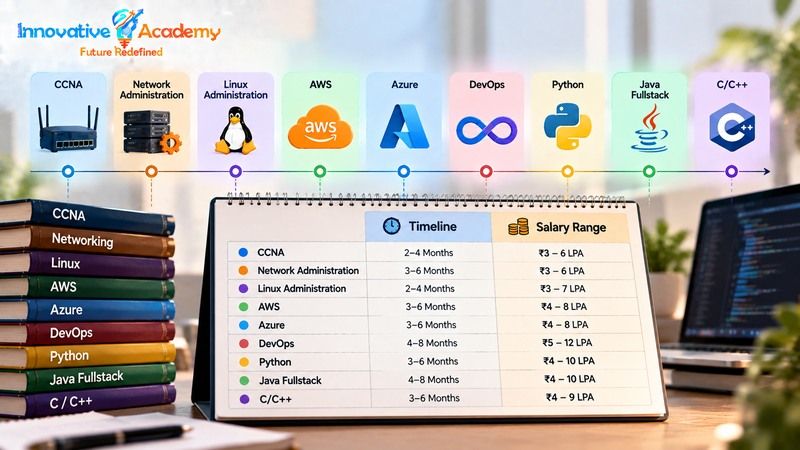
- The "2–3 Month Training" Line Doesn't Fit the Shortest or Longest Course
- The Salary Table Flattens Nine Very Different Starting Points
- "Hiring Partners... Abroad" and "No Limits" — Reading the Fine Print
- What Genuinely Holds Up Across All Nine
- A Better Way to Pick Among These Nine
- The Nine Courses at Innovative Academy, Individually
- FAQs
- Final Thoughts
1. Introduction
Bundling nine genuinely different IT courses — everything from a three-week Hardware & Networking fundamentals program to a full DevOps bootcamp — under one training timeline and one salary table is the kind of simplification that makes a pitch easier to write and harder to trust.
The courses themselves can be described individually, but the single blended numbers wrapped around all nine need more context. Training duration, entry-level roles, and starting salaries can vary significantly depending on the course and the role a learner targets.
For students comparing options, it is more useful to look at each course separately rather than assuming that one duration or salary range applies equally to every IT career path.
2. The "2–3 Month Training" Line Doesn't Fit the Shortest or Longest Course
Line these programs up by their individually stated durations, and "2–3 months" does not describe the full group accurately.
- Hardware & Networking: around three weeks.
- CCNA: around six weeks.
- AWS: around four weeks.
- Linux Administration: around four weeks.
- Azure: around twelve weeks at a lighter weekly pace.
- Python: around eight weeks.
- Java Full Stack: around ten to twelve weeks.
- DevOps Bootcamp: around six months.
That makes DevOps the clear duration outlier. A six-month bootcamp should not be presented as though it has the same timeline as a three- or four-week foundational program.
The safer approach is simple: check the specific course's current duration before enrolling. A broad "2–3 month" statement may sit somewhere near the middle of several programs, but it does not accurately describe the shortest or longest options.
3. The Salary Table Flattens Nine Very Different Starting Points
A single "Freshers: ₹3–6 LPA" range can make nine different career paths appear much more similar than they actually are.
Entry-level compensation depends on the job title, location, technical skills, employer, experience, and interview performance. The role a learner enters after training therefore matters as much as the course itself.
- Desktop Support and IT Helpdesk: entry-level compensation can fall below ₹2 lakh annually.
- Network Engineer: entry-level figures can be around ₹2.3 lakh in some datasets.
- NOC roles: can begin around the ₹2.4 lakh range.
- Linux Administration: entry-level roles can be around ₹2.5 lakh.
- Java development: entry-level compensation can move above ₹3 lakh depending on the role and employer.
- Python development: entry-level compensation can approach ₹4 lakh in some datasets.
- DevOps: entry-level compensation can be higher, although the actual role requirements are also more demanding.
- Cybersecurity: entry-level analyst roles can also command higher starting compensation depending on the employer and skill profile.
- Azure: salary figures need particular care because broad averages often include experienced professionals and should not automatically be treated as fresher salaries.
The important point is that salary tables should be treated as role-specific indicators rather than guarantees. A learner should compare the expected entry-level role, required skills, location, and experience level before using any salary figure to plan a career.
4. "Hiring Partners... Abroad" and "No Limits" — Reading the Fine Print
Two types of statements commonly need additional clarification when evaluating training and placement claims.
"Hiring Partners... Abroad"
A statement about hiring connections across Bangalore, Pune, Chennai, Hyderabad, Noida, and abroad can sound like an international placement pipeline. However, the word "abroad" by itself does not identify a specific country, employer, recruitment program, visa route, or guaranteed overseas opportunity.
A clearer interpretation is to distinguish between an institute's employer connections and graduates independently pursuing international opportunities after gaining experience.
"100% Job Assistance Until You Get Placed — No Limits"
Placement assistance and placement guarantees are not the same thing. Continued assistance can mean ongoing resume support, interview preparation, job referrals, employer communication, and interview opportunities.
However, the final hiring decision remains dependent on factors such as job availability, candidate skills, project experience, interview performance, employer requirements, and market conditions.
5. What Genuinely Holds Up Across All Nine
Several broader points remain useful when comparing these courses.
Not every course requires previous programming experience. Hardware & Networking, CCNA, AWS, Azure, and Linux are generally approached through conceptual and hands-on technical learning. Programming-oriented courses such as Python and Java can also be structured for beginners who are starting from the fundamentals.
IT skills are also relevant across a wide range of industries. Technology teams exist in sectors beyond traditional software companies, including finance, healthcare, retail, manufacturing, logistics, education, telecommunications, and professional services.
Hands-on practice is another important common factor. Labs, projects, troubleshooting exercises, cloud environments, coding assignments, and interview preparation can help learners turn theoretical knowledge into practical skills.
For learners exploring these paths, Innovative Academy's IT training programs provide different learning options across networking, cloud, Linux, programming, and DevOps.
6. A Better Way to Pick Among These Nine
Instead of asking which IT course is universally best, compare the options against your own starting point and career target.
If you need a shorter training period
Hardware & Networking, AWS, and Linux Administration are examples of programs that can be completed relatively quickly. Shorter training does not automatically mean higher starting pay, so expectations should be aligned with the entry-level roles associated with each program.
If you can commit two to three months
Python, Java Full Stack, and some networking or cloud pathways can provide more time for structured practice and project development. The right option depends on whether your target role is software development, networking, cloud administration, or another technical area.
If you are prepared for a longer program
DevOps requires a broader combination of Linux, networking fundamentals, cloud, automation, containers, orchestration, CI/CD, and infrastructure tools. A six-month program therefore represents a substantially larger learning commitment than a short foundational course.
7. The Nine Courses at Innovative Academy, Individually
Rather than applying one placement narrative to every program, it is more useful to consider the individual course structure and intended career direction.
- Hardware & Networking: approximately three weeks and 30 hours, focused on foundational hardware, networking, and troubleshooting skills.
- CCNA: approximately six weeks and 60 hours, focused on networking fundamentals and Cisco-oriented networking skills.
- AWS: approximately four weeks, covering core cloud concepts and AWS skills.
- Microsoft Azure: approximately twelve weeks and 40 hours, depending on the specific program structure.
- DevOps Bootcamp: approximately six months, covering a broader set of DevOps, cloud, Linux, automation, and infrastructure skills.
- Linux Administration: approximately four weeks, focused on Linux administration fundamentals.
- Java Full Stack: approximately ten to twelve weeks, covering frontend, backend, database, and Java development concepts.
- Python: approximately eight weeks, with programming fundamentals and practical development skills.
One common element across these programs is career-oriented support. Resume guidance, interview practice, project-based preparation, and employer interaction can help learners prepare for the recruitment process alongside technical training.
8. FAQs
1. Is "2–3 months" a reasonable training timeline to plan around?
Only for some programs. AWS and Linux can be completed faster, while Hardware & Networking and CCNA are also shorter than three months. DevOps, by comparison, is a substantially longer program. Always check the specific course duration rather than relying on a blended timeline.
2. Why can the ₹3–6 LPA fresher range be misleading?
Because different courses lead toward different entry-level roles. Desktop support, helpdesk, NOC, networking, software development, cloud, cybersecurity, and DevOps roles can have different compensation levels and requirements. A single salary range can therefore hide meaningful differences between career paths.
3. Does "hiring partners abroad" mean graduates receive international jobs directly?
Not necessarily. The phrase alone does not establish a direct international placement pathway. Students should ask which countries, employers, recruitment programs, visa arrangements, and placement processes are actually included.
4. Does placement assistance guarantee a job?
Placement assistance can provide ongoing career support, but assistance and a guaranteed job outcome are different concepts. Hiring decisions ultimately depend on employer requirements, candidate performance, available vacancies, and other market factors.
9. Final Thoughts
Nine different IT courses should not be reduced to one training timeline and one salary table. A three-week Hardware & Networking program and a six-month DevOps bootcamp represent very different learning commitments, career paths, and skill requirements.
The more useful approach is to evaluate each program individually: understand its duration, curriculum, practical work, target roles, entry-level expectations, and career support. That gives learners a clearer basis for choosing a course that matches their background, available time, and intended IT career path.