
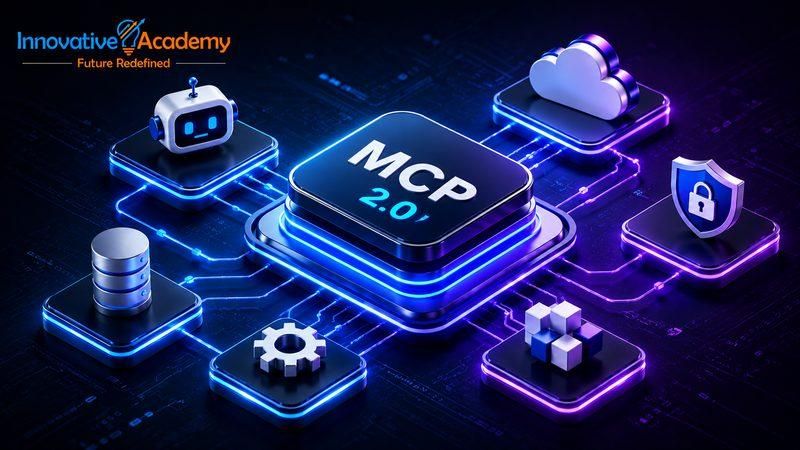

MCP's Biggest Rewrite Yet: What Changed and Why It Matters for Your Agent Stack
Table of Contents
- A Protocol You've Used Without Naming It
- Where the Old Design Started Breaking
- What Replaced It
- The Fine Print Worth Reading
- Why This Is a Platform-Team Story, Not Just an SDK Update
- Planning the Python SDK Migration
- Everything Else That Shipped in Python This Month
- Concluding Remarks
Ask most engineers building agent applications what MCP is, and you'll get a vague but accurate gesture: "the thing that lets the agent call tools." Fair enough—that's the whole point of good plumbing; you're not supposed to think about it.
This August, that plumbing got torn out and replaced, in the largest rewrite the Model Context Protocol has seen since it launched, and the change is worth understanding whether or not you've ever opened MCP's source code.
1. A Protocol You've Used Without Naming It
Chances are you've already encountered MCP through the back door. Our earlier piece comparing TrueForge to Claude Managed Agents flagged MCP-server support as one of the features separating an open, vendor-neutral harness from a single-provider managed service—and that's typical.
Nearly every serious agent framework at this point routes its tool-calling through MCP rather than reinventing its integration layer from scratch.
Protocols that win that kind of adoption tend to follow a predictable arc: they get designed for the use case in front of them, they succeed beyond that use case, and eventually something about the original design starts costing more than it saves.
MCP has reached that point.
2. Where the Old Design Started Breaking
The original protocol was session-based. A client opened a connection with a handshake and was handed a session ID. That ID carried the conversation's state for as long as the connection lasted—closer to a phone call than a text message, where the whole exchange happens on one continuous line, and everything either side says gets remembered because the same call is still open.
Phone calls don't scale well when you're running a call center instead of a single desk phone, though.
Once MCP servers started running behind load balancers and scaling out across many instances, that session state had to be stored somewhere accessible to every instance.
In practice, this meant either sticky routing so that a caller kept reaching the same instance, a shared store that kept every instance in sync, or both.
Neither is free. Both are precisely the kind of infrastructure tax that a stateless design wouldn't need to pay in the first place.
3. What Replaced It
The rewrite gets rid of the standing phone call entirely.
Every request now carries its protocol version and its own statement of client capabilities—nothing is inferred from something said earlier in a call that no longer exists.
When a client needs to know what a server supports, it asks directly, through a new server/discover call, rather than relying on information exchanged once during a handshake.
The team behind the change put the payoff in one sentence: "Any request can land on any instance, and a plain round-robin load balancer is sufficient."
Unpack that, and it means MCP servers can now be run exactly the way any garden-variety, stateless HTTP service is run—no sticky sessions, no shared state store, and no coordination between instances required.
Whichever instance happens to pick up a request can just answer it.
4. The Fine Print Worth Reading
The stateless shift gets the headline, but several smaller, more concrete changes ride along with it—the kind that won't make a slide deck but will absolutely surface the first time you try to integrate with the new version without reading the changelog first.
- No more handshake: The ceremony that used to open a session is simply gone; every request stands on its own.
- Two headers now have real significance: Servers are required to validate Mcp-Method and Mcp-Name on every incoming request—a more explicit, checkable contract than the old implicit session context provided.
- Errors follow a shared standard: A missing resource now returns JSON-RPC error -32602 instead of a bespoke error type, which makes MCP considerably easier to wire into tooling that already speaks JSON-RPC.
- Server-to-client requests changed shape: Roots, sampling, and elicitation—the mechanisms a server uses when it needs something back from the client mid-task—moved from callback-based patterns to result-based follow-ups, a much better fit once there's no persistent session to hang a callback on.
- The Tasks API has deliberately moved out of the core: What used to ship as part of the base specification is now an official extension, keeping the protocol's core surface smaller.
Every item on that list points the same direction: MCP servers are meant to behave like any other interchangeable, horizontally-scalable service now, not like a long-lived connection that has to remember who's calling.
5. Why This Is a Platform-Team Story, Not Just an SDK Update
If you're the person who actually keeps MCP servers running rather than the one calling them, this is where the rewrite stops being an interesting protocol detail and starts being an operational relief.
Session state was a genuine constraint at scale—like the configuration drift that plagues edge Kubernetes fleets once you're managing more instances than any one person can track by hand, where keeping shared state consistent becomes its own quiet, ongoing tax on a platform team's time.
Remove that constraint, and a few things get easier at once:
- Instances scale up and down purely on demand, with no session-migration step to choreograph first.
- A failed instance costs nothing in lost conversation state, because there's no state tied to any one instance to lose.
- Teams already deep in the agent-governance conversation can keep their governance layer focused purely on policy and access instead of also having to reason about session bookkeeping underneath it.
For engineers interested in the infrastructure side of scalable applications, understanding Linux administration, cloud infrastructure, containers, and DevOps becomes increasingly valuable. Explore the Innovative Academy training programs to see the available infrastructure and technology courses.
6. Planning the Python SDK Migration
Python usually gets the first SDK for any new agent framework, so it's no surprise the protocol rewrite arrived bundled with a major version jump—MCP's Python SDK moved to 2.0, and it isn't a soft, backward-compatible bump.
Here's what actually breaks:
- FastMCP has become MCPServer: There is no deprecation shim carrying old code forward—anything still importing FastMCP fails outright rather than warning first.
- Wire types switched to snake_case: So
isErroris nowis_error, which matches Python convention but means anything relying on the old casing needs a pass. - Client-side layers were unified: Three separate client-side layers collapsed into a single unified client object—a real simplification, but one that requires rewriting code built against the old structure.
- The HTTP layer changed: The SDK's HTTP layer moved to httpx2.
- McpError became MCPError: A one-character rename that a careless find-and-replace will absolutely miss.
None of this has to happen this week, though.
The 1.x line isn't disappearing—it's shifting into maintenance mode, so pinning mcp>=1.28,<2 keeps a team on security patches while they plan a proper migration instead of being forced into an emergency one.
If you're building your Python fundamentals alongside modern AI and cloud technologies, you can explore Python and other technology training programs at Innovative Academy.
7. Everything Else That Shipped in Python This Month
MCP wasn't the only thing moving this August, and a quick tour of the rest is worth having even if agent tooling isn't your team's focus.
Python 3.15 hit its final beta on July 18, with release candidates starting August 4.
Free-threaded Python is now the default direction the ecosystem is betting on—PyTorch 2.13 and JAX v0.11.0 both dropped experimental 3.13t support in favor of the more stable 3.14t.
A freshly submitted PEP 836 lays out a two-and-a-half-year roadmap for the JIT compiler, targeting a 20% performance gain by version 3.17—a real, multi-year commitment rather than a single tuning pass.
Tooling kept pace too: uv 0.12.0 now builds packaged projects by default via uv init, and Ruff 0.16.0 grew its default rule set from 59 rules to 413 while picking up the ability to format Markdown code blocks.
Model releases didn't slow down either, and it's useful background for anyone building against these systems through MCP: Claude Opus 5 shipped with thinking mode on by default; GPT-5.6 arrived across three variants with programmatic tool calling baked in; Gemini 3.6 Flash shipped lighter variants while its Pro release slipped; Meta's Muse Spark 1.1 became the company's first paid hosted API; Moonshot AI open-sourced the 2.8 trillion parameter Kimi K3; and Thinking Machines Lab—founded by former OpenAI CTO Mira Murati—shipped its debut model, Inkling.
8. Concluding Remarks
It's easy to treat a renamed error class or a snake_case conversion as routine SDK cleanup and move on.
The architecture underneath those details deserves more attention than that.
Rebuilding an entire protocol around stateless requests instead of stateful sessions is a statement about where agent infrastructure is expected to go next—toward the same load-balancer-friendly, horizontally scalable patterns ordinary web services settled on years ago, now applied specifically to the layer connecting AI agents to their tools.
Anyone building or evaluating agent infrastructure right now should treat this rewrite as a real signal, not a changelog entry to skim past.
Whatever harness or platform your agents sit on, the protocol underneath it just got noticeably easier to scale, and that alone is worth a line item on your next architecture review.
Getting comfortable reading past a changelog to the actual operational consequences of a decision like this—not just what changed, but why it will matter to how you run infrastructure six months out—is exactly the practical judgment Innovative Academy builds through its Python Development Training and technology programs in Bengaluru, paired naturally with DevOps and infrastructure learning.
For networking professionals who want to strengthen the infrastructure fundamentals behind scalable systems, the CCNA training program in Bangalore can also provide a strong foundation in networking concepts.
Linux administration training rounds out the systems-level grounding behind ideas like load balancing and horizontal scaling—the kind of hands-on IT training in Bangalore that turns "I read the changelog" into "I planned and executed the migration."