
Mastering Java: From Core Concepts to Advanced Development
Table of Contents
- 1. Introduction
- 2. Why Java Still Holds Up in 2026
- 3. Core Java: The Foundation You Actually Need
- 4. Advanced Java: What Job Postings Are Really Asking For
- 5. What This Actually Looks Like as a Career
- 6. Learning This in Bangalore
- 7. Conclusion
- 8. FAQs
1. Introduction
Java has been around long enough that it is tempting to treat it as a settled, unchanging subject—learn the syntax, learn object-oriented programming, and move on. That approach misses an important part of modern Java development. What counts as job-ready Java today looks noticeably different from what it looked like a decade ago, even though the core language fundamentals remain important.
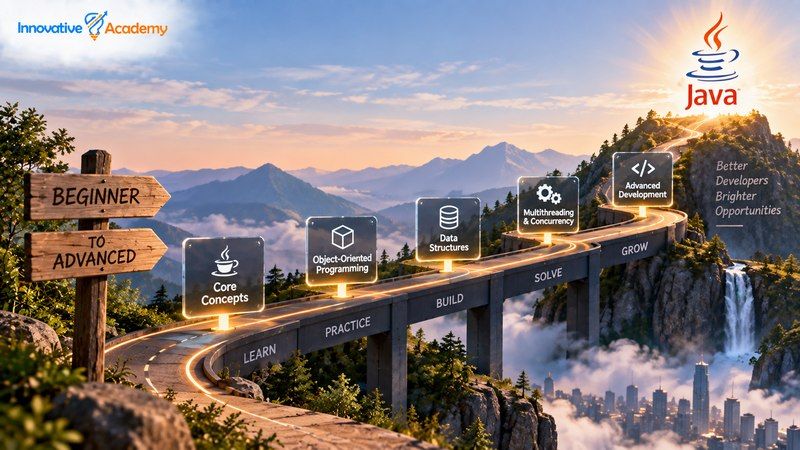
A strong Java learning path therefore needs both halves: the Core Java foundation that should not be skipped and the advanced, real-world development layer that determines how effectively you can build production applications.
2. Why Java Still Holds Up in 2026
Several factors continue to make Java relevant in modern software development.
Platform Independence
Java's platform-independent approach remains one of its defining strengths. Java applications run on the Java Virtual Machine (JVM), allowing organizations to deploy applications across different operating environments without rewriting the underlying application for each platform.
Predictable Release Cycle
Java has also developed a predictable release and long-term-support model. Java 25 became a long-term support release in September 2025, giving organizations a stable version around which they can plan development, maintenance, and security updates.
Large Enterprise Ecosystem
Perhaps the most practical reason Java remains relevant is the enormous amount of enterprise software already built with it. Banking platforms, insurance applications, e-commerce systems, enterprise applications, and backend services continue to depend on Java.
This combination of stability, backward compatibility, ecosystem maturity, and an extensive installed base continues to support demand for Java skills.
3. Core Java: The Foundation You Actually Need
Getting Started with Java
The first step is installing a current Java Development Kit (JDK) and becoming comfortable with an Integrated Development Environment (IDE). Eclipse and IntelliJ IDEA are widely used options.
It is also useful to understand Java's release model. Long-term support releases receive extended support and security updates, while non-LTS versions have shorter support periods.
Syntax and Basic Programming Constructs
Core Java starts with the fundamentals: data types, variables, operators, conditional statements, loops, switch statements, arrays, and string handling.
These concepts may appear simple, but they form the foundation for everything that comes later. Developers who rush through basic programming often encounter difficulties when they begin working with larger applications and frameworks.
Object-Oriented Programming
Object-oriented programming is central to Java development. Important concepts include:
- Classes and objects
- Constructors
- Encapsulation
- Inheritance
- Polymorphism
- Abstraction
- Interfaces
Learning the syntax is only part of the process. Understanding why these concepts exist and when to apply them is what helps developers design maintainable Java applications.
Exception Handling
Production applications inevitably encounter unexpected conditions. Java provides exception-handling mechanisms such as try, catch, finally, throw, and throws.
Developers should also understand how and when to create custom exceptions for application-specific situations.
File Handling and I/O
Java provides several APIs for working with files and input/output operations. Developers should understand text processing with classes such as FileReader and FileWriter, binary data using FileInputStream and FileOutputStream, and the fundamentals of serialization.
4. Advanced Java: What Job Postings Are Really Asking For
Modern Java development goes beyond the language syntax. Employers commonly expect developers to understand the Java ecosystem, frameworks, databases, APIs, build tools, and version control.
Collections Framework
The Java Collections Framework remains fundamental to application development. Important structures include:
- ArrayList
- LinkedList
- HashSet
- TreeSet
- HashMap
- TreeMap
- PriorityQueue
Understanding how these collections work and when to use them is essential for writing efficient Java applications.
Multithreading and Concurrency
Modern applications frequently perform multiple operations concurrently. Java developers should understand threads, the Thread class, the Runnable interface, synchronization, race conditions, executor services, and thread pools.
JDBC and Database Connectivity
Java applications frequently interact with relational databases. JDBC provides the underlying mechanism for database connectivity. Developers should understand connections, statements, PreparedStatement, result sets, and transaction handling.
Servlets and JSP
Servlets and JSP remain useful for understanding older Java web applications and the fundamentals underneath higher-level web frameworks. They can also be encountered when maintaining legacy enterprise applications.
However, modern Java web development commonly uses frameworks such as Spring and Spring Boot, which provide abstractions for dependency injection, configuration, request handling, and application development.
Spring and Spring Boot
Spring Boot has become an important part of the modern Java backend ecosystem. Developers can use it to create production-oriented applications while reducing configuration and boilerplate code.
Hibernate
Hibernate provides object-relational mapping, allowing developers to work with database data through Java objects rather than manually writing every database interaction.
Maven and Git
Maven is commonly used for dependency management and build automation, while Git and GitHub are important tools for source-code management and collaborative development.
RESTful APIs
Understanding how to create and consume REST APIs is an important skill for backend Java developers. REST APIs allow different applications and services to communicate through standard HTTP-based interactions.
Java Full Stack Development
For full-stack Java roles, backend knowledge is generally combined with frontend technologies such as HTML, CSS, JavaScript, and frameworks or libraries used for modern web interfaces. SQL and relational database knowledge are also important.
This combination moves a developer beyond simply knowing the Java language and toward building complete web applications.
5. What This Actually Looks Like as a Career
Java developer compensation varies significantly according to experience, location, company, technical skills, and project exposure. Salary figures should therefore be treated as indicative rather than guaranteed outcomes.
According to the figures referenced in this article, Java Developer compensation in India averages around ₹5.9 lakh per year, while professionals with less than one year of experience may typically start closer to ₹3–₹3.1 lakh annually.
With experience, developers who build deeper expertise in areas such as Spring, Spring Boot, Hibernate, databases, APIs, cloud platforms, and system development can access more advanced opportunities.
Real project experience also matters. Being able to explain how an application was designed, developed, tested, deployed, and maintained can be more useful in an interview than simply listing Java keywords on a resume.
6. Learning This in Bangalore
For learners looking for structured Java training in Bangalore, Innovative Academy provides a hybrid learning model with online and classroom options.
The Java curriculum progresses from Core Java fundamentals to Advanced Java and modern backend development technologies, including Spring Core, Spring Boot, Hibernate, Maven, Git, GitHub, and RESTful API development.
Learn more about the Java Full Stack Course in Bangalore at Innovative Academy.
Depending on the selected learning track, programs can include standard classroom batches, live online batches, fast-track options, and weekend schedules.
Practical Projects
Project-based learning can help students connect programming concepts with real application scenarios. Example projects include:
- E-commerce website backend
- Online banking system
- Inventory management system
Working on projects also gives learners practical examples to discuss during technical interviews.
Career and Placement Support
Career support can include resume preparation, mock interviews, aptitude and coding assessments, job referrals, and internship opportunities. Such support is intended to help students prepare for the transition from training to employment.
7. Conclusion
Mastering Java requires both strong fundamentals and practical development skills. Core Java provides the programming concepts and object-oriented thinking that everything else depends on, while advanced Java development introduces the frameworks, databases, APIs, tools, and practices used to build modern applications.
After establishing a strong foundation, learners can progress toward Spring Boot, Hibernate, REST APIs, databases, Git, Maven, and real-world projects. This approach provides a more complete understanding of what modern Java development involves.
8. FAQs
1. Is Java still worth learning in 2026, given how many newer languages exist?
Yes. Java continues to be used extensively in enterprise software, backend systems, financial applications, e-commerce platforms, and other large-scale applications. Its platform independence, mature ecosystem, long-term-support releases, and extensive existing codebase continue to make Java relevant.
2. Do I need to learn Servlets and JSP, or can I skip straight to Spring Boot?
Basic knowledge of Servlets and JSP can help you understand the foundations behind Java web development and legacy applications. However, learners targeting modern Java backend development should also focus on Spring and Spring Boot.
3. Realistically, how much time does becoming job-ready in Java take?
The timeline depends on your previous programming experience, learning pace, and the depth of the curriculum. Structured Java programs covering Core Java, Advanced Java, frameworks, and projects can typically take between two and six months depending on the chosen format.
4. What can I realistically expect to earn as a Java developer in India?
Compensation varies by experience, location, company, technical specialization, and project exposure. The figures referenced in this article place average Java Developer compensation around ₹5.9 lakh per year, with entry-level compensation often closer to ₹3–₹3.1 lakh. These figures are indicative and should not be treated as guaranteed salaries.