
Master AWS DevOps at Innovative Academy: An Honest Walkthrough of What's Actually Inside
Table of Contents
- 1. Introduction
- 2. Week by Week: What the 8 Sessions Actually Cover
- 3. The Tools You'll Actually Touch
- 4. The Projects, Not Just the Slides
- 5. How the DOP-C02 Certification Maps to This Course
- 6. Format, Placement, and Who This Is For
- 7. Conclusion
- 8. FAQs
1. Introduction
Most pages describing an AWS DevOps course lean on the same handful of sentences—cloud computing is transforming IT, DevOps engineers are in demand, and now is the time to act. All of that may be true, but it is not what you should focus on before committing two months of evenings to a program.
What actually matters is what you will be doing week to week, which tools you will leave able to use rather than simply recognize, and whether the certification the course points toward is realistic for your current experience level.
That is what this walkthrough covers for Innovative Academy's AWS DevOps training in Bangalore.
2. Week by Week: What the 8 Sessions Actually Cover
The program runs for 50 hours across eight weeks and is structured in three deliberate stages rather than as one flat list of topics.
Weeks 1–3: Building the Foundation
The first three weeks establish the technical foundation. Before working extensively with the AWS console, you work through core networking concepts, Linux fundamentals, and version control using Git and GitHub.
This sequence is important because much of the later DevOps work depends on being comfortable with a Linux shell and understanding how code moves through Git-based workflows. Building these fundamentals first can make later automation and deployment exercises easier to understand.
Weeks 4–6: The DevOps Core
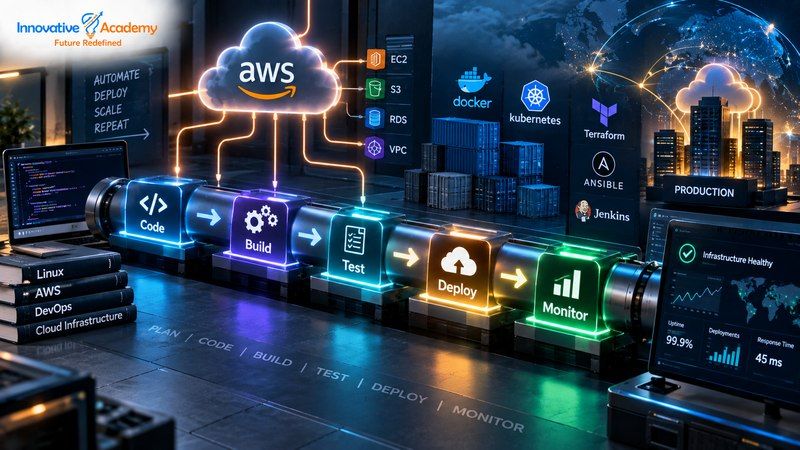
Weeks four through six move into the central DevOps topics. This stage introduces CI/CD pipelines and automation through hands-on exercises, AWS cloud fundamentals from a DevOps perspective, infrastructure as code, and configuration management.
Rather than treating these subjects as concepts alone, the course focuses on applying them through practical exercises and deployment workflows.
Weeks 7–8: Monitoring and Production-Oriented Work
The final two weeks cover monitoring, logging, and performance optimization before moving into real-world AWS DevOps projects and interview preparation.
This structure means the program does not end with another purely theoretical lecture block. The final stage connects the technical skills to projects and job-oriented preparation.
3. The Tools You'll Actually Touch
A curriculum outline tells you less than knowing which tools you will actually use during practical sessions. The AWS DevOps training covers a combination of development, automation, infrastructure, monitoring, and cloud tools.
- Git and GitHub: Source-code management and collaborative development workflows.
- Jenkins: CI/CD automation and deployment pipelines.
- Docker: Application containerization and packaging.
- Terraform: Infrastructure as code.
- Ansible: Configuration management and automation.
- Prometheus and Grafana: Monitoring, metrics, dashboards, and observability.
- VS Code: Development and configuration work throughout the training.
On AWS, the practical environment includes services such as EC2 for compute, S3 for storage, IAM for access control, VPC for networking, and Elastic Load Balancing for distributing application traffic.
The focus is therefore not simply on seeing a long list of AWS services once. The objective is to understand services and tools that are relevant to common DevOps workflows.
For learners comparing current course outlines with older material, source-control practices are also worth checking. AWS stopped accepting new customers for CodeCommit in 2024, making Git and GitHub an important part of a current source-control workflow.
4. The Projects, Not Just the Slides
The coursework builds toward multiple hands-on projects rather than relying on a single theoretical capstone.
- FinOps project: Practical AWS cost control and optimization.
- DevSecOps project: Integrating security checks into a CI/CD pipeline.
- Centralized logging and monitoring: Building monitoring and logging workflows.
- Docker on AWS: Containerizing and running workloads in an AWS environment.
- Kubernetes: Hands-on container orchestration exercises.
- Observability project: Monitoring application and infrastructure behavior.
- Final capstone: Deploying a production-style application using multiple DevOps components together.
The FinOps and DevSecOps components are particularly relevant for learners who want exposure beyond basic deployment. Cost management and security integration are increasingly connected to how cloud and DevOps teams operate in production environments.
5. How the DOP-C02 Certification Maps to This Course
The course concepts overlap with the skills assessed by the AWS Certified DevOps Engineer – Professional examination, commonly referred to as DOP-C02. However, completing a training program should not automatically be treated as equivalent to being ready for a professional-level certification exam.
The DOP-C02 exam covers six major domains:
- SDLC Automation: 22%
- Configuration Management and IaC: 17%
- Resilient Cloud Solutions: 15%
- Monitoring and Logging: 15%
- Incident and Event Response: 14%
- Security and Compliance: 17%
The exam contains 75 questions, with 65 questions contributing to the score. AWS positions the certification for experienced professionals, so candidates should distinguish between learning the underlying DevOps skills and meeting the experience level expected for a professional certification.
The course can provide a practical foundation for the technologies and workflows covered by the certification. However, anyone targeting DOP-C02 should plan additional hands-on practice and exam preparation after completing the training.
6. Format, Placement, and Who This Is For
Innovative Academy delivers the program through an AI-powered classroom model alongside online learning. This gives learners access to a structured training approach without requiring them to choose between classroom learning and remote participation.
No prior AWS or Linux experience is required to begin. However, familiarity with basic Linux commands, networking, or development concepts can make the initial sessions easier to follow.
The program also includes placement assistance focused on career preparation, including resume support, mock interviews, and project discussions.
Reported career outcomes include roles such as:
- AWS DevOps Engineer
- Cloud DevOps Engineer
- Site Reliability Engineer
- Cloud Operations Engineer
The training can be relevant to IT professionals moving toward DevOps, system administrators and network engineers adding cloud automation skills, developers interested in deployment pipelines, and graduates looking to build cloud-focused technical skills.
7. Conclusion
The useful way to evaluate an AWS DevOps course is to look beyond broad statements about cloud computing and career demand. The curriculum structure, practical tools, projects, AWS services, and level of certification preparation provide a clearer picture of what you will actually learn.
Innovative Academy's AWS DevOps program in Bangalore is structured around Linux, networking, Git, CI/CD, AWS, containers, infrastructure as code, configuration management, monitoring, security, and practical projects. Reviewing those specifics can help prospective learners decide whether the program matches their current skills and career goals.
For more information about AWS training programs, visit AWS Training in Bangalore at Innovative Academy.
8. FAQs
1. What's the total duration of this AWS DevOps course, and can I attend remotely?
The program runs for 50 hours across eight weeks. It is delivered through an AI-powered classroom model along with an online option, allowing learners to participate remotely.
2. Do I need prior AWS or Linux experience to join?
No. The program starts with fundamentals during the initial weeks. Familiarity with Linux or networking can be helpful, but it is not required to begin the training.
3. Does finishing this program mean I'm ready to sit the professional-level AWS DevOps exam?
The course develops hands-on skills related to areas covered by the DOP-C02 examination. However, AWS positions the professional-level certification for experienced practitioners. Learners should therefore plan additional real-world practice and certification preparation rather than assuming that completing eight weeks of training alone guarantees exam readiness.
4. What roles do graduates of this program actually go into?
Reported outcomes include AWS DevOps Engineer, Cloud DevOps Engineer, Site Reliability Engineer, and Cloud Operations Engineer roles. Placement assistance includes resume support, mock interviews, and project discussion preparation.