
Lovable Just Raised $400M For "Vibe Coding" — Are Coding Bootcamps Dead?
Table of Contents
- How Lovable Is Shifting the Paradigm of Software Development
- Why Lovable Raised $400 Million
- Does Vibe Coding Mean Everyone Can Be a Developer?
- What Are AI Coding Tools?
- Where AI Coding Tools Still Fall Short
- Why Coding Fundamentals Still Count
- Are Coding Bootcamps Over?
- How Coding Education Should Change
- The New Developer Skill Set
- Why Python and Java Still Count
- Why Cloud and DevOps Skills Matter More Than Ever
- Generative AI Is Entering the Development Process
- What Should Freshers Learn in 2026?
- How Innovative Academy Can Help
- The Future Is Not No-Code vs. Coding
- Conclusion
AI is changing how software gets built, and it is becoming a larger part of the development process every month.
Artificial intelligence can now turn a plain-language description of a website, application, or internal business tool into something that actually runs. Instead of writing hundreds of lines of code, you describe what you want, and the AI generates most of the implementation.
One of the companies leading this shift is Lovable.
On August 12, 2026, the Stockholm-based company closed a $400 million Series C at a $13.3 billion valuation — nearly double the $6.6 billion it reached in December 2025. Lovable is built on what has come to be called "vibe coding": using natural language prompts to build software with AI.
That raises a pointed question for anyone starting a career in software:
If AI can build apps from prompts, do we still need to learn how to code?
And a broader one for training institutes:
Is the coding bootcamp model finished?
There is one detail in the funding announcement that answers both questions better than any opinion could.
Lovable expects its headcount to grow from roughly 300 people to more than 450 by the end of 2026. Most of those new roles are in machine learning engineering, infrastructure, and cybersecurity.
So a company whose entire product is meant to reduce the need for programmers is spending part of its $400 million on hiring engineers.
The short answer: no, coding isn't dead. But how we teach it has to change.
The future isn't coding versus AI. It's coding, plus AI, plus a real understanding of software engineering.
How Lovable Is Shifting the Paradigm of Software Development
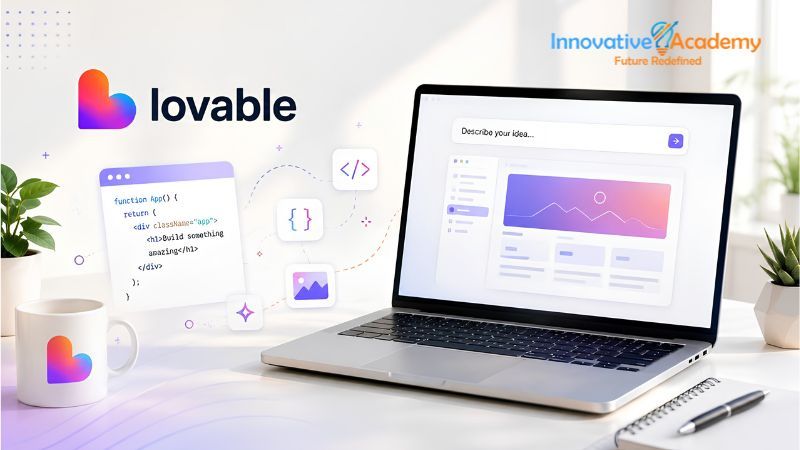
Lovable is an AI-powered software creation platform that lets people build applications through natural language prompts.
Instead of writing every line yourself, you describe the idea:
Build an online learning system with student accounts, course tracking, and an admin dashboard.
The AI then generates much of the application.
This approach — building software from conversational instructions — is what people mean by "vibe coding." The idea gained traction as AI coding tools became capable of producing increasingly complex software from plain descriptions.
Lovable's platform is designed for people without formal programming credentials to build working software. And it is being adopted at scale.
The company reports that about 60 million projects have been created on the platform, up from 25 million at its December funding round. Apps built on Lovable now average around 900 million visits a month. Annualised recurring revenue passed $500 million in June 2026, with the company targeting close to $600 million by the end of August.
Enterprise adoption is real too. Employees at more than two-thirds of Fortune 500 organisations now use the tool, up from roughly half six months earlier.
That isn't a side experiment. That is AI-assisted software development becoming a serious technology category.
Why Lovable Raised $400 Million
Investors are betting that AI-assisted development gets much bigger.
The Series C was co-led by Menlo Ventures and the EQT-managed Scaleup Europe Fund, with participation from Balderton Capital, Tencent, World Innovation Lab, and more than a dozen other investors. Menlo Ventures has described it as its largest single investment since Anthropic.
Lovable's rise is part of a wider movement. Replit, a competitor, reached a $9 billion valuation in March 2026, and OpenAI, Google, and Cursor all offer products in the same category.
The signal is clear: the market believes the way software gets made is changing.
But that does not mean traditional software engineering is disappearing. It means the developer's job is changing shape.
And it's worth noting that Lovable itself — founded in November 2024 — is now hiring machine learning engineers, infrastructure engineers, and security specialists to keep the platform running.
Somebody has to build the thing that builds the things.
Does Vibe Coding Mean Everyone Can Be a Developer?
This is where it gets more complicated.
Building software with AI is genuinely easier now. But building software and engineering software are not the same thing.
Anyone can use an AI tool to produce a website. But what happens when:
- The app has a security vulnerability?
- The database grows beyond what the design can handle?
- The application becomes slow under load?
- Two systems need to talk to each other?
- Different users need different permissions?
- The application needs to scale?
- An API goes down?
- The generated code has bugs?
- Customer data needs to be protected?
These are engineering problems. AI can help solve them, but you still need someone who understands what is happening underneath.
This distinction matters enormously for students.
AI makes it easier to write code. It does not reduce the need to understand what that code is doing.
What Are AI Coding Tools?
Modern AI coding tools can meaningfully accelerate development. They help developers:
- Generate code — describe a feature and get a first implementation
- Build interfaces — produce layouts, components, and frontend code from descriptions
- Debug problems — interpret error messages and suggest fixes
- Write documentation — generate comments, docs, and explanations
- Write tests — draft unit tests and test cases
- Build prototypes — turn an idea into something working, fast
- Explain existing code — help developers navigate unfamiliar codebases
This can dramatically reduce time spent on repetitive work. Which is exactly why companies are paying attention.
Where AI Coding Tools Still Fall Short
The most costly mistake is assuming this:
The AI produced the code, so the job is done.
It isn't. AI-generated code can still contain:
- Bugs
- Security vulnerabilities
- Poor architectural decisions
- Unnecessary complexity
- Performance problems
- Misunderstood requirements
- Dependency issues
- Technical debt
So the developer's role extends well beyond writing code. Increasingly, developers review, test, validate, debug, and improve what the AI produces.
That takes technical knowledge. AI is good at a first pass. A skilled person still has to judge whether the result is reliable, secure, maintainable, and actually solves the business problem.
This is why being able to read code still matters — even when most of it was written by a machine.
Why Coding Fundamentals Still Count
Picture two people with the same AI coding tool.
Person A understands variables, functions, data structures, object-oriented programming, databases, APIs, Git, debugging, and software architecture.
Person B understands none of it.
Both ask the AI to build the same application. Who is more likely to notice when something is wrong?
Person A. Every time.
Same tool. The difference is entirely in what the person knows.
Coding fundamentals let developers ask better questions, evaluate AI-generated code, and make sound technical decisions.
So learning to program is not wasted effort. But the reason for learning it is shifting. Students should learn how software works so they can use AI to build software more effectively — not so they can hand-write every line forever.
Are Coding Bootcamps Over?
No. But the old bootcamp model has to evolve.
A bootcamp that trains students to memorise syntax, copy tutorials, and build small apps without understanding the underlying technology will struggle in an AI-driven industry.
A modern program should teach:
Programming → Software Engineering → Tools → AI → Projects → Deployment
That's a far stronger combination.
Instead of spending an entire course hand-building one basic application, students should learn to:
- Understand the application's architecture
- Design the database
- Write the business logic
- Use AI to accelerate development
- Review the AI-generated code critically
- Test the application
- Debug what breaks
- Deploy it to the cloud
- Iterate against real requirements
That looks much more like how development actually works now.
Lovable's $400 million round does not prove coding is dead. It proves software development is changing quickly — and that the people building the tools still need deep engineering expertise.
The goal is to work with AI, not compete against it.
How Coding Education Should Change
What the future of coding education should not be:
Students don't need to learn to code, because AI will do it for them.
What it should be:
Students learn to code so they can direct AI effectively.
That distinction changes the entire learning path.
Old approach: Learn syntax → Write code → Build projects
Modern approach: Learn foundations → Understand architecture → Use AI → Review → Test → Deploy → Improve
The second path prepares students for a world where AI is simply part of the job.
The New Developer Skill Set
A modern developer needs a broader base than before.
1. Programming Foundations
Python, Java, JavaScript, C++, or C. The language matters; the concepts matter more.
2. Data Structures and Problem Solving
How data is stored, processed, and transformed. This underpins efficient programs, algorithms, debugging, technical interviews, and the ability to evaluate AI-generated solutions.
3. Databases
SQL, relational design, queries, indexing, and data relationships. AI can write SQL. Developers still need to judge whether the query is correct and efficient.
4. APIs
Modern apps rarely work in isolation. They talk to databases, cloud services, payment systems, authentication platforms, AI models, and third-party services.
5. Git and Version Control
AI can write code, but teams still have to manage it. Git, GitHub, branching, pull requests, merging, and history remain essential.
6. Cloud Computing
Applications increasingly run on cloud infrastructure. AWS or Azure training covers deployment, storage, compute, networking, security, and scalability.
7. DevOps
Writing an application isn't the end of the work. It has to be deployed, monitored, and maintained. CI/CD, Docker, Kubernetes, Jenkins, Terraform, and cloud infrastructure are important skills.
8. Generative AI
The newest layer. Designing effective prompts, using coding assistants, working with AI APIs, building AI-powered applications, evaluating AI output, debugging generated code, and integrating LLMs into real systems.
The new stack looks like this:
Coding + Cloud + DevOps + AI
Why Python and Java Still Count
You might assume programming languages matter less in an era of AI coding tools. They don't.
Languages are still how developers think about software.
Python dominates AI, machine learning, automation, backend development, data processing, and generative AI work. It's a strong foundation for both software development and AI.
Java remains central to enterprise applications, backend systems, APIs, financial technology, large-scale corporate platforms, and Spring Boot development.
AI can help you write Java faster. But knowing Java is what lets you read that output and improve it.
The distinction students need to hold onto: AI accelerates programming. It does not make programming knowledge less valuable.
Why Cloud and DevOps Skills Matter More Than Ever
This is where the Lovable story connects to a much larger career opportunity.
Building software is only half the picture. That software needs infrastructure:
Code → Cloud → Deployment → Network → Security → Monitoring
Which is exactly why cloud and DevOps skills remain in high demand.
A developer who can build an AI-powered application but can't deploy it still needs someone else to get it into production. A developer who understands programming, AI, cloud, and DevOps can work across far more of the IT lifecycle.
Lovable's own hiring plan makes the point. AI is getting genuinely good at building the application layer. Running that application reliably and securely at scale is a different problem — and one the company is hiring infrastructure and security engineers to solve.
Students shouldn't think of coding as an isolated skill. It's one component of a broader IT skill set.
Generative AI Is Entering the Development Process
Lovable's rise is part of a much bigger shift. Generative AI is becoming embedded in the fabric of software development.
AI can now help developers write code, explain code, refactor it, generate tests and documentation, debug applications, build prototypes, connect APIs, construct database queries, and create UI components.
Developers who ignore these tools will simply move slower than those who use them well.
But the opposite extreme carries real risk. Accepting AI-generated code without scrutiny is how vulnerabilities and technical debt get shipped to production.
The right balance:
Use AI for speed. Apply technical judgement to the decisions.
That may be the single most important principle of software development in the AI era.
What Should Freshers Learn in 2026?
If you're a fresher looking to enter software or IT, the fact that AI can write code is not a reason to panic. It's a reason to change what you learn.
A strong sequence looks like this:
- Learn a programming language
- Build computer science foundations — data structures, databases, APIs
- Do real projects, not just tutorial follow-alongs
- Learn to use AI as a development assistant
- Learn Git and GitHub
- Add a cloud platform — AWS or Azure
- Add DevOps — CI/CD, Docker, Kubernetes
- Learn generative AI integration
The real change is what you can claim at the end of it.
Instead of: "I can write code."
You can say: "I can build, deploy, and improve applications using modern development and AI tools."
How Innovative Academy Can Help
The goal isn't to prepare students for a world without AI. It's to prepare them for a world where AI is part of the job.
At Innovative Academy, our learning paths in programming, full-stack development, cloud, DevOps, networking, and generative AI are designed to build on each other rather than treat each technology as a separate career.
Java Full Stack
Core Java, Advanced Java, Spring Boot, SQL, HTML, CSS, JavaScript, Angular, and full-stack application development. The programming and application-development foundation you need to understand what AI coding tools are producing.
Python
A solid base for programming, automation, backend development, AI, generative AI, and data applications.
AWS and Azure
What happens after an app is built: how it gets deployed, managed, secured, and scaled.
DevOps
Build, test, deploy, monitor, improve. Git, GitHub, Jenkins, Docker, Kubernetes, Terraform, Ansible, and AWS.
Generative AI
How to embed modern AI capabilities into real software systems. (Launching soon.)
Together, that's a considerably stronger combination:
Programming | Full Stack | Cloud | DevOps | Generative AI
The Future Is Not No-Code vs. Coding
The debate around AI coding tools usually gets framed in overly simple terms. Either AI replaces developers entirely, or developers carry on exactly as before.
The reality sits somewhere in between.
AI will absorb more of the routine coding work. Developers will spend less time writing the same thing repeatedly. More people will be able to build software at all.
And developers will spend more time on architecture, requirements, problem solving, security, testing, validation, system design, product decisions, and reviewing AI-generated code.
Put differently: the value is shifting from writing code to understanding what the code needs to do.
Which makes software engineering knowledge more important, not less.
Conclusion
Lovable's $400 million round is a strong signal about where software development is heading.
People who could never build software before can now build applications by describing them. Developers can prototype faster. Companies can ship internal tools faster. Founders can test ideas without assembling a large engineering team.
But none of that makes programming knowledge obsolete. If anything, the opposite.
The clearest evidence is in the funding announcement itself: a $13.3 billion company built to make coding easier is spending the money to hire around 150 more engineers.
As AI writes more of our software, the value of people who understand how software works, how systems communicate, how applications are secured, and how infrastructure is operated can only rise.
Tomorrow's developer may not spend eight hours a day hand-writing code. They'll spend it designing, prompting, reviewing, testing, debugging, and deploying.
Which is why the right question was never "Is AI killing coding bootcamps?"
It's "Are coding bootcamps preparing students to work in an AI-driven software industry?"
Want to Build an AI-Ready Career in Software?
Don't learn to code as though AI doesn't exist.
Learn to code. Learn cloud. Learn AI. Learn DevOps. Build real things.
Explore the courses at Innovative Academy and choose the path that fits your current skills and where you want to end up.
Build the fundamentals. Use AI intelligently. Get hands-on experience. Prepare for what software development is becoming.
Funding and company figures are drawn from Lovable's Series C announcement of August 12, 2026, and related press coverage. Last updated: August 14, 2026.
```