
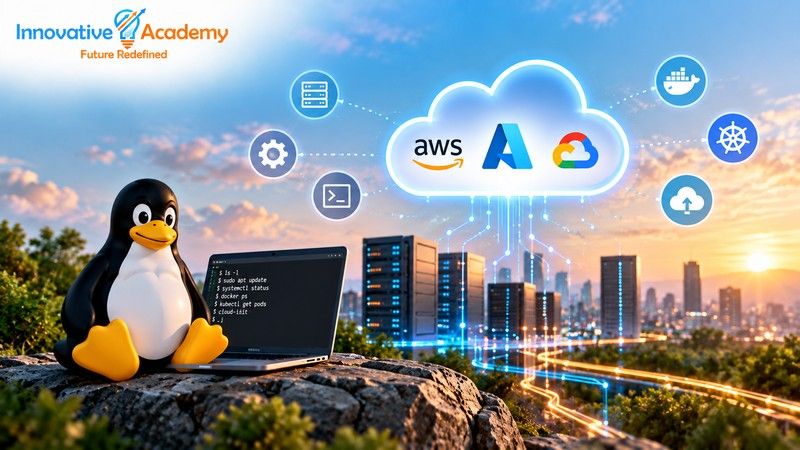

Linux + Cloud: The Combination That Actually Runs Modern IT
1. Introduction
"Linux plus cloud" gets pitched as a combination often enough that it is worth checking whether the argument actually holds up. It does—but the practical explanation is less about hype and more about infrastructure.
Many cloud workloads ultimately depend on operating-system-level concepts such as processes, permissions, networking, storage, services, logs, and security. Linux knowledge helps professionals understand what is happening beneath the cloud console and APIs.
Cloud platforms provide the infrastructure and services, while Linux provides one of the most widely used operating-system environments for running workloads. Understanding both can therefore create a stronger foundation for infrastructure, cloud engineering, and DevOps work.
2. Checking the Numbers Behind the Claim
The cloud computing market has grown into a massive global technology sector, with spending and infrastructure investment continuing to expand. This growth has increased demand for professionals who understand cloud platforms, infrastructure, networking, security, and operating systems.
Linux is particularly important in cloud and server environments. Public cloud platforms offer numerous Linux distributions, including Ubuntu, Amazon Linux, Red Hat Enterprise Linux, and others. Linux also dominates many areas of enterprise infrastructure, high-performance computing, containers, and cloud-native workloads.
The important point is not simply that Linux has a large infrastructure footprint. It is that Linux concepts repeatedly appear when engineers have to configure, troubleshoot, automate, secure, and monitor systems.
3. What's Actually Happening When You "Use the Cloud"
Take a concrete example: standing up a web server on an AWS EC2 instance. The AWS console can make provisioning an instance straightforward, but the work does not end when the virtual machine starts.
Linux Administration Inside a Cloud Instance
Installing a web server, managing users, configuring permissions, examining processes, checking logs, managing storage, configuring services, and troubleshooting connectivity are all common tasks performed inside a Linux environment.
Network security also becomes important. Engineers may need to understand ports, services, firewall rules, SSH access, DNS, routing, and system logs when diagnosing problems.
Automation and Cloud Operations
Cloud environments also depend heavily on automation. Shell scripting, infrastructure-as-code, containers, CI/CD platforms, and configuration management tools commonly operate in Linux-based environments.
Tools such as Docker, Kubernetes, Jenkins, and Terraform are widely associated with modern cloud and DevOps workflows. Learning Linux therefore gives learners useful context for understanding what these tools are actually interacting with.
For learners interested in building this foundation, the Linux Administration Training in Bangalore at Innovative Academy can be explored as a dedicated Linux learning path.
4. Where This Pairing Shows Up in Production, Concretely
Linux and cloud skills appear across a wide range of infrastructure scenarios. The scale may differ dramatically, but the underlying technical concepts are often similar.
Cloud-Based Web Applications
Web applications can run on Linux-based virtual machines or containers hosted by cloud providers. Engineers may be responsible for deployment, system configuration, monitoring, logging, security, and performance.
Enterprise Infrastructure
Large organizations frequently operate combinations of on-premises, private-cloud, and public-cloud infrastructure. Linux skills can be useful across these environments because the same operating-system concepts can apply across different infrastructure locations.
Containers and Kubernetes
Containerized workloads have become an important part of cloud-native infrastructure. Linux provides many of the underlying capabilities used by container environments, while orchestration platforms such as Kubernetes help organizations operate applications at scale.
Hybrid and Multi-Cloud Environments
Organizations may use multiple infrastructure environments for reasons including compliance, performance, resilience, cost management, and existing technology investments. Linux knowledge can provide continuity across these environments.
5. The Career Case, Without the Name-Dropping
The value of learning Linux and cloud computing is better understood through the technical responsibilities associated with the skills than through a list of famous company names.
Depending on experience and specialization, this combination can contribute to several infrastructure-focused career paths.
- Linux System Administrator
- Cloud Engineer
- DevOps Engineer
- Infrastructure Engineer
- Site Reliability Engineer
- Cloud Security Engineer
- Platform Engineer
- Technical Support Engineer
The specific requirements vary between employers. However, practical familiarity with operating systems, networking, cloud services, security, automation, and troubleshooting can provide a useful foundation for infrastructure-oriented roles.
Hands-on projects also matter. Being able to demonstrate that you can launch, configure, secure, monitor, and troubleshoot a cloud workload provides a more practical demonstration of ability than simply knowing cloud terminology.
6. Two Real Courses, Paired Deliberately
Linux and cloud do not have to be treated as one large subject. A structured approach can involve learning Linux administration first and then applying those fundamentals to a cloud platform.
Linux Administration Training
A Linux administration path can begin with fundamentals such as filesystems, users, groups, permissions, processes, storage, networking, services, scripting, and system security before moving toward more advanced administration and project work.
At Innovative Academy, the Linux Administration Training is designed around practical Linux administration concepts and RHCSA-oriented preparation.
AWS Cloud Training
Once Linux fundamentals are established, cloud training can introduce services such as compute, storage, networking, identity and access management, monitoring, and cloud security.
The AWS Training program in Bangalore at Innovative Academy focuses on AWS infrastructure and practical cloud concepts, including preparation aligned with the AWS Solutions Architect – Associate pathway.
Why the Sequence Matters
Learning Linux first can make cloud training easier to understand because learners already have a mental model for operating systems, services, permissions, networking, processes, and storage.
When those concepts appear inside an AWS environment, they are no longer completely new ideas. The cloud platform becomes an additional layer through which the learner applies skills they already understand.
Learners interested in extending this combination toward automation can also explore AWS DevOps Training in Bangalore , where cloud infrastructure is connected with DevOps practices and automation.
7. What's Actually Worth Watching Past 2026
The infrastructure landscape continues to change, but several developments reinforce rather than eliminate the importance of operating-system and cloud fundamentals.
Hybrid Cloud
Many organizations continue to operate a mixture of on-premises infrastructure and public-cloud services. Compliance, latency, legacy systems, data requirements, and operational considerations can all influence where a workload runs.
Edge Computing
Edge computing moves processing closer to where data is generated. Linux is widely used in embedded and edge environments because of its flexibility, hardware support, and ability to be customized for different workloads.
Serverless Computing
Serverless platforms such as AWS Lambda abstract much of the underlying infrastructure from developers. That does not mean operating systems have disappeared. Instead, many infrastructure responsibilities have moved behind managed services and platform abstractions.
Cloud-Native Infrastructure
Containers, Kubernetes, infrastructure-as-code, observability, automation, and platform engineering are continuing to shape how modern infrastructure teams work.
These developments make the fundamentals more useful rather than irrelevant. Understanding what happens underneath an abstraction can become particularly valuable when troubleshooting complex infrastructure.
8. FAQs
Do I need to learn Linux before starting cloud training?
Linux fundamentals are not an absolute prerequisite for every cloud course, but learning them first can make cloud concepts easier to understand. Knowledge of filesystems, permissions, processes, networking, services, and command-line administration becomes useful when working with cloud-based virtual machines and infrastructure.
Can I learn Linux and cloud computing together?
Yes. Beginners can study the two subjects in parallel, although a structured sequence can reduce the amount of new material being absorbed at the same time. A common approach is to establish Linux fundamentals first and then apply them through cloud labs.
Is RHCSA worth pursuing?
RHCSA can be useful for learners who want a structured Linux administration certification path. Its practical orientation can encourage learners to build hands-on skills rather than relying only on theoretical knowledge.
Which cloud platform should I learn first?
AWS, Microsoft Azure, and Google Cloud are all widely used cloud platforms. The best starting point can depend on the learner's target roles, existing knowledge, and the technology environment they want to work with.
Linux fundamentals remain transferable across cloud providers, so learning Linux well can provide a useful foundation regardless of which cloud platform is studied first.
Can Linux and cloud skills lead to DevOps?
Linux and cloud computing are both common foundations for DevOps work. Additional skills in Git, CI/CD, containers, Kubernetes, infrastructure as code, automation, monitoring, and security are typically required to build a broader DevOps skill set.
9. Final Thoughts
Linux gives IT professionals the ability to understand and operate systems, while cloud computing provides scalable infrastructure and managed services on top of that foundation.
Neither skill completely replaces the other. Understanding Linux can make cloud infrastructure easier to troubleshoot, secure, automate, and manage, while cloud knowledge shows how those infrastructure skills are applied at modern scale.
For learners building an infrastructure-focused career, studying Linux and cloud in a deliberate sequence can therefore create a practical foundation for roles across system administration, cloud engineering, infrastructure, DevOps, and related areas.
Explore Linux Administration Training , AWS Training , and AWS DevOps Training at Innovative Academy to build these skills through a structured learning path.