
Learning Python: An 8-Week Roadmap for Complete Beginners
1. Introduction
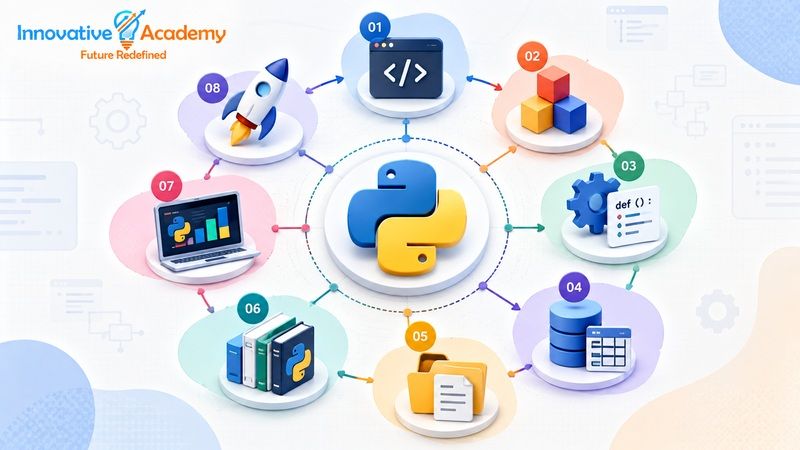
Most "learn Python" content describes a destination without a map—a list of topics to cover with no real sense of how much time each one deserves or what order actually works.
This is the map version: an eight-week roadmap that treats Python as something you build competence in deliberately, week by week, rather than something you absorb by browsing tutorials until it eventually clicks.
It's also honest about pace—eight weeks assumes real, consistent effort, not eight weeks of occasional browsing between other commitments.
2. Before Week One: Setting Expectations Honestly
Python's popularity makes it an attractive programming language for beginners, but that doesn't mean learning it requires no effort. Its readable syntax can make the first steps easier than many programming languages, but becoming comfortable with programming concepts still takes practice.
The important distinction is between being easy to start and being easy to master. This roadmap focuses on building practical skills gradually rather than trying to cover everything at once.
3. Weeks 1–3: Getting the Fundamentals to Actually Stick
Week 1: Python Fundamentals
Week 1 is about getting Python installed, writing your first working script, and building real comfort with variables, basic data types, and simple input/output.
These topics may seem basic, but the rest of the roadmap depends on having a strong understanding of them rather than rushing through them.
Week 2: Control Flow and Functions
Week 2 moves into control flow—if/else logic, loops, and the decision-making structures that turn a script from something that simply runs from top to bottom into a program that can respond to different situations.
Functions also become an important part of this stage. They help you organize reusable pieces of code and begin moving away from writing everything in one continuous block.
Week 3: Understanding Errors and Debugging
Week 3 closes out the foundation stage with an important but often-skipped topic: reading and reacting to errors.
Python error messages and tracebacks provide useful information about where a problem occurred and what kind of problem the program encountered. Learning to read a traceback instead of immediately searching for the answer is an important programming skill.
4. Weeks 4–6: Where Python Starts Looking Like Real Software
Week 4: Python Data Structures
Week 4 introduces Python's core data structures properly—lists, dictionaries, tuples, and sets.
Each structure has a different purpose. The goal is to understand when to use each one rather than automatically choosing a list for every problem.
Week 5: Object-Oriented Programming
Week 5 introduces object-oriented programming, including classes, objects, inheritance, and encapsulation.
OOP can represent a significant conceptual jump for beginners, so it is worth spending enough time understanding how objects and classes organize code instead of simply memorizing definitions.
Week 6: File Handling and Exception Management
Week 6 covers file handling and exception management. You learn how to read and write files and how to build programs that handle unexpected input more gracefully.
This stage helps Python programs move beyond simple classroom exercises toward scripts that can interact with real information and user input.
5. Weeks 7–8: Automation, a Real Project, and Getting Interview-Ready
Week 7: Automation and Practical Applications
Week 7 shifts from learning syntax to applying Python. This is a good point to work on practical automation tasks such as processing files, organizing information, or retrieving data from external sources.
The objective is to use Python to solve a repetitive or practical problem rather than simply completing another isolated coding exercise.
Week 8: Capstone Project and Interview Preparation
Week 8 is capstone territory. The objective is to combine the skills developed during the previous seven weeks into one coherent project.
Alongside the project, interview preparation can cover Python fundamentals, problem-solving questions, debugging, explaining your project, and discussing the decisions you made while building it.
6. Five Small Projects Worth Slotting In Along the Way
You don't need to wait until week eight before building something practical. Small projects provide an opportunity to test whether the concepts you've learned are actually sticking.
1. Basic Calculator
A basic calculator fits naturally around week two, once functions and control flow are in place.
2. Weather API Project
A small script that retrieves weather information from a public API is useful around weeks four or five, once you're comfortable working with dictionaries and structured data such as JSON.
3. Task Tracker
A task-tracking application that saves information to a file is a natural project after learning file handling in week six.
4. News Headline Scraper
A simple scraper that retrieves headlines from a suitable news page can fit naturally into week seven alongside automation concepts.
5. Quiz Game
A small quiz game built around clean, reusable functions works well during weeks two through four. It provides a simple way to check whether the fundamentals are becoming comfortable.
7. The Habits That Separate Week 8 Success from Week 8 Frustration
Type Code Instead of Only Watching
Typing code out by hand instead of copying it helps develop familiarity with syntax and coding patterns. Reading a solution and then writing your own version is more useful than passively watching someone else program.
Learn to Read Error Messages
Treat error messages as useful information rather than as a sign of failure. Python tracebacks can show where a problem occurred and often provide clues about what needs to be fixed.
Don't Rush Into Frameworks
Jumping into frameworks such as Django or Flask too early can add another layer of complexity before the core Python concepts are comfortable. Build a strong foundation first.
Practice Problem-Solving Regularly
Short and consistent coding-practice sessions throughout the eight weeks can help reinforce concepts more effectively than leaving all problem-solving practice until the end.
8. What Eight Weeks of Real Effort Actually Buys You
By the end of a genuinely consistent eight weeks, a beginner should be able to write functioning Python scripts from scratch, organize code using functions and classes, work with common data structures, handle files and errors, and complete at least one practical project.
That foundation can provide a starting point for several technology directions, including data analysis, machine learning, backend development, and automation-focused roles. Further learning and hands-on experience are still necessary for specialization.
Salary outcomes vary significantly by location, experience, employer, role, and technical skills, so an eight-week learning period should be viewed as a foundation rather than a guarantee of a particular salary or job title.
9. Following This Roadmap at Innovative Academy
This eight-week learning structure can also be followed through structured instructor-led training. At Innovative Academy's Python Training in Bangalore , learners can work through Python concepts with guided instruction and practical lab sessions.
A structured learning environment can be particularly useful for beginners who benefit from instructor guidance, practical exercises, doubt clarification, and a defined progression through the syllabus.
The broader goal is to move beyond isolated syntax exercises and develop the ability to build and explain practical Python projects.
10. FAQs
Is eight weeks realistic for someone starting from genuinely zero coding experience?
Yes, provided the effort is consistent. A few focused hours most days, combined with regular coding practice, can provide a realistic foundation. The exact pace depends on your previous experience and the amount of time available each week.
What if I fall behind the schedule in a given week?
It is better to understand the current material properly before moving ahead. Later topics such as object-oriented programming depend on earlier concepts, so strengthening weak fundamentals can save time later.
Do I need to know which career direction I want before starting?
No. The first several weeks focus on transferable Python fundamentals. Once you understand the basics, you can explore directions such as automation, backend development, data analysis, or machine learning and choose projects that match your interests.
Can I learn Python without a programming background?
Yes. Python is commonly used as a first programming language because its syntax is relatively readable. However, beginners still need consistent practice with programming logic, debugging, functions, data structures, and problem-solving.
What projects should a beginner build while learning Python?
Start with small projects such as calculators, quiz applications, task trackers, API-based applications, and simple automation scripts. The projects should gradually become more complex as your skills improve.
11. Final Thoughts
An eight-week roadmap only works if the weeks build on each other honestly. Rushing the fundamentals to reach more advanced topics can make later learning unnecessarily difficult.
Follow the sequence, build small projects along the way, practice regularly, and learn from your errors. By week eight, "learning Python" can become something much more concrete: a foundation of practical programming skills that you can demonstrate through working projects.
If you prefer structured instructor-led learning, explore Python Training in Bangalore at Innovative Academy for a guided approach to learning Python and developing practical skills.