
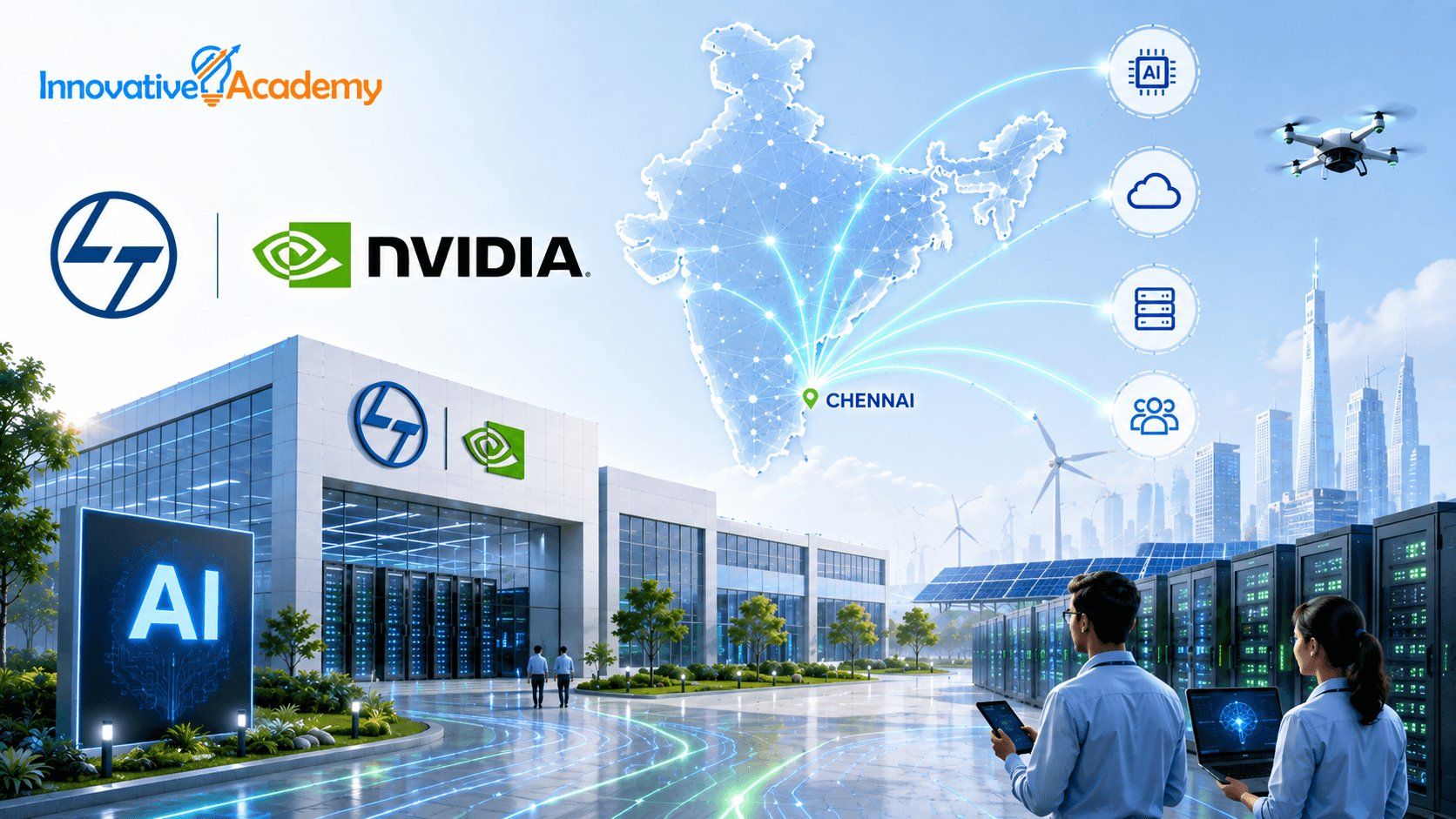

L&T's AI Expansion: What It Could Mean for India's IT Professionals
Table of Contents
- The AI Boom Needs More Than AI Engineers
- What L&T's Chennai Project Tells Us
- The IT Roles Behind AI Infrastructure
- Why Traditional IT Skills Still Matter
- Where Networking and Cloud Skills Fit
- Adapting Your IT Skills for the AI Era
- What This Does Not Mean for Jobs
- The Bigger Career Picture
- Final Takeaway
The AI Boom Needs More Than AI Engineers
When a company announces a major AI investment, it is easy to think about machine learning engineers first. But an AI system cannot run on models alone. Before an AI application can answer a question or generate an image, an enormous amount of infrastructure has to work properly.
There are servers to maintain. Networks have to move data between systems. Storage has to handle large workloads. Cloud platforms have to provide computing resources. Operating systems need to be configured and monitored. Security teams need to protect the environment. And all of it has to remain available while consuming huge amounts of power.
That creates an important career opportunity. AI is expanding the technology stack rather than simply replacing it.
What L&T's Chennai Project Tells Us
L&T's Chennai project is being developed for Together AI, a company that provides cloud infrastructure for AI development and deployment. The scale of the planned facility shows how much computing capacity companies are beginning to require as AI workloads grow.
The development is another step in L&T's growing presence in the AI infrastructure space.
This matters for India because the country has traditionally been strongest in the software and services side of technology. A growing AI infrastructure ecosystem adds another layer:
Software + Cloud + Networking + Hardware + Data Centres + AI.
This combination can change the types of technical skills companies look for. Future IT roles may require more than coding—they may demand an understanding of how infrastructure, cloud, and software interact.
The IT Roles Behind AI Infrastructure
Think about an AI data center as a large technology ecosystem rather than a room full of GPUs.
Network Engineers
Thousands of computing systems need to communicate efficiently. That makes networking an essential part of the environment. Professionals with knowledge of routing, switching, network security, troubleshooting, and data center connectivity can build toward more specialized infrastructure roles.
Cloud Engineers
AI workloads can require substantial computing resources. Cloud engineers help organizations provision and manage those resources while dealing with storage, networking, security, and scalability. Cloud knowledge can therefore become useful well beyond traditional web applications.
DevOps Engineers
AI applications still need deployment pipelines, monitoring, automation, and reliable infrastructure. DevOps professionals can help connect development teams with the infrastructure required to put applications into production. Skills such as CI/CD, containers, infrastructure automation, and monitoring can become especially useful.
Professionals who want to build these capabilities can explore AWS DevOps training in Bangalore as one possible pathway into cloud and automation-focused roles.
Linux Administrators
Many infrastructure environments rely on Linux. That makes Linux administration a valuable foundation for people moving into cloud, DevOps, and infrastructure roles.
Cybersecurity Professionals
More infrastructure also means more systems that need protection. As AI becomes part of business-critical operations, security teams will need to think about networks, cloud environments, identities, servers, applications, and sensitive data.
Hardware and Infrastructure Specialists
AI computing also brings the physical layer into focus. Servers, GPUs, power systems, cooling equipment, and data center facilities all need specialized professionals. This is one reason the AI infrastructure economy is broader than the software industry alone.
Why Traditional IT Skills Still Matter
There is a common misconception that the rise of AI means older IT skills are becoming irrelevant. The opposite can often be true.
Consider networking. AI may be new, but computers still need to communicate.
Consider Linux. AI workloads still need operating systems.
Consider cloud computing. AI applications still need infrastructure on which to run.
Consider cybersecurity. AI systems still need protection.
The technology at the top of the stack may change quickly, but the underlying principles remain important.
This approach gives existing IT professionals a potential advantage. Instead of abandoning their current skills, they can add new capabilities on top of them.
For professionals looking to strengthen their networking foundation, CCNA training in Bangalore can provide a structured path into networking concepts that remain relevant across modern IT environments.
Where Networking and Cloud Skills Fit in the AI Era
Imagine two professionals. The first knows networking but has never worked with cloud environments. The second understands networking and has also learned cloud architecture, automation, and AI infrastructure concepts. The second professional has a wider range of potential roles.
The same applies to other career paths.
- Linux + Cloud can lead toward infrastructure and DevOps.
- Networking and security can lead toward cloud security.
- Cloud + DevOps can lead toward automated infrastructure.
- Python and automation can support AI and technology operations.
This is why the AI shift may be less about completely new careers and more about new combinations of existing skills.
Adapting Your IT Skills for the AI Era
You don't need to learn every AI technology currently available. A more practical approach is to start with a strong technical base and then expand toward the areas that interest you.
Starting with Networking?
Build fundamentals in routing, switching, network security, the CCNA program, and troubleshooting before moving toward cloud or advanced infrastructure.
Innovative Academy's CCNA program focuses on routing, switching, network security, and Cisco technologies, with hands-on labs and projects.
Interested in Cloud?
Cloud skills can help you understand how computing resources are provisioned, connected, secured, and scaled. Innovative Academy offers an AWS training program covering AWS infrastructure and cloud-related skills.
Thinking About DevOps?
DevOps is particularly relevant because modern infrastructure depends heavily on automation. Innovative Academy's AWS DevOps Engineering program covers areas including CI/CD, cloud infrastructure, automation, monitoring and Infrastructure as Code.
The academy also offers a broader DevOps Engineering Bootcamp covering networking, Linux, AWS, CI/CD, Docker, and Kubernetes.
Want a Stronger Infrastructure Foundation?
Linux and networking can provide useful foundations before moving into more advanced cloud and DevOps roles. Innovative Academy's current portfolio includes Linux Administration, Networking Fundamentals, Hardware and Networking, CCNA and CCNP programs.
Interested in Security?
As cloud and AI infrastructure expands, security is increasingly important. Innovative Academy also offers Microsoft Azure Security training for learners interested in developing cloud-security skills.
You can see the complete range of programs on the Innovative Academy Programs page.
What This Does Not Mean for Jobs
It would be a mistake to interpret the L&T project as proof that AI will suddenly create huge numbers of jobs for everyone.
AI infrastructure is expensive and increasingly automated. A large facility can require significant investment without employing an equally large permanent workforce. Some of the opportunities will also be highly specialized.
Working with large GPU clusters, advanced data center systems, or AI platforms requires knowledge that goes beyond basic IT training.
There is also another important distinction.
Scale: Investment in infrastructure does not automatically equal immediate hiring. Projects can take years to build, scale, and become fully operational.
So the better conclusion is not that "AI will create jobs for everyone." It is the following:
The growth of AI is creating new technical environments, and professionals with relevant skills will be better positioned to work in them.
The Bigger Career Picture
L&T's Chennai AI project offers a useful way to think about India's technology future.
The country already has millions of professionals working across software, IT support, networking, cloud, and infrastructure. As AI adoption grows, many of those careers can evolve.
- A network engineer could move toward cloud networking.
- A Linux administrator could transition into DevOps.
- A cloud professional could specialize in AI workloads.
- A security professional could move into cloud and AI security.
- A Python developer could build AI-powered applications.
The key is to keep developing your skills. You don't necessarily need to throw away what you already know. You need to understand where your current skills fit into the next generation of technology.
Professionals who want to build a broader cloud foundation can also explore AWS cloud training in Bangalore and combine cloud knowledge with networking, Linux, automation, and DevOps skills.
Final Takeaway
The most important thing about L&T's NVIDIA AI Factory isn't simply the ₹10,000–15,000 crore figure. It is the ecosystem that must exist around the AI computing itself.
Networks have to connect it. Cloud platforms have to support it. Linux and infrastructure systems have to run it. DevOps teams have to automate it. Security professionals have to protect it. And skilled technology professionals have to keep everything working.
That creates an exciting opportunity for India's IT workforce. The AI era may not mean starting your career over. It may mean taking the IT skills you already have and making them relevant to the infrastructure powering AI.
If you're planning that next step, explore Innovative Academy's programs and choose a technical path that matches the career you want to build.
This article is based on publicly available information and reporting as of August 2026. Project values, infrastructure plans, and timelines may change as development progresses.