
Java Just Lost More Ground to C++ on the Language Rankings—Does That Actually Matter If You're Learning Java?
1. Introduction
A language-ranking swing makes for an unambiguous, alarming headline: Java is losing ground, C++ is closing in, and maybe it's time to reconsider. September's TIOBE index gives that headline real numbers to point to.
What it doesn't automatically tell you—and what's worth checking before anyone treats a ranking shift as career advice—is whether that specific number has anything to do with jobs, pay, or actual demand for either language.
For someone considering Java vs C++ in 2026, the more useful question is not simply which language moved up or down in a monthly ranking. It is what the ranking actually measures and whether that measurement corresponds to the career path you're considering.
2. What Actually Happened in September's Rankings
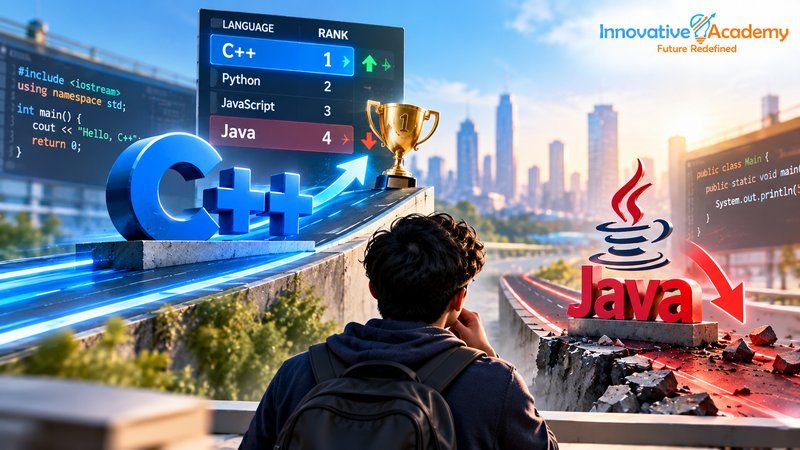
TIOBE's September 2026 index shows Java's rating falling to 7.54%, while C++ climbed to 8.67%. That creates a gap of 1.13 percentage points after the two languages had nearly converged the previous month.
Python continues to lead the overall index, although it also eased slightly to 17.76%, while C remained in third place.
Importantly, the overall top 10 languages remained the same as in August. What changed was the internal ordering and the size of the gaps between individual languages.
That distinction matters because a change in ranking position does not automatically represent a corresponding change in employment opportunities, salaries, or the amount of production software built with a language.
3. What TIOBE's Own Creator Says It Measures
Before reading too much into the gap between Java and C++, it is worth looking at how TIOBE describes its own methodology.
TIOBE's CEO has explained that the index is not intended to identify the "best" programming language. Instead, it reflects programming-language popularity based on signals such as search engines, websites, course listings, and online mentions.
In other words, the index is better understood as a measure of attention and visibility than as a direct measurement of employment demand.
Why That Distinction Matters
Developers searching for tutorials, students looking for courses, vendors discussing technologies, and engineers researching programming languages can all influence the signals that feed into a popularity index.
Those activities are useful indicators of interest, but they are not the same thing as measuring job vacancies or production deployments.
4. What the Index Explicitly Does Not Measure
This is perhaps the most important point when interpreting the September ranking.
TIOBE itself makes clear that its index is not a list of programming languages with the most code written. Therefore, the ranking does not directly tell you:
- How many companies currently maintain Java applications.
- How many production systems use Java or C++.
- How many job openings require Java or C++.
- How many developers are employed using either language.
- Which language provides the highest salary.
A language can therefore move up or down because of changes in online attention, tutorials, courses, discussions, or other signals without companies suddenly abandoning that technology.
Treating a TIOBE movement as a verdict on which programming language someone should learn applies the index to a question it was not designed to answer.
5. Checking It Against Something That Actually Matters: Real Pay
If the goal is to understand whether Java or C++ represents a viable career option, compensation data provides a more direct career-related signal than a programming-language popularity index.
PayScale's India figures for Java Developer and C++ Developer roles put the average annual compensation for the two roles very close together, with Java Developer compensation reported at just under ₹5.9 lakh per year and C++ Developer compensation at approximately ₹5.96 lakh per year.
The entry-level figures are similarly close. First-year Java Developer compensation is around the ₹3 lakh to ₹3.1 lakh range, while first-year C++ Developer compensation is approximately ₹3.09 lakh.
These figures should not be interpreted as a guarantee of salary. Actual compensation varies by experience, location, company, technical skills, role, and other factors.
More importantly, the numbers illustrate why a monthly TIOBE movement should not automatically be interpreted as a salary or employment trend.
6. So Why Did Java Slip At All?
TIOBE's commentary around the September cycle points toward gradual changes in attention rather than one event that suddenly damaged Java's position.
Python, C, and several other languages have continued to attract attention, while Rust has maintained its position in the top 10 and Julia has been moving toward the top 20.
None of that should automatically be interpreted as companies migrating existing Java applications to C++. Enterprise software migrations are complex projects involving architecture, infrastructure, application dependencies, developer skills, testing, and significant costs.
Java also has a substantial installed base across enterprise applications, backend systems, financial technology, and other large-scale software environments. A monthly popularity-index movement does not by itself indicate that those systems are disappearing.
A Ranking Change Is Not the Same as a Technology Migration
This distinction is especially important for students. A programming language can lose percentage points in an online popularity index without losing an equivalent percentage of real-world enterprise usage.
7. What This Means If You're Choosing Between Java and C++
A more useful way to compare Java and C++ is to look at the kinds of software development each language is commonly associated with rather than treating the TIOBE ranking as a tiebreaker.
Where C++ Fits
C++ provides fine-grained control over memory and system resources and is widely associated with performance-sensitive software, embedded systems, operating-system components, game engines, and other applications where low-level control is important.
Where Java Fits
Java is widely used in enterprise backend development and has a substantial ecosystem around frameworks such as Spring and Hibernate. It is also part of many large-scale application environments and remains relevant to full-stack development.
For a beginner, the choice should therefore be based on the type of development they want to pursue, their learning objectives, and the technologies they intend to build alongside the language.
Java vs C++ in 2026: The Practical Question
The September TIOBE ranking alone does not establish that C++ has become a better career option than Java. It measures a different kind of signal.
If your goal is enterprise backend or full-stack development, learning Java alongside technologies such as Spring, databases, REST APIs, Git, frontend fundamentals, and deployment tools can provide a much more relevant learning path than focusing on one monthly ranking.
8. Learning Java at Innovative Academy
If you're looking for structured Java training in Bangalore, Innovative Academy offers Java Full Stack training designed around programming fundamentals, application development, and the broader skills required for modern software development.
You can explore the program here: Java Full Stack Course in Bangalore .
A practical Java learning path should go beyond syntax. Students can benefit from working with object-oriented programming, databases, backend frameworks, APIs, frontend technologies, version control, projects, and interview preparation.
The goal should be to develop skills that can be demonstrated through projects and technical discussions rather than simply following a programming-language ranking.
9. FAQs
Does Java's slip on the TIOBE index mean fewer companies are hiring for it?
Not directly. TIOBE measures programming-language popularity using signals such as search activity and other online indicators rather than directly counting job vacancies or deployed production code. A monthly ranking movement therefore should not be treated as a direct hiring report.
Should a beginner pick C++ over Java because C++ is gaining ground on the index?
The TIOBE movement alone does not provide enough information to make that conclusion. C++ and Java are used in different areas of software development, so the better starting point depends on the learner's goals, interests, and intended career path.
How often does the TIOBE ranking change?
TIOBE publishes its programming-language index monthly. Because the index reflects popularity-related signals, rankings can change even when the underlying production use of a language has not changed by the same magnitude.
Is Java still worth learning in 2026?
The September 2026 TIOBE movement by itself does not establish that Java has become irrelevant. Java continues to have a significant ecosystem around enterprise and backend development. Learners should evaluate the complete technology stack, job requirements, project opportunities, and their own career goals rather than relying on a single monthly index.
Is Java better than C++?
The two languages serve different technical purposes, so a single ranking cannot establish one as universally better. Java is commonly associated with enterprise and backend development, while C++ is widely used where performance, resource control, and lower-level system access are important.
10. Final Thoughts
A widening percentage-point gap on a monthly programming-language index makes for an attention-grabbing headline, but the methodology behind the index matters just as much as the ranking itself.
TIOBE's stated approach focuses on programming-language popularity signals, including online searches and related activity. It is not designed to directly measure job postings, deployed code, or developer salaries.
That makes the September 2026 movement worth noticing, but not something that should independently determine whether someone learns Java.
For learners deciding between Java and C++, a more useful approach is to compare the technologies, development areas, learning requirements, projects, and career paths associated with each language.
In short, Java's TIOBE ranking slipped, but that fact alone does not answer whether Java is worth learning in 2026.