
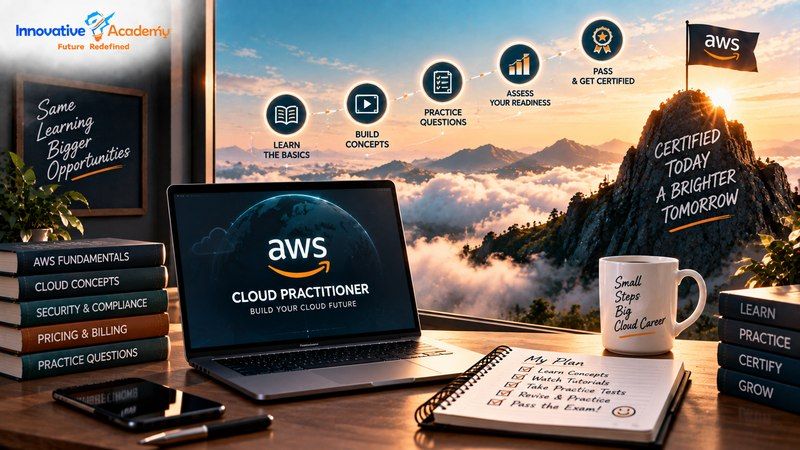

How to Pass the AWS Cloud Practitioner Exam
Table of Contents
- What Is the AWS Cloud Practitioner Certification?
- What Does the Exam Actually Test?
- Eligibility and Exam Format
- How to Actually Pass the Exam
- FAQs
The AWS Cloud Practitioner certification is one of the most accessible ways to build a foundation in cloud computing and Amazon Web Services (AWS). If you're preparing for the AWS Cloud Practitioner exam, a structured study plan can help you understand the core concepts and approach the exam with greater confidence.
This guide explains what the certification covers, what you can expect on exam day, and how to prepare effectively.
1. What Is the AWS Cloud Practitioner Certification?
The AWS Certified Cloud Practitioner certification provides a foundational understanding of AWS Cloud concepts, services, terminology, security, pricing, and basic cloud architecture.
It can be a useful starting point for people from both technical and non-technical backgrounds. You do not need to be an experienced cloud engineer or developer to begin learning AWS at this level.
Professionals such as system engineers, network engineers, developers, sales professionals, marketers, and IT managers may pursue the certification to develop a basic understanding of AWS and cloud computing.
The certification can also serve as a foundation before moving toward more advanced, role-based AWS certifications.
2. What Does the Exam Actually Test?
The AWS Cloud Practitioner exam focuses on fundamental cloud concepts and an overall understanding of the AWS platform. It is not designed to make you an experienced AWS developer, architect, or administrator. Instead, it establishes whether you understand the fundamental concepts required to work with AWS Cloud.
The exam evaluates your ability to:
- Describe the core features of deploying and operating in the AWS Cloud.
- Identify where to find AWS technical support and documentation.
- Explain fundamental AWS security and compliance concepts.
- Understand the AWS Shared Responsibility Model.
- Explain fundamental principles of AWS Cloud architecture.
- Identify AWS cloud best practices.
- Understand AWS pricing, billing, and account management.
- Describe the AWS Cloud platform and its underlying architecture at a high level.
Key Areas to Study
When preparing for the exam, pay particular attention to cloud concepts, AWS services, security, compliance, pricing, billing, support, and basic architecture. Understanding why and when a service is used is generally more useful than simply memorizing service names.
3. Eligibility and Exam Format
There are no formal prerequisites for the AWS Certified Cloud Practitioner certification. You do not need to hold another AWS certification or have mandatory professional experience before taking the exam.
The current CLF-C02 exam includes multiple-choice and multiple-response questions. Candidates should also understand the exam-day requirements if they plan to take the test through online proctoring.
What to Expect
- Exam: AWS Certified Cloud Practitioner (CLF-C02)
- Duration: 90 minutes
- Number of questions: 65
- Question types: Multiple choice and multiple response
- Delivery: Available through approved testing options, including online proctoring
If you choose an online-proctored exam, make sure your testing environment meets the requirements before the appointment. Remove unauthorized devices, notes, additional monitors, and other items that may interfere with the security check.
It is also useful to review the current AWS policies for scheduling, rescheduling, cancellation, identification, and testing requirements before booking your exam.
4. How to Actually Pass the Exam
There is no shortcut that guarantees success in the AWS Cloud Practitioner exam. The most practical approach is to study the fundamentals systematically, test your understanding, identify weak areas, and complete enough practice questions before exam day.
1. Start With a Structured Learning Path
Begin with a structured AWS Cloud Practitioner learning path instead of jumping randomly between different tutorials and videos.
Study the major topics in sequence and make sure you understand the basic purpose of important AWS services. After completing each topic, test yourself with questions before moving to the next section.
2. Review the Official AWS Exam Guide
The official AWS exam guide is an important resource because it explains the domains and concepts covered by the certification exam.
Use the exam guide as a checklist during your preparation. If there is a topic mentioned in the guide that you cannot explain in your own words, spend additional time reviewing it.
3. Use a Current Study Guide
A dedicated study guide can make preparation easier by organizing the topics into a logical sequence. When selecting a book or study resource, make sure it is updated for the current CLF-C02 exam.
Avoid relying entirely on old study material because AWS certifications and exam objectives can change over time.
4. Take Multiple Practice Exams
Practice exams are useful for understanding the style of questions you may encounter and for identifying knowledge gaps.
Do not simply memorize the answers. After completing a practice test, review every incorrect answer and understand why the correct option is appropriate.
5. Use Video-Based Learning
Video lessons can complement written study material, particularly when you're learning cloud concepts for the first time.
Look for courses that explain AWS services through practical examples and business scenarios. Seeing how services relate to one another can make abstract cloud concepts easier to understand.
6. Combine Theory With Practical Exposure
Although Cloud Practitioner is a foundational certification, practical exposure can make the concepts easier to remember.
Where appropriate, explore AWS services through demonstrations, labs, or guided exercises. Try to understand what a service does, why an organization would use it, and how it differs from related services.
7. Consider Structured AWS Training
If you prefer instructor-led learning, structured AWS training can provide a more organized preparation experience.
Common AWS learning options include:
- AWS Cloud Practitioner Essentials: Focuses on AWS Cloud fundamentals, core services, security, pricing, architecture, and support.
- AWS Technical Essentials: Introduces AWS services and common solution approaches for technical scenarios.
- AWS Business Essentials: Focuses more on the business value of cloud adoption, financial considerations, and cloud strategy.
For learners looking for a broader AWS learning path, you can also explore AWS training in Bangalore at Innovative Academy, which covers AWS concepts and certification-oriented learning with placement support.
8. Read Relevant AWS Whitepapers
AWS publishes documentation and whitepapers covering areas such as cloud fundamentals, security, pricing, architecture, and best practices.
Once you have learned the basic concepts, reviewing relevant AWS documentation can help strengthen your understanding and expose you to AWS terminology used in professional environments.
9. Create a Final Revision Plan
During the final stage of preparation, concentrate on the topics where your practice-test performance is weakest.
A useful revision checklist includes:
- Cloud computing fundamentals
- AWS core services
- AWS security and compliance
- Shared Responsibility Model
- AWS pricing and billing
- AWS support plans
- Basic AWS architecture concepts
- AWS Well-Architected principles
- Common AWS use cases
The goal should be to understand the concepts rather than memorize isolated facts.
5. FAQs
Which institute offers AWS certification training in Bangalore?
Innovative Academy offers AWS training in Bangalore through online and classroom learning formats. The training is designed to help learners build AWS skills and prepare for certification-oriented learning, with placement support available for eligible students.
Is the AWS Cloud Practitioner exam easy?
The AWS Cloud Practitioner certification is designed as a foundational-level certification, making it more accessible to beginners than many role-based AWS certifications. However, candidates still need to prepare properly.
Topics such as security, pricing, billing, cloud architecture, AWS services, and the Shared Responsibility Model require careful study. Completing practice questions and reviewing weak areas can help you prepare more effectively.
Do I need previous AWS experience to take the Cloud Practitioner exam?
No. The certification does not require a previous AWS certification or mandatory professional experience. However, learning basic cloud concepts before attempting the exam can make preparation easier.
How long should I study for the AWS Cloud Practitioner exam?
The required preparation time varies depending on your existing IT and cloud knowledge, study schedule, and familiarity with AWS. Beginners should allow enough time to learn the fundamentals, review the official exam objectives, and complete multiple practice tests.
What should I do after AWS Cloud Practitioner?
After building a foundation with Cloud Practitioner, you can explore AWS certifications and learning paths that align with your career goals. Depending on your interests, these may include solutions architecture, cloud operations, development, DevOps, or other AWS-specialized areas.
Conclusion
Passing the AWS Cloud Practitioner exam is primarily about building a clear understanding of AWS Cloud fundamentals rather than memorizing answers. Start with the official exam objectives, follow a structured learning path, study AWS core services and security concepts, practice regularly, and review your mistakes before the exam.
If you prefer guided learning, Innovative Academy's AWS training program in Bangalore can provide structured AWS learning along with placement support for eligible students.