
Google's New Gemini 3.8 Live Just Redefined What a Voice AI Can Actually Do
Table of Contents
- 1. What Google Actually Launched
- 2. The Two Models—and Why There Are Two
- 3. The Numbers Behind the Announcement
- 4. How Gemini 3.8 Live Stacks Up Against GPT and Grok
- 5. What This Actually Looks Like in Practice
- 6. Where You Can Actually Use It
- 7. Why Voice Is the Next Real Battleground in AI
- 8. Why This Matters for Anyone Learning AI in Bangalore
- 9. Final Thoughts
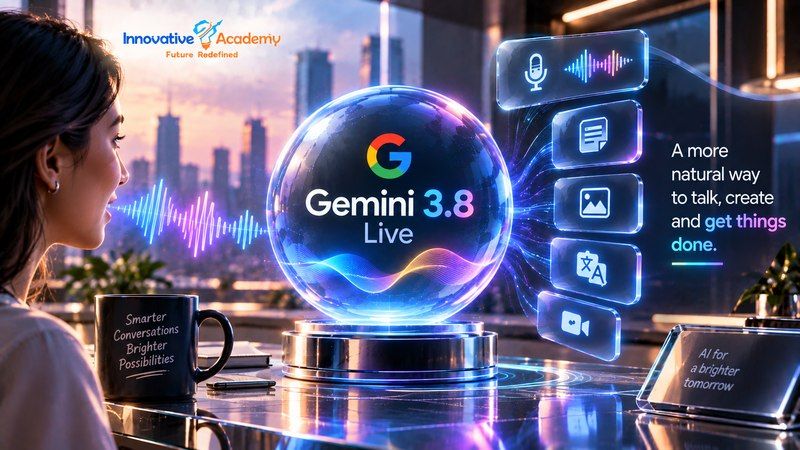
Voice assistants have spent years feeling like a slightly awkward compromise: useful for setting timers but clumsy at anything genuinely complex. On September 15, 2026, Google made a serious effort to close that gap, launching Gemini 3.8 Live and Gemini 3.8 Live Extended Thinking—two voice models built specifically to hold natural, real-time conversations while also getting multi-step work done in the background.
1. What Google Actually Launched
Both models are designed around the same core idea: a voice AI shouldn't have to choose between sounding natural and being genuinely useful.
Gemini 3.8 Live is built for scale and cost efficiency, aimed at high-volume, everyday conversational use cases. Gemini 3.8 Live Extended Thinking is the more capable sibling—built specifically for complex tasks that require multi-step reasoning and able to reason and speak simultaneously rather than pausing to "think" before responding.
Both support near real-time visual processing alongside language, can execute background tasks without interrupting the flow of conversation, and can switch fluidly between 97 different languages mid-conversation—a genuinely difficult problem in conversational AI that's historically tripped up even strong text-based models.
2. The Two Models—and Why There Are Two
Splitting the release into two models reflects a real tension in voice AI: latency versus depth.
A voice assistant that takes several seconds to "think" before responding feels broken, no matter how good the eventual answer is—conversation depends on quick turn-taking. But genuinely complex tasks, such as walking someone through a multi-step coding problem, planning a business workflow, or working through a customer support escalation, need more deliberate reasoning than a snappy response allows.
Gemini 3.8 Live is tuned to stay fast and cost-efficient for the bulk of everyday interactions.
Gemini 3.8 Live Extended Thinking accepts a bit more latency in exchange for deeper reasoning, while still speaking in real time rather than reasoning silently and then delivering a finished answer. The model can be heard "thinking out loud" while still holding the conversational thread.
3. The Numbers Behind the Announcement
Google backed the launch with a detailed benchmark sheet, and the results are competitive across several areas:
- Speech-to-Speech Quality Index: 82.6, with the Extended Thinking variant ranking first among tested voice models.
- Agentic Task Completion: 68.6% on the τ-Voice benchmark and 35.1% on Sierra's more demanding τ-Voice-banking benchmark, which tests whether a voice agent can correctly complete real financial-services tasks.
- Big Bench Audio Reasoning: 97.7%, a benchmark testing whether a model can reason correctly about information delivered through audio rather than text.
- Speech Agent Arena: The standard Gemini 3.8 Live model placed second overall.
- EVA-Bench: Used to measure the balance between raw accuracy and how natural a conversation actually feels.
Early partner feedback echoed the same theme. Companies including Salesforce, ServiceNow, LiveKit, Agora, Genspark, and Lumeris praised the models specifically for latency, fluidity, and tool-calling reliability—the ability for the model to actually execute an action mid-conversation rather than simply describing what it would do.
4. How Gemini 3.8 Live Stacks Up Against GPT and Grok
Benchmark numbers only have meaning when placed in context. Google did not launch Gemini 3.8 Live in a vacuum—OpenAI's GPT-Live-1 Astra and xAI's Grok Voice Think Fast 2.0 provide useful comparison points.
Gemini 3.8 Live Extended Thinking is most directly competing against these voice models, with the reported benchmark results showing relatively close performance across several tests.
Speech-to-Speech Quality
On the Speech-to-Speech Quality Index, Gemini 3.8 Live Extended Thinking scored 82.6, compared with 81.5 for GPT-Live-1 Astra and 81.3 for Grok Voice Think Fast 2.0.
Agentic Task Completion
On the τ-Voice agentic benchmark, Gemini recorded 68.6%, compared with 67.9% for GPT-Live-1 Astra and 56.5% for Grok.
On the harder τ³-Banking leaderboard, which tests whether a voice agent can correctly execute real financial-services tasks, Gemini recorded 35.1%, compared with 32.0% for GPT-Live-1 Astra and 16.5% for xAI-Realtime.
Pricing
Pricing is another important part of the comparison. Measured per hour of input audio on the Big Bench Audio subset, standard Gemini 3.8 Live comes in at approximately $0.84 per hour, while the Extended Thinking variant costs approximately $3.50 per hour.
For comparison, Grok Voice Think Fast 2.0 is reported at approximately $4.80 per hour, while GPT-Live-1 Astra is approximately $5.83 per hour.
This makes the combination of voice quality, agentic capabilities, and operating cost an important part of the Gemini 3.8 Live announcement.
5. What This Actually Looks Like in Practice
Google's use-case examples provide a clearer sense of what these models are intended to accomplish beyond demonstrations.
- Walking a new employee through onboarding with real-time visual guidance.
- Working through complex problems such as chess positions, coding bugs, or business plans through conversation.
- Handling customer-support troubleshooting conversationally.
- Coordinating multi-step bookings.
- Assisting with document creation and broader workflow tasks.
The common thread is that the model isn't simply talking—it is taking actions. It can call tools, execute background tasks, and use visual context while the conversation continues.
That's a meaningfully different approach from earlier voice assistants, which generally waited for a command, executed it, and then reported the result.
It is also a considerably harder engineering problem. Keeping natural conversation flowing while a model is simultaneously calling an external API, waiting on a database query, or reasoning through a multi-step plan requires the system to manage several processes without making the interaction feel stalled.
This is why latency and agentic task-completion metrics are increasingly important for modern voice AI. A model can be highly capable, but if it takes too long to respond, the experience no longer feels like a natural conversation.
6. Where You Can Actually Use It
The availability of the models varies by audience.
For Developers
Developers can access both models through the Gemini API and Google AI Studio, making it possible to integrate real-time voice capabilities into applications and workflows.
For Enterprises
Enterprise users can access the models through a private preview in Gemini Enterprise, with support also coming to Google's Customer Experience platform.
For Consumers
Consumers can see the models appear in Search Live and across Google Workspace applications such as Docs, Gmail, and Keep for eligible Google AI Pro and Ultra subscribers.
AI-Generated Audio Safety
Google has also incorporated a safety measure into the system. AI-generated audio from these models carries a SynthID watermark, designed to make synthetic audio identifiable even after it has been shared or re-recorded.
This is particularly relevant as increasingly realistic voice generation creates concerns around impersonation, misinformation, and voice-based deepfakes.
7. Why Voice Is the Next Real Battleground in AI
For the past couple of years, much of the visible competition between AI labs has focused on text—coding performance, reasoning benchmarks, context windows, and general language capabilities.
Voice is becoming another important area of competition because it is an interface people can use when their hands or eyes are busy.
Driving, cooking, working on a factory floor, walking through a warehouse, performing inventory, and working in a call center are all situations where typing can be inconvenient or impossible, while talking remains natural.
That's also why benchmarks such as banking customer-service tasks matter. They test whether voice agents can move beyond casual conversation and handle structured interactions that businesses already perform at scale.
The broader direction is clear: voice AI is increasingly being designed not simply to answer questions, but to understand context, reason through tasks, call tools, and take actions.
8. Why This Matters for Anyone Learning AI in Bangalore
Voice-driven, tool-calling AI agents are becoming an important part of modern software development. Building and integrating models like Gemini 3.8 Live into real applications—whether a customer-support assistant, internal onboarding tool, or automated workflow—requires more than simply knowing how to use an AI chatbot.
Developers need programming fundamentals, API integration skills, asynchronous programming concepts, and an understanding of how applications communicate with external tools and services.
Python is particularly useful for building AI and automation applications because of its extensive ecosystem and straightforward syntax. For learners who want to build a foundation before working with generative AI and agentic AI systems, structured Python Training in Bangalore can help develop these programming fundamentals.
Innovative Academy provides Python training designed to help learners build practical programming skills that can later be applied to AI, automation, APIs, and application development.
For students interested in expanding beyond Python into broader AI concepts, exploring Innovative Academy's technology training programs can provide additional pathways for building technical skills.
Bangalore's technology, IT services, and BPO ecosystem also provides a relevant environment for learning these skills. Customer support automation, internal assistants, workflow automation, and AI-enabled applications are examples of areas where developers can apply voice and agentic AI technologies.
9. Final Thoughts
Gemini 3.8 Live represents an important direction for voice AI: moving beyond scripted responses toward systems capable of handling multi-step reasoning, tool use, visual context, and real-time conversation.
The significance of this shift extends beyond voice assistants. As AI models become increasingly capable of interacting with APIs, applications, databases, and business workflows, developers need the programming and integration skills required to build useful systems around them.
For aspiring AI developers in Bangalore, learning foundational technologies such as Python can provide a practical starting point before moving into generative AI, AI agents, automation, and real-time voice applications.
The future of voice AI is therefore not simply about making machines sound more human. It is about making conversational systems capable of understanding, reasoning, and taking meaningful actions in real time.