
DevOps Bootcamp Roadmaps for Freshers: What Holds Up and What's Oversold
1. Introduction
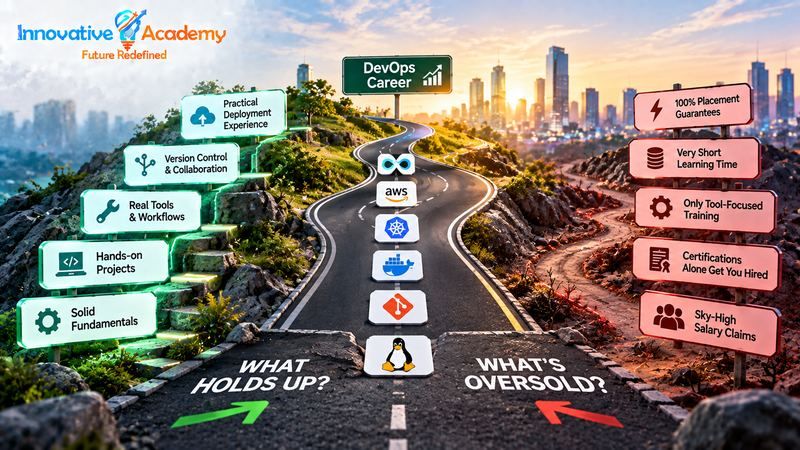
Search for DevOps bootcamp roadmap for freshers, and the same six-step structure appears on page after page: networking and Linux, then a cloud platform, followed by the tool stack, projects, resume preparation, and interview preparation.
The sequence itself is genuinely useful. What deserves more scrutiny are the claims often wrapped around it, including statements about zero coding, large Bangalore technology-company counts, job-market rankings, and salary ladders that appear unusually predictable.
A realistic DevOps roadmap should separate useful learning guidance from marketing claims. The goal is to understand what skills a fresher actually needs and how those skills can be developed progressively.
2. Claim: "No Coding Required" — Not Quite
"No coding required" is one of the most common phrases used in DevOps bootcamp marketing, but it can create the wrong expectation about the work involved.
DevOps work involves automation and scripting. Bash and Python are commonly used for operational tasks, while technologies such as Ansible and Terraform rely on configuration languages and structured automation that are effectively code-based in how they are used.
A more accurate statement is that you do not necessarily need a prior software development background to begin learning DevOps. However, you should expect to develop scripting skills during the learning process.
For a fresher, this distinction matters. Starting without programming experience can be completely manageable, but expecting to avoid scripting altogether can become a problem when working with automation, deployment pipelines, cloud infrastructure, and troubleshooting.
3. Claim: Bangalore's Company Counts and "Top 5 Job Category" Status
Bangalore is one of India's major technology and startup hubs, which makes it an important location for people exploring careers in cloud computing, infrastructure, software engineering, cybersecurity, and DevOps.
However, precise claims such as "10,000+ tech companies" or "2,000+ startups" can vary significantly depending on the source, definition, and date used to calculate them. Marketing content should therefore avoid presenting one precise figure as an unquestionable current count unless it is supported by a clearly identified source.
The same principle applies to statements such as "DevOps is one of the top five highest-demand jobs." Demand for DevOps and cloud-related skills is substantial, but a specific ranking should be treated cautiously unless it comes from a transparent and current methodology.
For a fresher, the more useful question is not whether DevOps occupies a particular ranking. It is whether the candidate has the practical skills required for the roles they are applying for.
4. Claim: A ₹3.5L → ₹20L+ Salary Ladder
Salary tables showing a neat progression from an entry-level figure to ₹20 lakh or more can make DevOps careers look more predictable than they actually are.
Actual compensation varies based on experience, technical depth, location, company type, responsibilities, interview performance, and the specific role being offered. A fresher and an experienced DevOps engineer should not be treated as if they belong to the same salary category.
Product companies, services companies, startups, and larger enterprises can also have significantly different compensation structures for similar job titles.
The important takeaway is that salary growth is not automatic simply because someone completes a DevOps course. Technical capability, practical projects, experience, problem-solving ability, and continued learning all influence career progression.
5. What Actually Holds Up: The Skill Order Matters
The standard DevOps learning sequence has a practical reason behind it. Foundational technologies make the later tools easier to understand and troubleshoot.
Start With Linux and Networking
Linux fundamentals and basic networking provide an important foundation for DevOps. Learners should become comfortable with processes, permissions, filesystems, services, logs, SSH, ports, IP addressing, DNS, and basic troubleshooting.
These concepts become useful later when working with cloud servers, containers, CI/CD systems, and infrastructure automation.
Learn Scripting
Basic Bash and Python scripting can help automate repetitive tasks and improve a learner's ability to work with DevOps tooling.
Move to Cloud
After establishing the fundamentals, learning one cloud platform properly is generally more useful than briefly studying several platforms.
Learn Version Control and CI/CD
Git provides the foundation for managing code and configuration changes. CI/CD concepts then introduce automated testing, building, and deployment workflows.
Understand Containers and Infrastructure as Code
Docker and Kubernetes introduce container-based application deployment, while Terraform provides an infrastructure-as-code approach for managing infrastructure through configuration.
Learning these technologies progressively helps learners understand how the individual components connect instead of simply memorizing commands.
6. What Actually Holds Up: Projects Beat a Certificate
A course certificate can show that a learner completed a program, but a practical project provides a different type of evidence: it can demonstrate how the learner actually used the technology.
A useful DevOps project could include a Git repository, automated build and deployment, containerization, cloud infrastructure, monitoring, or infrastructure-as-code depending on the learner's level.
The most valuable part of a project is not simply having it listed on a resume. A candidate should be able to explain what they built, why they selected particular tools, what went wrong, and how they solved the problem.
This makes project-based learning particularly useful for technical interviews, where interviewers may ask candidates to explain implementation decisions and troubleshoot hypothetical problems.
7. The Realistic Version of the Roadmap
Remove the inflated promises and the roadmap becomes much more straightforward.
- Linux fundamentals: Learn commands, permissions, processes, services, logs, SSH, and basic administration.
- Networking fundamentals: Understand IP addressing, DNS, ports, protocols, routing, and troubleshooting.
- Basic scripting: Build working knowledge of Bash and introductory Python.
- Cloud computing: Learn one cloud platform and understand its core services.
- Git: Learn repositories, branching, merging, pull requests, and practical version-control workflows.
- CI/CD: Build automated workflows for testing, building, and deploying applications.
- Containers: Learn Docker and understand container images, registries, networking, and deployment.
- Kubernetes: Progress to orchestration after developing a solid container foundation.
- Infrastructure as Code: Learn Terraform and use it to provision repeatable infrastructure.
- Projects: Build two or three practical projects that can be explained in technical interviews.
- Career preparation: Create a focused resume, portfolio, LinkedIn profile, and interview preparation plan.
After completing this path, candidates should expect a genuine job-search process rather than assuming that completing a bootcamp automatically results in employment.
8. Building This Path at Innovative Academy
Innovative Academy's DevOps Bootcamp in Bangalore is structured around a progression from foundational concepts to practical DevOps tools and projects.
The learning path covers areas such as Linux, networking, shell scripting, cloud fundamentals, Git, CI/CD, containers, Kubernetes, and infrastructure-as-code. The objective is to connect individual technologies into practical workflows rather than treating each tool as an isolated topic.
The program also emphasizes project work so learners have practical experience they can discuss during interviews.
Learn more about the DevOps Bootcamp Training in Bangalore at Innovative Academy.
Career preparation can include resume support, interview practice, communication development, and placement assistance as part of the learner's broader job-search process.
9. FAQs
Do I really need to know how to code before starting a DevOps bootcamp?
No prior software development background is necessarily required to begin learning DevOps. However, you should expect to learn scripting, particularly Bash and Python, as you progress. "No coding required" should not be interpreted as "no scripting ever."
Is the ₹3.5L to ₹20L+ salary progression something I can count on?
No salary progression should be treated as guaranteed. Compensation depends on experience, skills, employer, location, role, interview performance, and market conditions. Salary examples should be treated as indicative rather than promises.
Does the order of the roadmap actually matter?
The order can make learning easier because later DevOps technologies build on foundational concepts. Linux and networking provide useful foundations before moving into cloud, automation, containers, and orchestration.
How many DevOps projects should a fresher build?
Two or three well-understood projects can be more useful than a long list of shallow projects. Focus on projects where you can explain the architecture, tools, implementation choices, problems encountered, and solutions.
Can a fresher start DevOps without an IT background?
Yes. A non-IT learner can start with the fundamentals and progressively develop Linux, networking, scripting, cloud, automation, and DevOps skills. The learning curve may require additional practice with technical foundations.
10. Final Thoughts
Much of the standard DevOps bootcamp roadmap for freshers gets the underlying sequence right while sometimes overstating the claims surrounding it.
Company counts, job-market rankings, guaranteed salary ladders, and "no coding" statements deserve careful scrutiny. The more durable parts of the roadmap are the foundations, the progression from Linux and networking into cloud and automation, and the emphasis on practical projects.
A realistic DevOps career path requires consistent practice, scripting, technical troubleshooting, project work, and a genuine job search. A bootcamp can provide structure, but the learner's ability to apply and explain the skills is what ultimately matters.
For freshers, the goal should therefore be simple: learn the fundamentals, build real projects, understand the tools instead of memorizing them, and prepare for the actual hiring process.