
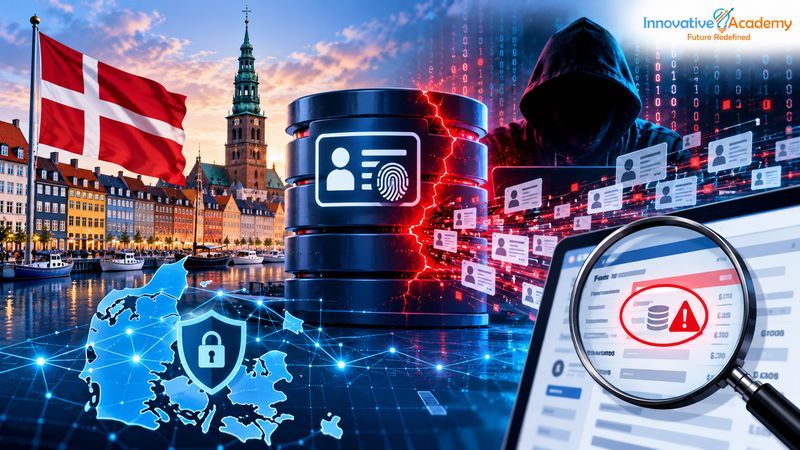

Denmark's National ID Database Was Breached — and a Billing Anomaly Is What Caught It
Table of Contents
- What's solid across every source
- Timeline of the breach
- How it was actually caught — the part worth paying attention to
- The detail that's not yet confirmed
- Why third-party access is so often the real attack surface
- Why this is relevant even without a confirmed password
- What's still open
On October 5, 2026, Denmark's digitalisation ministry announced that unauthorized parties had accessed the country's Central Person Register — the CPR, which is Denmark's national population database and the rough equivalent of a combined Social Security and national ID system — and pulled personal records on roughly 8.8 million people. The database itself holds around 11 million records once you include people who have died or moved abroad, against a resident population of about 6 million, which is part of why the number sounds larger than the country itself. Here's what's actually confirmed, what's still contested, and why the detection method is the more interesting part of this story.
What's solid across every source
Multiple outlets — CSO Online, SecurityWeek, The Next Web, and TV 2's own reporting — agree on the core shape of the incident. The breach wasn't a hack of the CPR system's own infrastructure. It was abuse of a private Danish company's legitimate, lawful access to the register — access that companies can be granted to verify customer identity information for ordinary business purposes like fraud checks or onboarding. Someone misused that standing access to pull far more records than any normal business process would need.
The exposed data was names, addresses, and CPR numbers — the identification number itself, which functions the way a Social Security number does in the US and is used to authenticate people across Danish banking, healthcare, and government services. That combination is exactly the kind of data that enables identity fraud, which is why Danish authorities have been treating this as serious enough to warrant a police investigation through the National Unit for Special Crime, not just a regulatory notification.
It was discovered on October 2, 2026, and the company's access was cut off before the public announcement three days later. As of the most recent reporting, Danish police say no one has been identified or charged, and they're in contact with police in other countries as part of the investigation.
Timeline of the breach
Laid out in order, the confirmed sequence of events looks like this:
Sometime between September 10 and September 20, 2026, an account tied to a private Danish company began making an unusually high volume of automated lookups against the CPR system — more than 14 million requests over roughly a ten-day window, of which about 8.8 million returned an actual record.
On October 2, 2026, the CPR administration's routine billing process flagged the account for an abnormally large invoice, which is what first surfaced the activity internally.
On October 4, 2026, the Danish Data Protection Agency was notified of the incident.
On October 5, 2026, the government publicly disclosed the breach, with the digitalisation ministry — led by Minister Christina Egelund — describing it as "a deeply serious incident." The company's access to the register was cut off around this point, and officers from the National Unit for Special Crime visited the company to secure evidence.
On October 9, 2026, the company's managing director reportedly confirmed that its access had been misused, according to later reporting.
As of the most recent reporting available, no suspect has been identified or charged, and Danish police say they are coordinating with police in other countries as part of the ongoing investigation.
How it was actually caught — the part worth paying attention to
This is the detail that makes the story useful beyond "another database got breached." Denmark's population register bills companies per lookup for the identity-verification service. According to Danish officials cited by TV 2, the breach surfaced when the CPR administration's routine Friday invoicing run showed one company's account generating an abnormally large bill — because that account had made more than 14 million lookup attempts over a ten-day window in September, of which about 8.8 million returned an actual record.
In other words: nobody caught this by watching for a security alert or an intrusion signature. An accounting process noticed the number didn't look right. That's a pattern worth sitting with if you work anywhere near system administration or access monitoring — the controls that eventually surface abuse of legitimate credentials are sometimes financial or operational metrics, not security tooling at all. A system that logs every lookup but never alerts on a 14-million-request spike from one account over ten days has a monitoring gap, even if nothing about the individual requests looks malicious on its face.
The detail that's not yet confirmed
Pakistani outlet ProPakistani, citing Danish newspaper Politiken, reported that the hacker claimed to have gained access using the password "123456" on an account belonging to a company named Pays ApS, and that at least three accounts at that company — including an administrator account — reportedly used the same password. That's a vivid detail, and if true it would make this a near-textbook case of credential hygiene failure rather than any kind of sophisticated intrusion.
But it's worth being precise about sourcing here: that specific claim appears in only one of the four outlets reviewed for this piece, it traces back to a single unnamed source's account to Politiken, and — per that same report — Danish authorities have not confirmed the password claim. The other three outlets (CSO Online, SecurityWeek, The Next Web) describe the root cause only as abuse of a company's lawful access, without naming a password or a company. So "weak password breached a national database" is a plausible and specific allegation, not yet an established fact. Treat it accordingly until an official investigation confirms or denies it.
Why third-party access is so often the real attack surface
Set the password detail aside entirely and the confirmed facts alone still make an important point about how these systems fail. A national database like the CPR isn't exposed to the open internet the way a public website is — it's exposed through a set of contracts and integrations with outside companies that have a legitimate business reason to query it. Each one of those integrations is a door that the core system's own security team doesn't fully control, because the account holder is a separate organization with its own password policies, its own staff turnover, and its own internal access reviews — or lack of them.
This is why mature access-control practice treats third-party and vendor accounts as a distinct risk category rather than folding them into "everyone with a login." The standard mitigations are not exotic: granting the minimum level of access actually needed for the stated business purpose, reviewing who still needs that access on a regular schedule, rotating credentials rather than letting them sit unchanged for years, and — critically for this case — logging and alerting on volume, not just on individual request content. A single lookup that returns one record looks identical, request by request, to a lookup that's part of a 14-million-request harvesting run; only the aggregate pattern gives it away, which is exactly why Denmark's system caught it through an invoice rather than a security dashboard.
Why this is relevant even without a confirmed password
Whether or not "123456" turns out to be accurate, the confirmed facts alone make the point: a system is only as secure as the weakest account that has standing access to it, and third-party access — vendors, partners, or companies with a legitimate integration — is routinely the path attackers or careless insiders use, not the core system itself. Denmark didn't lose control of the CPR database; it lost control of who could be trusted with access to query it, and for how long, without anyone checking.
Innovative Academy doesn't run a dedicated incident-response or forensics program, but its Linux Administration training covers exactly the fundamentals that sit underneath a case like this one: user and account management, authentication configuration, sudo and privilege controls, and the logging and auditing practices that let an administrator notice unusual access patterns before a billing department does. The course works through setting up and reviewing system logs, configuring account lockout and password policies, and understanding the kind of access review discipline that would have flagged an account making millions of requests long before an invoice did. Contact for course details: 8447712333.
What's still open
The identity of whoever carried out the access abuse is unconfirmed. The exact password detail is unconfirmed. Whether this was a single rogue actor at the company, an external party who compromised the company's credentials, or something else entirely hasn't been settled publicly as of this writing. If you're going to cite this case, the safe, fully-sourced version is: a company's legitimate access to Denmark's population register was abused to pull records on 8.8 million people over a ten-day window in September 2026, discovered through a billing anomaly rather than a security alert, and disclosed October 5, 2026. Everything past that — especially the password detail — should be flagged as reported-but-unconfirmed, the way it's flagged here.