
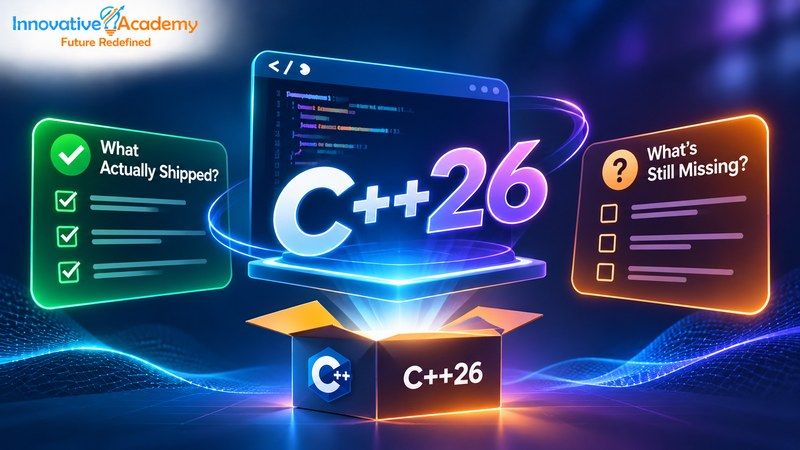

C++26 Is Officially Finalized — Here's What Actually Shipped, and What's Still Missing
Table of Contents
- What actually happened, and when
- A few terms worth knowing before the feature list
- The headline features, in plain terms
- Not everyone on the committee is happy about this
- What got cut, and what that tells you
- Can you actually use any of this today?
- Why this is worth knowing if you're learning C or C++
- What we're not claiming
C++ doesn't get a new standard very often, and when it does, most of the coverage either oversells it as a total reinvention of the language or buries the real news under a pile of proposal numbers nobody outside the committee can parse. This one's worth a straight explanation: in March 2026, the ISO C++ committee finished the technical work on C++26, calling it the most significant release since C++11 — and that comparison is coming from the person who used to chair the committee, not from a marketing blurb. Here's what was actually approved, what's genuinely new, where the committee itself disagreed, and — the part most coverage skips — whether any of it actually compiles yet.
What actually happened, and when
The ISO C++ committee (formally WG21) held a six-day meeting in Croydon, London, running Monday through Saturday, with roughly 210 people attending — about 130 in person and 80 remote, representing 24 countries. On Saturday, March 28, 2026, the committee completed technical work on C++26, resolving the last of 411 national-body comments that had come in during the prior international comment ballot. Herb Sutter, who chaired the committee from 2002 through 2025, posted the trip report himself and called it "the most compelling release since C++11."
The vote to finalize wasn't unanimous: 114 in favor, 12 opposed, and 3 abstaining, according to Sutter's own account, corroborated by The Register's coverage of the same meeting. That's a real number of dissenting votes for a standards body, and — as covered further down — the disagreement centered on one specific feature. What comes next is procedural rather than technical: the committee produces a final document that goes out for an international approval ballot (what ISO calls a Draft International Standard), followed by editorial work, before ISO formally publishes it. Neither Sutter's post nor the news coverage reviewed for this piece gives a firm publication date — "published in the near future by ISO" is as specific as the primary source gets.
A few terms worth knowing before the feature list
Reflection, in this context, means a program can inspect its own structure — types, member names, functions — at compile time, and generate code based on what it finds. Until now, C++ developers simulated this with macros and template tricks; reflection makes it a first-class language feature.
Contracts are a way to write a function's expectations directly into its declaration: what has to be true before it's called (a precondition), what has to be true when it returns (a postcondition), and assertions in between. The goal is catching violated assumptions automatically rather than relying on comments or separate test code.
std::execution, sometimes called the "sender/receiver" model, is C++'s standardized approach to asynchronous and parallel work — a common vocabulary for describing a chain of operations that might run concurrently, instead of every library inventing its own threading abstraction.
Erroneous behaviour is a newly defined middle ground between "undefined behaviour" (the compiler can do literally anything, including nothing sensible) and a full runtime error. Reading an uninitialized local variable is now erroneous behaviour in C++26 rather than undefined behaviour — the value you get is unspecified, but the compiler can no longer treat it as a license to generate arbitrary nonsense.
The headline features, in plain terms
Sutter's own trip report groups the release around four major pieces, and it's worth taking them one at a time rather than as an undifferentiated list.
Reflection (standardized under proposal P2996) is the one he's most emphatic about, describing it as "the most powerful new engine for expressing efficient abstractions that C++ has ever had" — strong language from someone who's spent over two decades inside this committee. In practice, it lets code written today generate serialization logic, debugging output, or boilerplate-heavy patterns automatically from a type's own structure, instead of a developer hand-writing or macro-generating that code separately for every type.
The hardened standard library addresses a narrower but very concrete problem: memory safety. Reading an uninitialized local variable moves from undefined behaviour to the erroneous-behaviour category described above, and the standard library itself gets bounds-checking for commonly used operations on types like vector, span, string, and string_view. Sutter cites an internal measurement — a 30% reduction in segfault rate across a production fleet — as the kind of real-world payoff this category of change is meant to produce, though that figure describes one organization's experience with hardening generally, not a guaranteed result for every codebase that adopts C++26.
Contracts (P2900) bring preconditions, postconditions, and a dedicated assertion statement directly into function declarations, using new keywords: pre, post, and contract_assert. This is the feature that produced the committee's split vote, covered in the next section.
std::execution (P2300), the sender/receiver model, standardizes how asynchronous and parallel operations are described and composed. Sutter is candid that this is the piece with the roughest edges right now, noting it "lacks great documentation and is missing some 'fingers-and-toes' libraries" — meaning the core abstraction is standardized, but the surrounding ecosystem of convenience functions that make it pleasant to use day-to-day isn't fully there yet.
Not everyone on the committee is happy about this
The 12 votes against finalizing C++26 weren't a rubber-stamp footnote — they reflect a real, named disagreement. Bjarne Stroustrup, who created C++, argued publicly against contracts in their current form, telling The Register: "it's claimed to be a minimal viable product. It's not minimal, it's not viable," and separately that the feature is "adding complexity in very obscure ways." That's the language's original designer, on the record, disagreeing with a feature that shipped anyway — worth knowing before you take any single person's enthusiasm (including Sutter's) as the full picture. The Register also notes a specific, acknowledged gap: contracts don't currently support virtual functions, with that capability expected in a future standard rather than this one.
What got cut, and what that tells you
Not everything proposed for C++26 made it in. Trivial relocatability — a feature meant to let the compiler move certain objects around in memory more efficiently (covered under proposals like P2786) — was pulled from the standard due to implementation bugs discovered during development, and deferred to a later release. Profiles and pattern matching, two other features that had been discussed as potential C++26 material, also didn't make the final cut. None of this is unusual for a standards process — features that aren't ready get deferred rather than shipped broken — but it's a useful reminder that "C++26 is finalized" doesn't mean every feature anyone hoped for arrived on schedule.
Can you actually use any of this today?
This is the question most coverage of a new C++ standard skips entirely, and it matters more than the feature list itself if you're deciding whether to care right now. Sutter's own post states that "throughout the development of C++26, at any given point both GCC and Clang had already implemented two-thirds of C++26 features," and that GCC already had reflection and contracts merged into its development trunk at the time of the March meeting, awaiting an official release. Separately, Wikipedia's C++26 page states that GCC version 16.1, as of April 30, 2026, supports most C++26 features — though that's a secondary, crowd-edited source and worth independent confirmation before you treat it as settled.
A more hands-on, independently run test (from an unnamed author at a site called Modern C++ // dev, so treat this one as a single data point rather than an authoritative reference) found a messier picture using GCC 15.2.1 and Clang 21.1.8 in April 2026: GCC supported contracts behind an explicit -fcontracts flag, but neither compiler recognized reflection syntax or the new <meta> header at that point, with that test's author guessing mainstream reflection support was "2027 at the earliest." Microsoft's MSVC compiler isn't mentioned with any specific C++26 support status in any of the sources checked for this piece. The honest summary: contracts are showing up in at least one mainline compiler already, reflection is further behind despite being the feature getting the most attention, and anyone planning to actually use C++26 in production code should check their specific compiler's current release notes rather than assume the standard being "finalized" means it's immediately usable everywhere.
Why this is worth knowing if you're learning C or C++
If you're in the middle of learning C or C++, none of this changes what you should focus on first — pointers, memory management, data structures, and the standard library fundamentals that every version of C++ has built on top of for decades. What a release like this actually signals is that the language is still actively evolving to solve real problems: reflection exists because developers have spent years working around its absence with macros and code generation, and the memory-safety work exists because segfaults and undefined-behaviour bugs remain a genuine, measured cost in production C++ code. Innovative Academy's C and C++ programming courses are built around those fundamentals rather than chasing whichever standard is newest, which matters precisely because of what this piece just described — a brand-new standard feature can take a year or more to become something you can reliably use, while the core language skills underneath it are what you'll actually be hired to apply in the meantime. Contact for course details: 8447712333.
What we're not claiming
This isn't a claim that C++26 is universally usable right now, and it isn't a claim that every developer should rush to learn reflection or contracts immediately — the compiler-support picture above says plainly that much of this is still rolling out unevenly. It's also not a claim that the committee's internal disagreement over contracts has been resolved; Stroustrup's objection is on the record and unanswered in anything reviewed for this piece. What's solid: the finalization itself, the March 28, 2026 date, the 114-12-3 vote, and the four headline features are all confirmed directly from Herb Sutter's own committee trip report and corroborated by The Register's independent, named-author coverage of the same meeting. The specific compiler-version claims carry more uncertainty, sourced partly from a secondary wiki page and partly from a single unnamed hands-on test, and are presented here as exactly that rather than settled fact.