
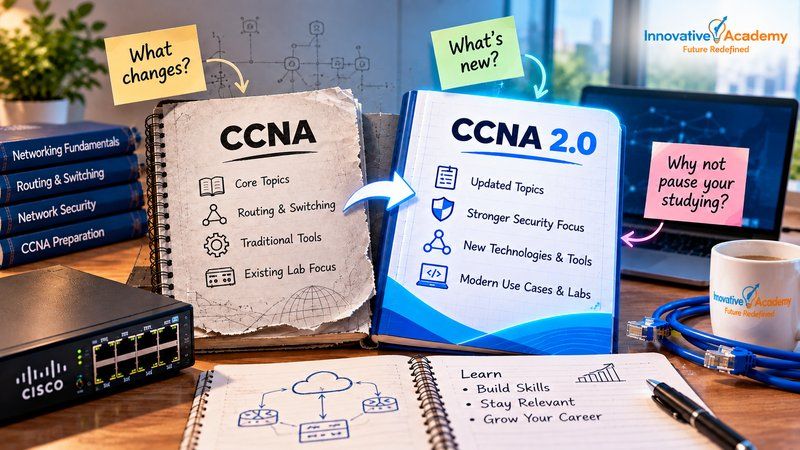

Cisco Just Announced CCNA 2.0—Here's Exactly What Changes, and Why Cisco Itself Says Not to Pause Your Studying
Table of Contents
- Introduction
- The Dates That Actually Matter
- What's Actually Changing in the Blueprint
- The Detail Worth Noticing: Troubleshooting Is Coming Back
- Cisco's Own Advice to Current Candidates
- What This Means If You Haven't Started Yet
- Learning CCNA at Innovative Academy
- FAQs
- Final Thoughts
Any time a certification body announces a version change, the instinct is to wonder whether everything you've already studied just became worthless. Cisco's announcement of CCNA 2.0 at Cisco Live 2026 is a particularly relevant test case for that instinct, because Cisco itself publicly argued the opposite—telling current candidates to keep going rather than wait.
Whether that advice actually holds up is worth checking against what's changing, not just taking on faith. For learners considering a CCNA course in Bangalore, understanding the new exam timeline and blueprint can help them plan their preparation more effectively.
1. Introduction
Any time a certification body announces a version change, the instinct is to wonder whether everything you've already studied just became worthless. Cisco's announcement of CCNA 2.0 at Cisco Live 2026 is a particularly relevant test case for that instinct, because Cisco itself publicly argued the opposite—telling current candidates to keep going rather than wait.
Whether that advice actually holds up is worth checking against what's changing, not just taking on faith. The important questions are when the new exam begins, what changes in the blueprint, and whether students should alter their preparation strategy.
2. The Dates That Actually Matter
Cisco confirmed a firm cutover: the current CCNA exam, 200-301 version 1.1, can be taken through February 2, 2027. Version 2.0—using the same exam code, 200-301, but with a new blueprint—launches the very next day, February 3, 2027.
There is no overlap window or additional grace period built into the announced schedule. Candidates who want to take the current version therefore have a firm deadline, while those who wait will move to the new version when it becomes available.
For anyone following a CCNA exam blueprint 2027 update, these dates are the most important part of the announcement because they directly affect study planning and exam scheduling.
3. What's Actually Changing in the Blueprint
The restructuring isn't simply cosmetic. Cisco is collapsing the exam from six domains down to five, redistributing topic weight across them in the process.
That means the update represents a genuine reorganization of what is tested and how heavily different areas are represented. It is not simply a renumbering of the existing six sections.
However, the core networking foundation remains relevant. Students preparing for routing, switching, IP connectivity, network access, security fundamentals, and automation-related concepts are not starting from zero when the new version arrives.
4. The Detail Worth Noticing: Troubleshooting Is Coming Back
The single change worth understanding closely is the return of explicit troubleshooting and diagnostic language to the blueprint.
The current exam version had moved away from explicit troubleshooting and diagnostic verbs in its objectives, emphasizing terms such as “configure and verify.” Version 2.0 brings “troubleshoot” and “diagnose” back into the blueprint alongside configuration and verification.
In practical terms, this places greater emphasis on genuine hands-on command-line fluency. A candidate may need to read output, identify a fault, isolate the problem, and determine why a configuration is not behaving as expected.
That is a different learning experience from simply recognizing the correct configuration syntax in a multiple-choice question.
For aspiring network engineers, this reinforces the importance of lab practice. Understanding why a network fails can be just as important as knowing how to configure it when everything is working correctly.
5. Cisco's Own Advice to Current Candidates
Cisco's messaging to people already in the middle of their preparation is clear: candidates should not automatically stop studying simply because a revised blueprint has been announced.
The company's guidance states that “hitting the pause button on your CCNA exam prep will just delay your career goals—and the gains that come with getting certified.”
Distinguished Architect Hank Preston, quoted in the same announcement, also described the scale of the revision as relatively limited, saying that “the CCNA revision isn't that big a deal.”
The broader argument is that the two versions represent a shift in emphasis rather than a complete rebuild of the certification. Networking fundamentals learned for the current version remain useful when preparing for the revised exam.
6. What This Means If You Haven't Started Yet
For someone who has not started CCNA preparation yet, the calendar becomes an important factor.
There is roughly four months between the current date and the February 2, 2027 cutoff. That can be workable for a learner who starts immediately and follows an intensive, structured study plan, but it is a considerably tighter schedule for someone who studies only occasionally.
Cisco Press author Wendell Odom has advised candidates already in progress to target a first attempt by around mid-January and completion by late January 2027, leaving some room for a retake before the current version closes.
Someone starting from zero should therefore consider their available study time rather than assuming that four calendar months automatically equals four comfortable months of preparation.
Waiting for version 2.0 is also an option. The new version places more explicit emphasis on troubleshooting and diagnostic skills, which may appeal to learners who prefer hands-on networking and practical fault-finding.
The important point is to make the decision based on preparation time, learning goals, and the exam version being targeted—not simply on the fact that a new version number has appeared.
7. Learning CCNA at Innovative Academy
Innovative Academy's CCNA training in Bangalore is structured across two phases, covering routing and switching fundamentals before moving into practical troubleshooting and fault-finding.
The training approach focuses not only on building a working configuration but also on understanding what happens when something goes wrong. Students can practice identifying configuration issues, reading network behavior, and working through problems rather than relying entirely on memorized commands.
This practical approach is particularly relevant as Cisco's revised blueprint places renewed emphasis on troubleshooting and diagnostic abilities.
For learners looking for a CCNA training institute in Bangalore, the course is available through online and classroom learning formats, with practical lab-oriented preparation and placement assistance.
8. FAQs
1. If I'm currently studying for CCNA, should I rush to finish before February 2027 or wait for version 2.0?
Cisco's guidance favors continuing preparation for candidates who are already partway through their studies. The foundational networking knowledge carries forward, and stopping preparation would delay the opportunity to complete the certification.
Someone who has not started yet has more flexibility to decide whether to target version 1.1 before February 2, 2027, or begin preparation specifically for version 2.0.
2. Is CCNA 2.0 an entirely different exam?
No. The revised exam retains the 200-301 exam code and much of the same core subject matter. The blueprint is reorganized from six scored domains into five, with changes to topic weighting.
One of the notable changes is the return of explicit troubleshooting and diagnostic objectives.
3. Does this change affect CCNP certification too?
This particular announcement concerns CCNA. Cisco has separate update schedules for other certification tracks, including automation and security-focused paths. Those changes should be considered independently rather than treated as part of the CCNA 2.0 update.
4. When does CCNA 2.0 become available?
According to the announced schedule, CCNA version 2.0 launches on February 3, 2027, immediately after the current version 1.1's final date of February 2, 2027.
5. Will current CCNA study material become useless?
No. Much of the networking foundation remains relevant. Candidates should, however, check their study resources against the applicable exam blueprint and add practice around troubleshooting and diagnostic scenarios when preparing for version 2.0.
9. Final Thoughts
A version number changing on a certification exam can sound more dramatic than the underlying change actually is. In the case of CCNA 2.0, the announced update involves a reorganization of the blueprint and a renewed emphasis on troubleshooting and diagnostic skills rather than an entirely different certification.
The February 2, 2027 cutoff for the current version is worth planning around. For candidates already deep into preparation, continuing toward the current exam remains consistent with Cisco's own guidance. For new learners, the choice can depend on their preparation timeline and whether they prefer to target the current blueprint or begin directly with version 2.0.
Either way, the underlying networking skills remain central: configuring, verifying, understanding, and troubleshooting networks. Those abilities matter beyond the version number printed on the exam.