
Choosing Your First Cloud Platform: An Honest AWS vs Azure vs Google Cloud Framework for Beginners
1. Introduction
Most articles explaining why AWS is the best cloud platform skip an important step: they do not compare AWS against its two major competitors before declaring a winner. That can make it harder for someone genuinely deciding where to spend their first few months of cloud learning.
The more useful question is not simply whether AWS is the best cloud platform. It is which platform makes the most sense for a beginner based on market demand, career opportunities, learning resources, technology ecosystems, and long-term flexibility.
AWS remains a strong starting point for many beginners in India, but Azure and Google Cloud have significant strengths of their own. Understanding those differences can help learners make a more informed decision.
2. What Cloud Computing Actually Replaces
Running an application traditionally meant owning or renting physical servers, managing storage and networking, and maintaining infrastructure around the clock. These models could require significant upfront investment even when infrastructure was not being fully utilized.
Cloud computing replaces much of that ownership model with on-demand infrastructure and services. Organizations can provision compute, storage, databases, networking, security, analytics, and other capabilities as needed instead of maintaining every component themselves.
This model has made sophisticated infrastructure accessible to startups, enterprises, development teams, and individual developers without requiring every organization to operate its own physical data center.
The important career lesson is that cloud learning is not simply about memorizing a vendor's console. Professionals need to understand how applications, networks, storage, databases, identity, security, automation, and monitoring work together in modern infrastructure.
3. The Real 2026 Numbers: AWS vs Azure vs Google Cloud
The cloud infrastructure market remains highly competitive. According to the figures referenced in this comparison, Synergy Research Group's Q2 2026 data puts AWS at approximately 28% of worldwide cloud infrastructure spending, Microsoft Azure at 20%, and Google Cloud at 15%.
The overall market has also continued to expand rapidly, with quarterly cloud infrastructure spending reaching approximately $143.4 billion. AWS remains the largest individual provider, but its share has become more closely contested as Azure and Google Cloud continue to grow.
Google Cloud's growth is particularly notable in areas connected to artificial intelligence, data analytics, and cloud-native infrastructure. Azure continues to benefit from Microsoft's broad enterprise ecosystem, while AWS maintains a substantial installed base across industries and workloads.
For beginners, however, market share should not be treated as the only deciding factor. Job requirements, target employers, existing technical skills, learning resources, and long-term career goals can all influence which platform makes sense.
4. Where Each Platform Actually Makes Sense
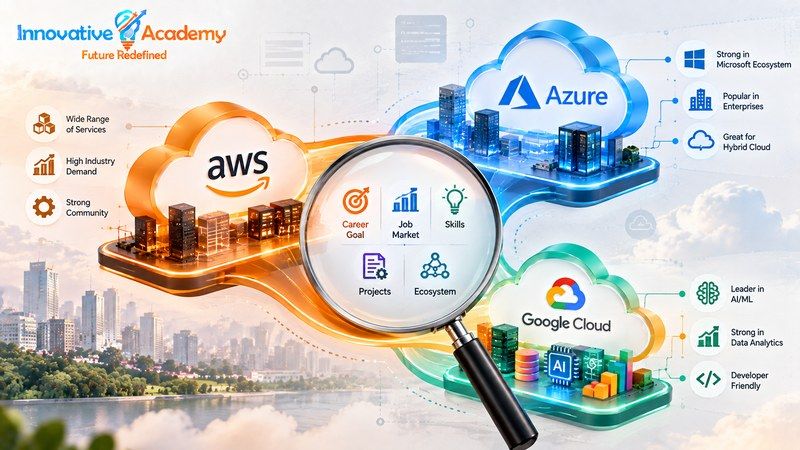
AWS
AWS has a broad service portfolio and a large installed base of production workloads. Its services are used across startups, enterprises, financial services, technology companies, consulting organizations, and other industries.
For learners who have not yet decided which type of organization they want to work for, AWS can provide exposure to a wide range of infrastructure concepts and cloud services.
Microsoft Azure
Azure has a particularly strong position in organizations already invested in Microsoft's technology ecosystem. Companies using Windows Server, Active Directory, Microsoft 365, and other Microsoft enterprise technologies may have strong reasons to adopt Azure.
For someone specifically targeting Microsoft-centric enterprise environments, Azure can therefore be a highly relevant starting point.
Google Cloud
Google Cloud has strong capabilities in data analytics, artificial intelligence, machine learning, containers, and Kubernetes-based workloads. These areas reflect Google's long-standing strengths in large-scale data and distributed computing.
Learners interested specifically in data engineering, AI infrastructure, machine learning platforms, or Kubernetes-heavy environments may find Google Cloud particularly relevant.
5. Why AWS Still Wins for Most First-Time Learners
AWS can be a practical default for beginners who do not yet have a specific employer or specialization in mind.
One reason is the breadth of organizations using AWS. A large existing base of AWS workloads creates demand across infrastructure, cloud administration, support, architecture, DevOps, security, and related technical roles.
The AWS ecosystem also provides extensive documentation, learning resources, certification material, community discussions, and hands-on tutorials. For a beginner, this ecosystem can be valuable when troubleshooting a lab or learning a new service.
AWS also provides ways for new learners to experiment with cloud services through its free and credit-based offerings, although beginners should always monitor usage and billing carefully when working with cloud resources.
The important distinction is that AWS is not the only useful cloud platform. Rather, its market presence and breadth can make it a practical first choice when a learner has not yet narrowed down a specific career direction.
6. What Beginners Actually Need to Learn First
A useful cloud learning path should not begin with an attempt to memorize dozens of services. Beginners benefit more from understanding the fundamentals and then building progressively more realistic environments.
Step 1: Understand AWS Fundamentals
Start with regions, Availability Zones, accounts, identity, basic pricing concepts, and the overall AWS infrastructure model.
Step 2: Learn Core Services
Begin with commonly used services such as:
- Amazon EC2
- Amazon S3
- AWS IAM
- Amazon RDS
- Amazon VPC
The objective should be practical understanding rather than memorization. Learners should create resources, configure them, observe how they behave, and troubleshoot problems.
Step 3: Build Networking Knowledge
Cloud networking is one of the most important areas for anyone moving beyond basic cloud administration. Subnets, routing, security groups, network access, and connectivity become much easier to understand when learners actually build and troubleshoot a working environment.
Step 4: Move Toward Architecture
After the fundamentals, learners can progress toward architecture concepts such as availability, scalability, security, cost optimization, monitoring, and disaster recovery.
Step 5: Consider Certification
A common certification sequence begins with AWS Certified Cloud Practitioner (CLF-C02) and can progress toward AWS Certified Solutions Architect – Associate (SAA-C03).
Certification should be treated as a structured learning checkpoint rather than a substitute for practical experience.
7. Realistic Salary Numbers for AWS Freshers in India
Cloud salary figures can vary considerably depending on job title, company, location, technical depth, previous experience, and the skills included alongside AWS.
Broad entry-level AWS-related roles in India can fall within a wide range, often around ₹3–8 lakh per year, while some beginner-level cloud support positions may fall closer to ₹2.5–5 lakh.
Roles requiring stronger practical knowledge can command higher compensation. Cloud administration, cloud engineering, solutions architecture, and DevOps-oriented positions generally require more than basic certification knowledge and therefore can have different salary ranges.
It is also important to separate fresher compensation from experienced professional salaries. Packages above ₹15 lakh or ₹20 lakh can exist in cloud careers, but those figures generally correspond to more experience, stronger technical specialization, larger responsibilities, or particular employers.
For a fresher, the more useful goal is to build a combination of cloud fundamentals, networking, Linux, projects, troubleshooting ability, and interview readiness rather than choosing a learning path based solely on a headline salary figure.
8. AWS Training at Innovative Academy
Innovative Academy's AWS Training in Bangalore follows a practical learning approach designed around AWS fundamentals, compute, networking, architecture, security, and hands-on projects.
The program is structured around approximately four weeks and 40 hours of learning, with the curriculum progressing from cloud fundamentals toward more advanced AWS architecture concepts.
The training focuses on AWS Solutions Architect – Associate preparation while also emphasizing practical exposure. Learners work on projects so that they can demonstrate their understanding through actual implementation rather than relying entirely on theoretical knowledge.
Career support can also include resume preparation, mock interviews, communication support, and placement assistance. The objective is to connect technical learning with the practical requirements of an entry-level cloud career.
For learners considering AWS alongside networking, Linux, or DevOps, combining these skills can provide a broader understanding of how cloud infrastructure is deployed, secured, automated, and maintained.
9. Who This Path Fits
AWS can be suitable for several types of learners.
Fresh Graduates
Graduates without extensive professional experience can use cloud training to build practical infrastructure knowledge and projects that supplement their academic background.
Networking and System Administration Learners
People with networking or Linux administration knowledge may find cloud concepts easier to understand because many AWS infrastructure concepts build on traditional networking and systems principles.
Developers
Developers can use AWS to understand how applications are deployed, secured, scaled, monitored, and operated in production environments.
Career Switchers
People moving from another field can use a structured cloud curriculum and hands-on projects to develop demonstrable technical skills. The transition still requires consistent practice and realistic expectations about entry-level roles.
10. FAQs
Is AWS still the biggest cloud platform in 2026?
Yes. Based on the Q2 2026 market figures referenced above, AWS remains the largest individual cloud infrastructure provider, with approximately 28% market share compared with Azure at 20% and Google Cloud at 15%.
Should I choose Azure if I want to work with Microsoft technologies?
Azure can be particularly relevant for organizations that rely heavily on Microsoft technologies such as Windows Server, Active Directory, and Microsoft 365. The target employer's technology stack is an important factor when choosing a cloud platform.
Is Google Cloud suitable for beginners?
Yes. Google Cloud is a legitimate option for beginners, particularly for learners interested in data, analytics, machine learning, AI infrastructure, containers, and Kubernetes. The best starting platform depends on the learner's intended career direction.
Do I need programming experience before learning AWS?
No formal programming background is required to begin learning AWS fundamentals. Beginners can start with the AWS console and infrastructure concepts. Basic scripting and programming become increasingly useful as learners move toward automation, DevOps, infrastructure as code, and advanced cloud engineering.
Which AWS certification should a beginner consider?
AWS Certified Cloud Practitioner can provide a foundation for learners completely new to cloud computing. Learners who want to move toward architecture can then consider AWS Certified Solutions Architect – Associate.
Is AWS enough to get a cloud job?
AWS certification alone does not guarantee employment. Employers may also look for Linux, networking, troubleshooting, security, scripting, DevOps, projects, communication skills, and practical experience depending on the role.
11. Final Thoughts
The honest answer to choosing a first cloud platform is not that AWS is the only platform worth learning. Azure and Google Cloud both have substantial enterprise ecosystems and continue to expand their capabilities.
AWS remains a practical starting point for many beginners because of its large installed base, broad service ecosystem, extensive learning resources, and relevance across different types of employers.
However, the right decision ultimately depends on where you want your cloud career to go. Azure can make particular sense for Microsoft-focused environments, while Google Cloud can be highly relevant for data, AI, and Kubernetes-oriented roles.
For someone starting without a clearly defined target employer or specialization, AWS provides a broad foundation from which to develop cloud, networking, Linux, architecture, and DevOps skills.
The strongest approach is therefore not to chase a platform simply because it has the largest market share. Learn the fundamentals, build real projects, understand networking and security, work toward a relevant certification, and develop the practical skills that transfer across cloud platforms.