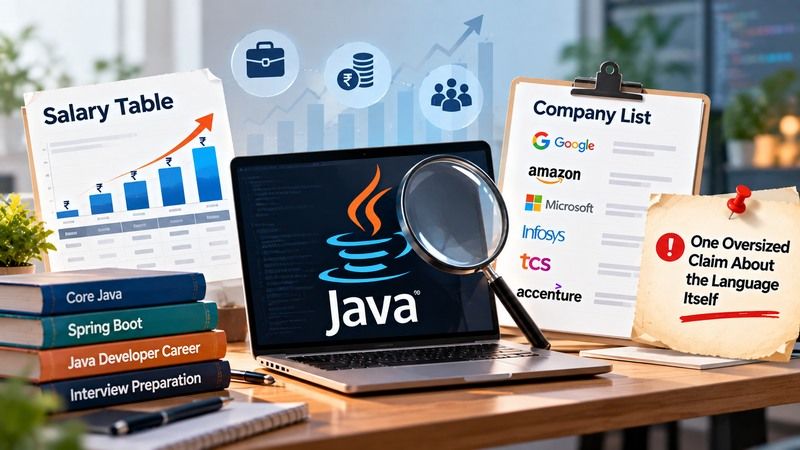

Checking the 2026 Case for Java: The Salary Table, the Company List, and One Oversized Claim About the Language Itself
Table of Contents
- 1. Introduction
- 2. "More Than Half the World's Applications Run on Java" — Where That Number Actually Comes From
- 3. The Salary Table's Weakest Row: "Entry-Level Java Developer, ₹5–8 LPA"
- 4. The Rest of the Table, Checked Band by Band
- 5. The Fourteen-Company List — What It Can and Can't Prove
- 6. "No Other Language Integrates With Cloud and Automation as Smoothly" — A Claim That Overreaches
- 7. What Actually Checks Out
- 8. The Real Numbers at Innovative Academy
- 9. FAQs
- 10. Final Thoughts
Java remains one of the most established programming languages for enterprise software, backend development, and large-scale applications. But some popular claims about Java salaries, company demand, and its role in cloud computing need closer examination.
This guide checks those claims one by one, separating documented market information from promotional language. It also looks at what Java actually offers learners considering a career in software development in 2026.
1. Introduction
Nothing in a "Why Java in 2026?" pitch needs to be dismissed simply because some of its supporting claims are overstated. Java remains a durable programming language with a substantial enterprise footprint and continued relevance in backend and application development.
However, four specific claims deserve a closer look before someone uses them to build a career plan: an opening statistic with no clear count behind it, a salary table whose first row may confuse experienced salaries with genuine entry-level compensation, a company roster that implies more than fourteen names can prove, and an absolute claim about Java's position in cloud and automation.
The distinction matters. A strong technology does not need exaggerated statistics to remain valuable.
2. "More Than Half the World's Applications Run on Java" — Where That Number Actually Comes From
"More than half the world's applications run on Java" sounds precise, but the wording raises an immediate question: what exactly is being counted?
Different technology surveys measure different things, including websites, programming-language popularity, devices, developer activity, or software projects. These measurements cannot automatically be converted into a percentage of all applications worldwide.
For example, measurements of Java's server-side website presence provide useful evidence about its web footprint, but they do not establish that Java powers a majority of all software applications. Likewise, programming-language popularity indexes measure interest or usage indicators rather than the percentage of every application running in production.
Java's continued appearance near the top of programming-language rankings is meaningful. It demonstrates that the language remains relevant decades after its introduction. But "top-ranked programming language" and "more than half of the world's applications" are fundamentally different claims.
Older Java marketing has also used very large figures concerning devices running Java. Those figures refer to a much broader category than the specific claim that more than half of the world's applications run on Java.
The safer conclusion is straightforward: Java has a large and durable software ecosystem, but a majority-of-all-applications statistic should not be presented without a clearly defined methodology and source.
3. The Salary Table's Weakest Row: "Entry-Level Java Developer, ₹5–8 LPA"
The ₹5–8 LPA entry-level figure is the part of the salary table that requires the most caution.
Salary aggregators often combine employees with different amounts of professional experience when reporting headline averages. That can make an overall average look like a realistic starting salary for a first-time employee.
For a fresher, actual compensation can be considerably lower than the headline average. Experience, location, employer type, technical skills, interview performance, degree, internships, and the specific development role can all influence an offer.
Consequently, treating ₹5–8 LPA as a guaranteed or typical first-job outcome would give learners an unnecessarily narrow picture of the market.
A more responsible interpretation is to separate fresher compensation from salaries earned after several years of professional experience.
4. The Rest of the Table, Checked Band by Band
Mid-Level Java Engineer: ₹8–14 LPA
This range becomes more plausible once a developer has moved beyond the first stage of their career. Developers with several years of experience can command substantially more than fresh graduates, particularly when they have strong Spring Boot, REST API, database, cloud, testing, and system-design skills.
The important qualification is that this should not be interpreted as a normal starting salary for a fresher.
Senior Java Developer: ₹14–22 LPA
This range is more consistent with experienced Java development roles. Seniority typically brings responsibility for architecture, production systems, code quality, technical decisions, mentoring, and sometimes team leadership.
Actual compensation still varies substantially between employers and cities, so the range should be treated as an indicative market band rather than a guaranteed outcome.
Java Architect / Specialist: ₹22–40 LPA+
This range is possible at the upper end of the Java career ladder, but the ₹40 lakh figure should not be treated as a typical outcome for every Java Architect.
Higher compensation at this level usually reflects a combination of substantial experience, architectural responsibility, cloud knowledge, distributed systems expertise, leadership, domain knowledge, and the employer's compensation structure.
A better way to interpret the table is therefore:
- Fresher: Compensation can be significantly below the ₹5 lakh floor.
- Early career: Compensation can move into the mid-range as professional experience grows.
- Senior developer: ₹14–22 LPA can be a reasonable indicative range in the right market and role.
- Architect / specialist: ₹22 LPA and above is possible, but higher figures depend heavily on experience and responsibility.
5. The Fourteen-Company List — What It Can and Can't Prove
The list includes Infosys, Accenture, Wipro, TCS, IBM, Dell, Amazon, Google, Microsoft, Flipkart, Paytm, PhonePe, Swiggy, and Razorpay.
These are major technology employers, and Java skills can be relevant to backend and enterprise development roles across many large organizations.
However, a list of company names by itself does not establish that those companies "prefer Java-certified professionals."
A company may recruit Java developers while simultaneously hiring professionals who work with Python, JavaScript, TypeScript, Go, C#, C++, Kotlin, or other technologies. Job requirements also vary by team and role.
A specific, current job description is therefore more useful evidence than a collection of company logos. A job posting can show the actual role, required skills, experience level, location, and technology stack.
The more accurate statement is that Java skills can be relevant to roles at many large technology and enterprise employers. That is different from claiming that those companies universally prefer Java-certified candidates.
6. "No Other Language Integrates With Cloud and Automation as Smoothly" — A Claim That Overreaches
Java works well with modern cloud platforms, containers, CI/CD systems, application monitoring, databases, and enterprise infrastructure. That part of the argument is well supported by the size of its ecosystem.
The problem is the word "no."
Java is not the only language strongly associated with cloud and automation.
Python is widely used for automation, scripting, infrastructure tooling, testing, data workflows, and DevOps-related tasks.
Go has become particularly important in cloud-native infrastructure. Major cloud-native technologies and infrastructure tools have strong connections to Go, including Kubernetes and other components of the broader cloud ecosystem.
Java therefore should be viewed as one strong option for cloud-oriented software development, rather than as a language that uniquely dominates every aspect of cloud automation.
7. What Actually Checks Out
Once the exaggerated claims are removed, several important arguments for learning Java remain intact.
Java Has a Large Enterprise Footprint
Java has been used extensively in banking, financial services, insurance, telecommunications, e-commerce, enterprise applications, and other large-scale systems.
That installed base matters because organizations do not automatically replace mature software systems simply because newer programming languages become popular.
The Modern Java Stack Goes Beyond Core Syntax
A career-oriented Java curriculum should not stop with basic syntax, object-oriented programming, or legacy servlet development.
Modern Java development can involve technologies such as:
- Java and object-oriented programming
- Spring Boot
- Spring Security
- REST APIs
- Hibernate and JPA
- SQL and databases
- JUnit and Mockito
- Git and version control
- Docker
- Kubernetes
- Cloud platforms
- CI/CD workflows
This technology combination reflects a much more current approach to Java development than a syllabus focused mainly on servlets and JSP.
Java Can Connect to Multiple Career Directions
Java development can provide a foundation for backend engineering, enterprise application development, API development, full-stack development, cloud-oriented application development, and some DevOps-adjacent roles.
Those paths still require additional skills. Learning Java alone does not automatically qualify someone for every role in the software industry.
8. The Real Numbers at Innovative Academy
For learners considering Java training in Bangalore, the training approach matters as much as the language itself.
Innovative Academy's Java Full Stack course in Bangalore focuses on a broader development path rather than treating Java as an isolated programming language.
The program is built around practical development skills, project work, interview preparation, and career support. The goal is to help learners understand how the individual technologies connect to an actual development workflow.
Innovative Academy also reports a documented figure of 1,200+ graduates placed to date for its Java Full Stack program. This figure should be understood as an institute-reported outcome rather than as a guarantee that every future learner will receive a particular salary or placement.
The broader lesson is important: prospective students should look for specific, checkable information about curriculum, projects, training format, interview preparation, and reported outcomes rather than relying only on phrases such as "100% placement" or "highest salary."
9. FAQs
1. Is it true that more than half the world's applications run on Java?
There is no clearly traceable, universally accepted measurement that establishes that specific claim. Java has a substantial global software footprint, but statistics about website usage, language popularity, devices, or developer activity should not be converted into a claim that more than half of all applications run on Java.
2. Why does the ₹5–8 lakh "entry-level" salary figure look inflated?
Because headline salary averages can include developers with several years of experience. Genuine fresher compensation can be considerably lower, and the final offer depends on the employer, location, skills, degree, experience, interview performance, and role.
3. Does Java integrate with cloud and automation better than every other language?
No language should be described as uniquely superior across every cloud and automation use case. Java has a mature cloud ecosystem, while Python is widely used for automation and scripting and Go is strongly represented in cloud-native infrastructure.
4. Is Java still worth learning in 2026?
Java remains relevant for backend development, enterprise software, APIs, and large-scale applications. Its value for an individual learner depends on the career role they want, the skills they build around Java, and the quality of their practical experience.
5. What should a Java Full Stack learner study beyond Java?
A practical learning path can include Java, object-oriented programming, Spring Boot, REST APIs, databases, Hibernate/JPA, testing, Git, frontend fundamentals, Docker, cloud concepts, and project development.
6. Does learning Java guarantee a job?
No. Learning a programming language does not guarantee employment. Job outcomes depend on technical ability, practical projects, interview performance, communication skills, experience, employer requirements, and the broader hiring market.
10. Final Thoughts
The case for Java in 2026 remains substantial even after its more aggressive marketing claims are removed.
Java has a long-established enterprise presence, a large ecosystem, modern frameworks, and continued relevance in backend development. Those are strong reasons to consider it without relying on inflated statistics.
The claims that need correction are narrower: the unsupported "more than half the world's applications" statistic, the potentially misleading entry-level salary band, the company list presented as proof of universal Java preference, and the claim that Java uniquely dominates cloud and automation.
For someone evaluating a Java career, the more useful question is not whether Java is the only language worth learning. It is whether Java, combined with modern frameworks, databases, APIs, cloud knowledge, testing, version control, and practical projects, matches the role they want to pursue.
That is a much more realistic way to evaluate the Java career path in 2026.