
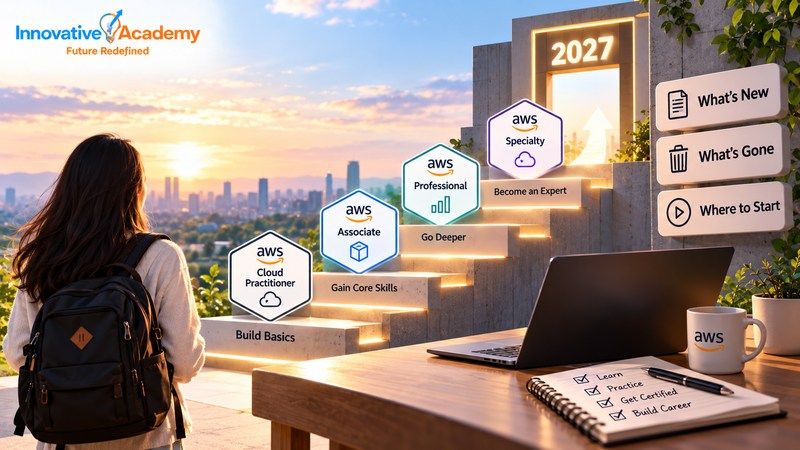

The AWS Certification Path for 2027: What's New, What's Gone, and Where to Start
Table of Content
- Introduction
- The Levels and What Each One Is Actually For
- Where to Actually Start
- The Associate-Level Fork in the Road
- Professional and Specialty: Who Actually Needs These
- What Changed on the Way Into 2027
- What Each Level Actually Costs
- A Realistic Path for Someone Starting From Zero in 2027
- Learning AWS at Innovative Academy
- FAQs
- Final Thoughts
Introduction
The AWS certification lineup someone researches in 2027 looks noticeably different from the one a two-year-old roadmap article describes—AWS has retired, refreshed, and added certifications at a faster pace recently than it has in years, particularly around AI. This lays out the lineup as it actually stands heading into 2027, what changed to get there, what each level costs, and a realistic order for someone starting without prior cloud experience.
The Levels and What Each One Is Actually For
AWS's certifications still sit across four main tiers, plus a newer AI-focused business track that sits somewhat apart from the rest.
- Foundational certifications establish broad awareness of AWS services and cloud concepts without requiring hands-on technical depth.
- Associate-level certifications test practical, role-specific ability—actually architecting, developing, or operating on AWS, not just recognizing service names.
- Professional-level certifications test advanced high-stakes judgment across complex, multi-service scenarios and officially recommend at least two years of hands-on AWS experience before attempting them.
- Specialty certifications go deep on one specific technical domain rather than testing breadth.
Where to Actually Start
For almost anyone without prior cloud experience, AWS Certified Cloud Practitioner is still the sensible starting point heading into 2027, and it's explicitly designed that way—no technical background is assumed, and it covers foundational AWS service awareness, basic billing and pricing concepts, and high-level architectural principles rather than hands-on configuration. It's not usually the certification that gets someone hired on its own, but it's the fastest way to build a coherent mental map of AWS's service catalog before specializing.
AWS also now offers a parallel AI Practitioner foundational certification, covering AI/ML concepts on AWS specifically, for anyone whose career direction is pointing toward that side of the platform instead—and that side of the platform has only gotten more central to AWS's own roadmap over the past year.
The Associate-Level Fork in the Road
This section is where the path actually branches based on what kind of AWS role someone's aiming for.
- AWS Certified Solutions Architect – Associate remains the most broadly useful starting point for most people, covering designing resilient, cost-effective architectures across AWS's core services—it's the certification most hiring managers recognize by name even outside specialized cloud roles.
- AWS Certified Developer – Associate fits someone who writes application code that runs on AWS rather than designing the infrastructure itself.
- AWS Certified CloudOps Engineer – Associate, which has effectively replaced the older SysOps Administrator track, fits someone responsible for day-to-day operations, monitoring, and deployment automation.
- Data Engineer – Associate and Machine Learning Engineer – Associate exist specifically for people heading toward data pipeline or ML-focused roles.
Professional and Specialty: Who Actually Needs These
AWS Certified Solutions Architect – Professional and AWS Certified DevOps Engineer – Professional sit at the top of the general track, and both officially assume real hands-on experience—these aren't exams to attempt as a second or third certification without having actually worked with AWS first.
A new AWS Certified Generative AI Developer – Professional certification has joined this tier as well, validating the ability to build production-ready AI solutions using foundation models, retrieval-augmented generation architectures, and vector databases—a genuinely new addition rather than a rebrand of something older.
At the specialty level, AWS Certified Security – Specialty remains active, now in its current SCS-C03 version with expanded coverage of generative AI and machine learning security topics. Specialty certifications are worth pursuing specifically when a role or career direction genuinely concentrates in that one area, not as a general "collect more badges" strategy.
What Changed on the Way Into 2027
This section is the part that makes 2027's lineup genuinely different from what older guides describe, not just a different year printed on the same list.
- AWS Certified Machine Learning – Specialty retired on March 31, 2026—it's gone from the active lineup entirely by 2027, though people who earned it before that date keep the credential through its original expiration.
- AWS Certified Advanced Networking – Specialty is also scheduled to retire at the end of 2026, meaning it will no longer be available to new candidates starting in 2027.
- In their place, AWS has leaned hard into AI-specific credentials: the Generative AI Developer – Professional certification mentioned above, the foundational AI Practitioner certification, and the business-focused AI Business Strategist certification have all launched in roughly the past year.
The practical takeaway for 2027 specifically: the core architecture and operations certifications—Cloud Practitioner, Solutions Architect, and DevOps Engineer—are still the most stable and widely recognized part of the lineup, but the specialty tier has shifted meaningfully toward AI and away from some of the narrower technical specialties that used to sit there.
What Each Level Actually Costs
Exam pricing is tiered by level and has stayed consistent through this round of lineup changes:
- Foundational exams: $100
- Associate exams: $150
- Professional and specialty exams: $300 each
A realistic path from Cloud Practitioner through one associate certification to one professional certification still runs $550 in exam fees alone heading into 2027, before counting study materials, practice exams, or retake fees.
A Realistic Path for Someone Starting From Zero in 2027
A sensible sequence for someone with no prior AWS experience starting in 2027:
- Begin with Cloud Practitioner to build foundational awareness and confirm genuine interest in the platform.
- Move to Solutions Architect – Associate as the single most broadly useful next credential regardless of eventual specialization.
- Choose a second associate certification—Developer or CloudOps Engineer—based on which kind of work actually ends up being more appealing in practice.
- Only pursue a professional-level certification once you have real, hands-on AWS experience to draw on.
If AI-focused work is your actual career direction, know that the Generative AI Developer – Professional certification now exists as a dedicated path for it, rather than something to approach only through the older, now-retired Machine Learning Specialty route.
Learning AWS at Innovative Academy
Innovative Academy's AWS Training program in Bangalore is structured around exactly this foundational-to-associate progression, working inside real AWS accounts so the Solutions Architect and Developer-level concepts covered in this certification path get practiced hands-on rather than studied purely from exam-prep material—the difference between a certification earned alongside genuine ability and one earned in isolation from it.
FAQs
- I already studied for the Machine Learning – Specialty exam before it retired—does that work still count for anything?
The underlying ML knowledge is still entirely relevant to AWS's newer AI-focused certifications, like AI Practitioner and Generative AI Developer – Professional, even though the specific Machine Learning – Specialty exam itself is no longer available to sit for new candidates.
- Which associate certification is most valuable if I'm not sure yet which direction I want to specialize in?
Solutions Architect – Associate, specifically because it's the most broadly recognized by name across different kinds of AWS-related roles, even ones that aren't architecture-focused day to day.
- Is the new Generative AI Developer – Professional certification worth pursuing instead of Solutions Architect – Professional?
That depends entirely on career direction—it's worth pursuing specifically for someone building production AI applications on AWS, but it doesn't replace Solutions Architect – Professional's broader relevance for general cloud architecture roles.
- Does AWS's push into AI-specific certifications mean the traditional architecture certifications are becoming less important heading into 2027?
Not based on what's actually in the current lineup—Solutions Architect and DevOps Engineer remain core, widely recognized credentials; the retirements and new AI tracks are reshaping the specialty tier specifically, not displacing the foundational and associate-level core.
- How long does it realistically take to go from zero experience to Solutions Architect – Associate?
That depends heavily on prior technical background and study pace, but a structured course followed by dedicated practice-exam preparation over a few months is a realistic timeline for someone starting without existing cloud experience.
Final Thoughts
The AWS certification lineup heading into 2027 has genuinely moved, not just aged by a year—two specialty certifications have gone, a new professional-level AI certification has arrived, and the center of gravity around AI credentials has shifted noticeably. For most people, though, the practical starting path hasn't actually changed: start foundational, pick one associate certification that matches the work actually wanted, and treat professional-level certifications as something earned alongside real experience rather than raced toward.