
Apple Finally Shipped Its Generative AI Siri—Here's What Actually Changed With iOS 27
Table of Contents
- 1. Years in the Making, Released September 14
- 2. What "Siri AI" Actually Does Differently
- 3. A New, Dedicated Siri App
- 4. Which Devices Actually Get the New Siri
- 5. Why It's Not Available Everywhere Yet
- 6. The Rest of the September 2026 Release Wave
- 7. Why Apple Took This Long
- 8. What This Means for Developers and Businesses Building on iOS
- 9. Build These Skills—Innovative Academy
- 10. Final Thoughts
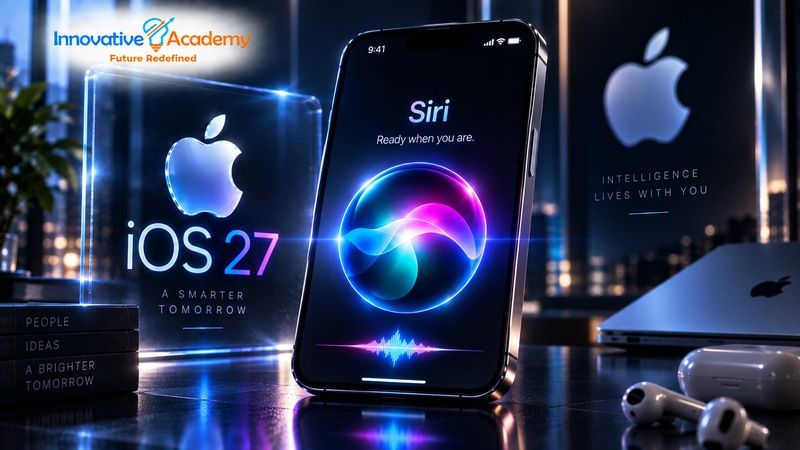
Apple's biggest and longest-delayed Siri overhaul finally reached real users on September 14, 2026. iOS 27, alongside macOS Golden Gate, iPadOS 27, watchOS 27, and visionOS 27, shipped with what Apple is simply branding "Siri AI"—a generative-AI-powered rebuild of the assistant that's been the subject of speculation, leaked demos, and repeated delays for well over a year.
1. Years in the Making, Released September 14
The new Siri arrives as part of a coordinated release across Apple's entire device lineup, all landing on the same day.
That synchronized rollout matters because Siri AI isn't a standalone feature. It's built to work consistently across iPhone, iPad, Mac, Apple Watch, and Vision Pro, which meant Apple needed every platform update ready at once rather than staggering the rollout device by device.
The release represents a significant step in Apple's broader transition toward generative AI and more context-aware computing.
2. What "Siri AI" Actually Does Differently
The headline change is Siri's ability to access personal information across a user's various apps and use on-screen context to shape more relevant responses.
This is a meaningful difference from the pattern-matching, command-based Siri of previous years. Rather than requiring narrowly phrased requests, the new Siri is designed to understand what's happening on someone's screen and pull in relevant personal data from across the device.
This brings Siri closer to the behavior users have come to expect from modern generative AI assistants.
For example, an AI assistant that understands the content displayed on a screen can potentially provide more contextual answers instead of treating every request as an isolated command.
Understanding how these systems work requires knowledge of programming, artificial intelligence, APIs, data processing, and automation. Students interested in developing these skills can explore Python Training in Bangalore at Innovative Academy.
3. A New, Dedicated Siri App
Alongside the capability upgrade, Apple introduced a standalone Siri app—a dedicated space for interacting with the assistant directly, rather than relying solely on traditional voice activation or Spotlight-style entry points.
That's a notable structural shift. It signals that Apple is treating Siri less like a background utility and more like a primary AI product that users might open and interact with intentionally, similar to how people use dedicated chatbot applications.
Usage of the new capabilities is subject to limits, an approach consistent with how AI providers manage the computational cost of generative features at scale.
From Voice Assistant to AI Interface
The change also reflects a broader shift in how people interact with computers. Instead of navigating through menus and applications for every task, users increasingly expect AI systems to understand natural language, context, and intent.
This trend is creating new opportunities for developers who understand both traditional software development and modern AI technologies.
4. Which Devices Actually Get the New Siri
Siri AI isn't available on every device that can run iOS 27. The generative AI functionality is restricted to hardware capable of supporting Apple Intelligence.
iPhone
- iPhone 15 Pro
- iPhone 15 Pro Max
- iPhone 16 series and later
iPad
- iPad mini with the A17 Pro chip
- iPads with M1 or later
Mac
- Mac models with M1 or later
Apple Watch
- Apple Watch Series 9 and later
- Apple Watch Ultra 2 and later
- Apple Watch SE 3 and later
Apple Vision Pro
Apple Vision Pro is also included among the supported devices for the new AI capabilities.
The base iOS 27 update itself installs more broadly on iPhone 11 and newer, along with the second- and third-generation iPhone SE. However, the generative AI features specifically require newer Apple Intelligence-capable hardware.
5. Why It's Not Available Everywhere Yet
Siri AI launched in English only, with French, Japanese, Korean, Portuguese, and Spanish support scheduled to roll out in October 2026.
More notably, the feature is unavailable at launch in both the European Union and China, as Apple continues navigating privacy and regulatory requirements specific to those markets.
That's a meaningful gap for a company with substantial user bases in both regions. It also highlights how regulatory requirements increasingly influence the global rollout of AI-powered products.
Privacy and Regulation
AI assistants that can access personal information introduce additional privacy and security considerations. Developers need to understand how applications collect, process, store, and share information while still providing useful AI-powered functionality.
This makes areas such as Cybersecurity Training, networking, cloud computing, and AI development increasingly relevant for modern technology careers.
6. The Rest of the September 2026 Release Wave
Siri wasn't the only major change in this release cycle.
macOS Golden Gate shipped alongside iOS 27 with app launch speeds reportedly up to 30% faster and refinements to Apple's Liquid Glass design language, improving customization and readability across the interface.
Bundling meaningful performance work with the headline AI feature is a deliberate move. It gives users tangible day-to-day improvements even in markets or on devices where the new Siri isn't yet available.
The wider release also demonstrates how modern operating systems are becoming increasingly integrated platforms for AI, cloud services, applications, and automation.
7. Why Apple Took This Long
Apple's generative AI Siri has been anticipated, delayed, and reported on extensively since it was first previewed. The gap between announcement and actual shipping became one of the more closely watched storylines in consumer technology over the past couple of years.
Getting an AI assistant to reliably access personal data across a user's apps—such as calendar, messages, photos, and email—while maintaining Apple's privacy commitments is considerably harder than building a general-purpose chatbot.
The extended timeline therefore reflects the engineering and policy challenges involved in creating an AI assistant capable of operating within a deeply integrated personal computing environment.
Why Context Makes AI Harder
A general-purpose chatbot can answer a question using information supplied directly by the user. A personal AI assistant needs to understand context, permissions, application data, device state, and user intent.
That requires multiple layers of technology working together, including:
- Large language models
- Natural language processing
- Context management
- Application programming interfaces
- Data privacy controls
- Cloud and edge computing
- Security and authentication
These technologies are increasingly becoming core skills for AI and software developers.
8. What This Means for Developers and Businesses Building on iOS
For developers and businesses building on Apple's platforms, a Siri that can reason over on-screen context and personal data across apps changes what's worth building.
App experiences that integrate cleanly with system-level AI context, rather than operating as isolated silos, are positioned to benefit directly from this type of platform-level intelligence.
This dynamic is already becoming familiar across the technology industry. As AI becomes more deeply integrated into operating systems and applications, some traditional user interactions can increasingly be handled directly through intelligent assistants.
AI Integration Is Becoming a Developer Skill
Developers building modern applications need more than programming syntax. They increasingly need to understand APIs, AI models, automation, cloud platforms, databases, security, and application architecture.
For learners building a foundation in software development, Java Full Stack training can provide exposure to frontend and backend development concepts that are useful when building modern applications.
Similarly, learners interested in Python-based AI development can explore Python training in Bangalore to build programming fundamentals and practical development skills.
9. Build These Skills—Innovative Academy
Understanding how modern AI assistants are built—the models, context-handling systems, APIs, and integration layers that enable an assistant to reason across applications and personal data—begins with genuine programming fluency.
Innovative Academy's Python Training in Bangalore focuses on building a practical programming foundation that can help learners progress toward AI, automation, software development, and data-driven technologies.
For learners interested in cloud infrastructure and the technologies that support AI-powered applications, Innovative Academy also provides AWS Training in Bangalore.
Those interested in building and deploying applications through modern development pipelines can explore the DevOps Bootcamp Training in Bangalore, covering technologies and practices used across software development, cloud infrastructure, automation, and deployment.
Skills Worth Building for the AI Era
- Python programming
- Artificial intelligence fundamentals
- Cloud computing
- API integration
- Software development
- Automation
- DevOps and deployment
- Cybersecurity
- Data and application architecture
These skills can help learners understand not only how to use AI tools, but also how AI-powered applications are designed, developed, integrated, and deployed.
10. Final Thoughts
What makes this Siri AI launch worth paying attention to isn't simply that Apple finally shipped a long-promised feature. The more important story is the scale of the coordinated rollout and how privacy, regulation, hardware requirements, and AI infrastructure shaped the final product.
A generative AI assistant with access to personal context across applications represents a fundamentally different product category from the command-based Siri that came before it.
For anyone building a career in AI development, software engineering, cloud computing, or mobile application development, Apple's Siri AI rollout offers a useful real-world case study in what it takes to ship generative AI responsibly at consumer scale.
The next generation of applications will increasingly combine traditional software with AI models, contextual information, automation, and cloud infrastructure. Developers who understand these technologies will be better positioned to build the applications and services that emerge from this shift.
To build the technical foundation required for this evolving technology landscape, explore Innovative Academy's IT training programs and develop practical skills across programming, cloud computing, DevOps, networking, and AI.