
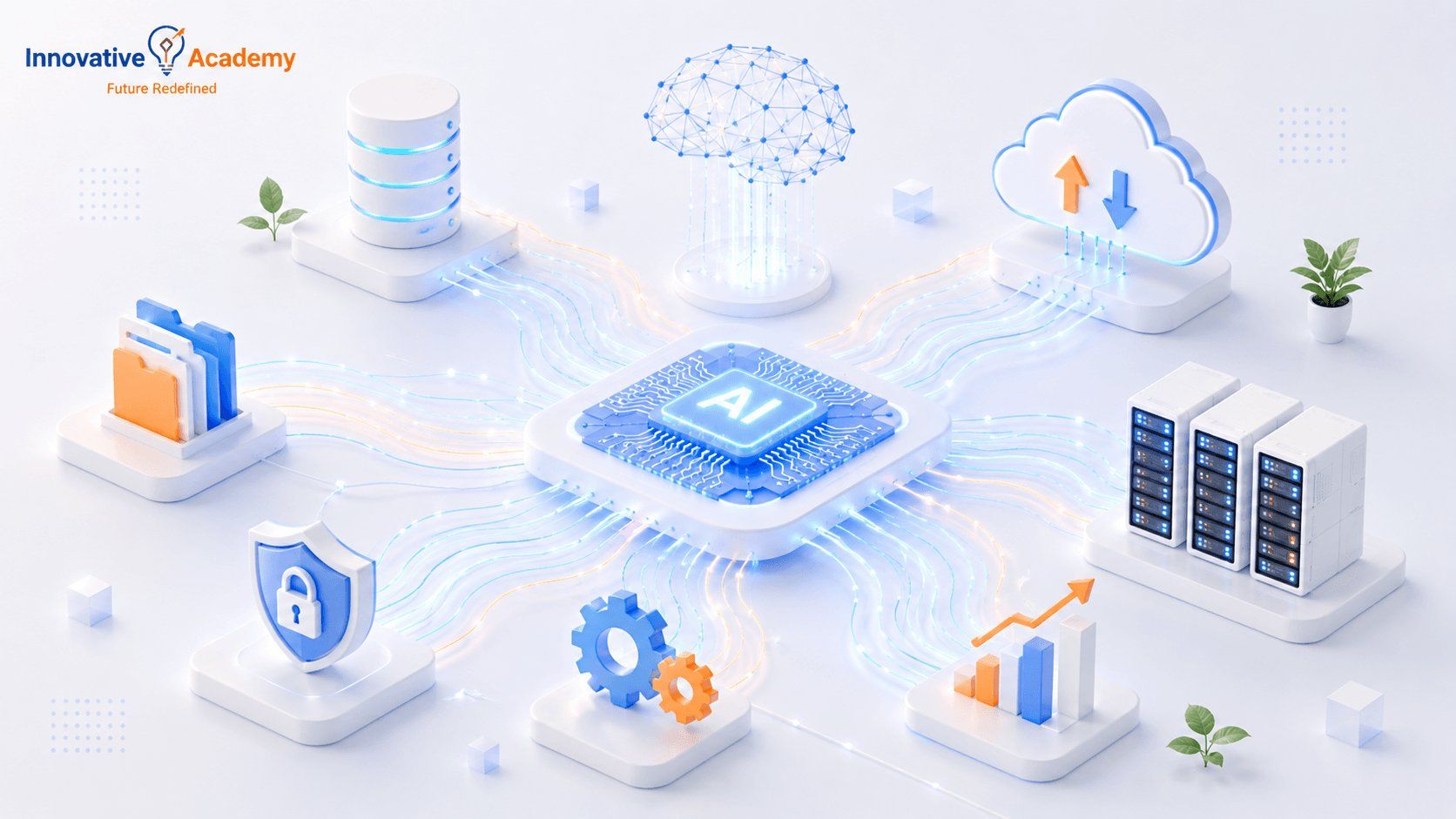

AI Needs More Than GPUs: Why Networking Is Becoming the Backbone of AI
Table of Contents
- Why Do AI Systems Need So Much Networking?
- Traditional Networking vs. AI Networking
- Scale-Up vs. Scale-Out Networking
- Ethernet vs. InfiniBand
- Why Network Congestion Matters for AI
- The Rise of High-Speed Ethernet
- Why Networking Matters for AI Inference
- What Does This Mean for Network Engineers?
- Why CCNA Fundamentals Still Matter
- The Future of AI Infrastructure
- What Should Students Learn for an AI-Driven Future?
- Final Thoughts
When people talk about the artificial intelligence boom, the conversation often focuses on one thing: GPUs. Companies are racing to build larger AI models, deploy more powerful processors, and construct enormous data centers capable of handling increasingly demanding workloads.
But there is another piece of the AI infrastructure puzzle that is becoming impossible to ignore: networking.
A GPU can perform billions of calculations, but modern AI systems rarely depend on a single GPU. Large-scale AI workloads distribute computation across many processors, servers, racks, and sometimes entire data centers. All of these components need to communicate rapidly.
That communication happens through the network.
As AI clusters scale to thousands—and increasingly hundreds of thousands—of GPUs, networking is becoming a major factor in how efficiently those systems operate.
The message is becoming clear:
AI may be powered by GPUs, but networking is what allows those GPUs to work together at scale.
Why Do AI Systems Need So Much Networking?
To understand the importance of networking, imagine a large AI model being trained across hundreds or thousands of GPUs. Instead of one processor handling the entire workload, the task is divided among many processors.
A simplified process looks like this:
GPU → Network Interface → Switch → Network → Other GPU → Switch → GPU
The GPUs constantly exchange information during distributed training and inference. If that communication is slow, the GPUs may spend time waiting for data.
That means expensive computing resources can remain underutilized.
This creates an important relationship:
- Faster GPUs + Slow Network = Potential Bottleneck
- Faster GPUs + High-Performance Network = Better Utilization
So, buying more powerful GPUs is only part of the solution. The infrastructure connecting them needs to keep pace.
Traditional Networking vs. AI Networking
Traditional enterprise networks are designed to connect users, applications, servers, storage systems, and cloud services. AI networks have some of the same fundamental principles, but their workloads can be dramatically different.
Large AI clusters can generate huge volumes of traffic between GPUs. Training workloads may require many processors to exchange information in a highly synchronized way.
This creates demanding requirements for:
- High bandwidth
- Low latency
- Predictable performance
- Congestion management
- Efficient data movement
- High availability
- Scalability
- Fast recovery from failures
In other words, an AI network isn't simply connecting computers. It is helping those computers behave like one coordinated computing system.
Scale-Up vs. Scale-Out Networking
One useful way to understand AI networking is to divide it into scale-up and scale-out.
Scale-Up Networking
Scale-up focuses on connecting processors or accelerators closely together within a system or rack. The goal is extremely fast communication between computing resources.
Technologies such as NVIDIA NVLink are designed to provide high-bandwidth communication between GPUs and other accelerators. This allows multiple accelerators to work together as a tightly connected computing resource.
Scale-Out Networking
Scale-out takes the concept much further.
Server → Rack → Rack → Data Center → Multiple AI Clusters
This allows AI workloads to run across many machines. Modern scale-out AI networks commonly rely on high-bandwidth Ethernet fabrics and specialized networking technologies designed to handle the traffic generated by distributed AI workloads.
The larger the AI cluster becomes, the more important scale-out networking becomes.
Ethernet vs. InfiniBand
Two technologies frequently appear in discussions about high-performance AI networking: Ethernet and InfiniBand.
InfiniBand
InfiniBand has traditionally been important in high-performance computing and AI environments because it is designed for high throughput and low-latency communication.
It also supports technologies such as RDMA, which can allow data to move between systems with reduced CPU involvement.
Ethernet
Ethernet is one of the most widely deployed networking technologies in the world. Its huge ecosystem, interoperability, and established infrastructure make it attractive for large-scale AI deployments.
Traditional Ethernet is also evolving. Networking companies are developing Ethernet platforms specifically optimized for AI workloads, including technologies for congestion management, traffic optimization, and high-speed data movement.
The result is an interesting shift:
Ethernet is no longer just the network connecting ordinary enterprise systems. It is increasingly being engineered to connect massive AI clusters.
Why Network Congestion Matters for AI
Imagine having 1,000 powerful GPUs ready to process a workload. Now imagine the network becomes congested.
Some GPUs receive data quickly. Others have to wait. Eventually, parts of the computing cluster may sit idle.
Network congestion can therefore translate into:
- Longer training times
- Lower GPU utilization
- Higher infrastructure costs
- Slower AI application performance
- Less predictable workloads
As AI clusters grow, these problems become more difficult to manage. The reason is simple: when the cluster becomes enormous, even small networking inefficiencies can have a large impact.
The Rise of High-Speed Ethernet
AI workloads are pushing networking speeds higher. The industry has moved from 400G networking toward 800G and is working toward increasingly higher-speed networking for demanding AI infrastructure.
NVIDIA has also introduced high-capacity Ethernet switching platforms designed for large-scale AI infrastructure.
Why does this matter?
Because AI isn't only generating more computation. It is generating more data movement.
The simplified relationship looks like this:
- More GPUs
- More distributed computation
- More data exchanged
- More network traffic
- Higher bandwidth requirements
This is why networking has become such a major part of the AI infrastructure race.
Why Networking Matters for AI Inference
Networking isn't only important when training AI models. It is equally important when those models are used to serve real users.
This process is called inference.
Every time an AI application generates a response, infrastructure needs to:
- Receive the request
- Route it to the appropriate systems
- Process the workload
- Access the required data
- Generate the output
- Return the result
At large scale, thousands or millions of requests may be processed. This shows that networking isn't just a training requirement. It is becoming a critical part of production AI infrastructure.
What Does This Mean for Network Engineers?
This shift creates an interesting opportunity for networking professionals.
The traditional network engineer might have worked primarily with:
- Routers
- Switches
- Firewalls
- VLANs
- IP addressing
- Routing protocols
- Enterprise networks
Those fundamentals aren't disappearing. Instead, they are being extended into new environments.
The future network engineer may increasingly work with:
- AI data centers
- GPU clusters
- High-speed Ethernet
- Cloud networking
- Network automation
- Data-center fabrics
- AI workload monitoring
- Network security
- Infrastructure optimization
This means networking knowledge can become a foundation for moving into emerging areas of technology.
Why CCNA Fundamentals Still Matter
With all the discussion around GPUs, AI models, and high-speed networking, it can be easy to assume that traditional networking certifications are becoming less relevant.
The opposite may be true. The technologies may become more advanced, but the fundamentals remain important.
A professional working with complex infrastructure still needs to understand:
- IP addressing
- Subnetting
- Routing
- Switching
- VLANs
- TCP/IP
- Network troubleshooting
- Network security
- Connectivity
You cannot effectively troubleshoot a complex network if you don't understand how networks communicate at a fundamental level.
A CCNA-level foundation can therefore serve as a starting point for learning more advanced areas such as:
Networking → Linux → Cloud → Python → Automation → Data Center Networking → AI Infrastructure
The goal isn't to stop at CCNA. The goal is to use networking fundamentals as a foundation for continuing to learn.
If you're looking for structured, hands-on training, explore CCNA training in Bangalore at Innovative Academy.
You can also explore the broader Networking, Cloud and IT training programs available at Innovative Academy.
The Future of AI Infrastructure
AI infrastructure is moving toward increasingly large and distributed systems. Modern AI factories may contain enormous numbers of processors working together.
At this scale, the network becomes more than a communication layer. It becomes part of the computing architecture itself.
Future AI infrastructure will increasingly need to optimize:
- Compute
- Networking
- Storage
- Power
- Cooling
- Security
- Software
- Automation
And these systems will need to operate together.
This is why companies are increasingly describing AI data centers as integrated AI factories rather than simply collections of servers.
What Should Students Learn for an AI-Driven Future?
The good news is that students don't need to learn everything at once. A strong technology foundation can be built step by step.
Step 1: Learn Networking
- Networking fundamentals
- IP addressing
- Subnetting
- Routing
- Switching
- VLANs
- Troubleshooting
A structured CCNA program can help students develop these networking fundamentals through practical learning.
Step 2: Learn Linux
Linux is widely used in servers, cloud environments, containers, and infrastructure. Students interested in infrastructure careers can build on networking knowledge by learning Linux and cloud technologies.
Step 3: Learn Cloud Computing
Understand:
- Virtual machines
- Cloud networking
- Storage
- Security
- Infrastructure
Step 4: Learn Automation
Learn basic:
- Python
- Scripting
- APIs
- Infrastructure automation
Automation becomes increasingly valuable as infrastructure grows.
Step 5: Explore AI Infrastructure
Once the fundamentals are strong, students can explore:
- GPU clusters
- Data-center networking
- AI networking
- High-speed Ethernet
- RDMA
- AI infrastructure monitoring
- Cloud AI platforms
- AI security
This creates a broader skill profile than simply learning how to use an AI chatbot.
Final Thoughts
The AI revolution is often described as a competition for the fastest GPU or the largest AI model. But the real picture is much bigger.
AI systems depend on an entire technology stack.
- Power provides the energy.
- GPUs provide the computing power.
- Storage holds the data.
- Software controls the workloads.
- Security protects the infrastructure.
- Networking connects everything together.
As AI clusters become larger and more distributed, the ability to move data quickly, reliably, and efficiently becomes increasingly important.
That's why networking is moving from being a supporting layer of AI infrastructure to becoming one of its core components.
For students and IT professionals, this creates an important opportunity. You don't necessarily have to choose between AI and networking.
You can build a foundation in networking and gradually move toward cloud, automation, data centers, and AI infrastructure.
If you want expert-led training to start that journey, explore Innovative Academy's networking and IT programs, including hands-on networking and cloud-focused learning.
The future of AI won't be determined by compute alone. It will also depend on how effectively that compute can communicate.
GPUs may do the thinking—but networks make the thinking possible at scale.