
A Realistic Python Roadmap for 2027 (Built Around What's Actually Changing This Time)
Table of Contents
- Introduction
- Stage One: Syntax and Problem-Solving, Not Frameworks
- Stage Two: Data Structures and Handling Things Going Wrong
- Stage Three: Object-Oriented Programming
- Stage Four: Picking Up the Libraries That Actually Matter
- Stage Five: Choosing a Specialization, Not Chasing All of Them
- Stage Six: The Skills That Aren't "Python" But Get Treated Like They Are
- Where Python Actually Stands Heading Into 2027
- Why Skipping Stages Catches Up With People
- Learning Python at Innovative Academy
- FAQs
- Final Thoughts
1. Introduction
A lot of "Python roadmap" content promises a job-ready developer in four weeks, which undersells both how much there actually is to learn and how much of it only makes sense once something earlier in the sequence is genuinely solid. This is a roadmap built around the order things actually need to happen in, updated for where Python itself actually stands heading into 2027—not just the same six stages with the year changed in the title.
2. Stage One: Syntax and Problem-Solving, Not Frameworks
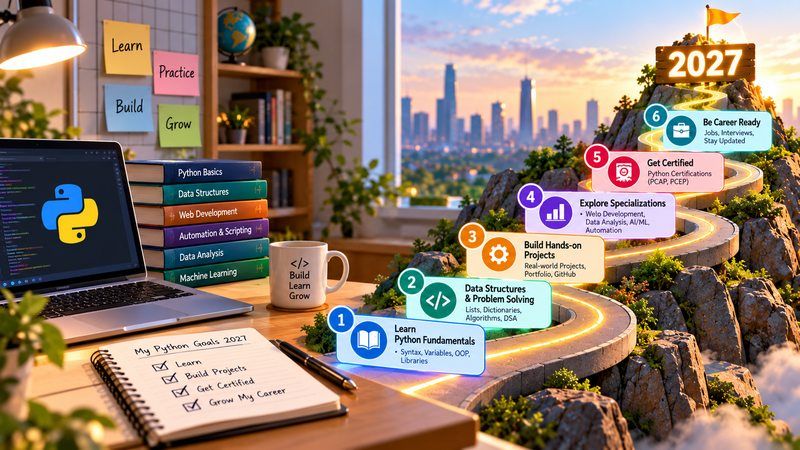
The first stage is deliberately unglamorous: variables, data types, loops, conditionals, and functions, practiced until writing a basic script doesn't require constantly checking syntax references. This stage is also where actual problem-solving habits get built—breaking a vague task into steps, testing small pieces of logic before combining them—which matters more long-term than the specific syntax being memorized, since syntax gets looked up constantly throughout an entire career while problem-decomposition skill compounds. Working in an interactive environment rather than only writing complete scripts from the start makes this stage considerably less frustrating, because mistakes get caught one line at a time instead of all at once.
3. Stage Two: Data Structures and Handling Things Going Wrong
Once basic syntax is comfortable, the next stage is Python's core data structures—lists, tuples, sets, and dictionaries—along with file handling and exception management. This is the stage where real programs start looking different from tutorial exercises: reading data from a file that might not exist, handling user input that might be malformed, and structuring data in the container that actually fits the problem rather than defaulting to a list for everything. Skipping ahead to frameworks before this stage is solid tends to produce code that works on the happy path shown in a tutorial and falls over on any input that the tutorial doesn't anticipate.
4. Stage Three: Object-Oriented Programming
Classes, inheritance, encapsulation, and polymorphism come next—organizing code around objects that bundle data and behavior together, rather than loose functions operating on loose variables. This stage is where many self-taught learners feel the biggest jump in difficulty, because OOP requires thinking about program structure at a higher level of abstraction than the previous two stages did. It's worth the friction: most production Python code, and essentially every popular framework or library you encounter in later stages, uses object-oriented patterns.
5. Stage Four: Picking Up the Libraries That Actually Matter
With fundamentals and OOP in place, the next stage is learning the specific libraries that make Python practically useful for real work:
- NumPy for numerical array operations
- Pandas for data manipulation and analysis
- Matplotlib for visualization
- Requests for calling APIs
- BeautifulSoup for web scraping
These five show up constantly across very different Python specializations, which is why they're worth learning as a shared foundation before branching into any one specific direction.
6. Stage Five: Choosing a Specialization, Not Chasing All of Them
This phase is the stage where trying to learn everything at once actually starts hurting rather than helping.
- Web development: a framework like Flask or FastAPI, building REST APIs, handling routes, and connecting to a database.
- Data science or AI-adjacent work: scikit-learn for traditional machine learning model training, some introduction to a deep learning framework like TensorFlow, and increasingly, working with APIs for large language models.
Both paths build on everything in Stages One through Four. Picking one specialization to go deep on, rather than shallowly sampling several, is what actually produces something demonstrable at the end of this stage.
7. Stage Six: The Skills That Aren't "Python" But Get Treated Like They Are
The last stage covers the skills that aren't technically part of the Python language but that every real Python job expects anyway: Git and version control for tracking changes and collaborating, basic Docker for packaging an application so it runs consistently outside one specific machine, and enough understanding of CI/CD pipelines to know what happens to code after it's written and tested locally. Deploying an actual project, even a small one, belongs here too, because the gap between "code that runs on my machine" and "code that runs reliably somewhere else, for other people" only closes by actually doing it at least once.
8. Where Python Actually Stands Heading Into 2027
This section is the part of the roadmap that genuinely needed updating, not just re-dating. Python 3.15 was originally scheduled for its first stable release on October 1, 2026; a few last-minute fixes pushed the final release back by about a week, to October 9, 2026. Either way, by the time 2027 actually begins, 3.15 is the current release—the one new environments should default to learning on.
That pushes the rest of the version lineup down a notch:
- Python 3.14 moves into bugfix maintenance—still fully supported, still receiving regular updates, just no longer the newest release.
- Python 3.13 shifts into security-only maintenance, meaning it still gets critical fixes but no further bugfix updates.
- Python 3.11 and 3.12 remain in security-only status as well, which in practice means they're fine for existing projects already built on them but not where a beginner starting fresh in 2027 should deliberately choose to learn.
What hasn't shifted at all is how much day-to-day Python work now touches AI in some form—integrating large language model APIs into otherwise ordinary applications has become common enough to treat as part of a modern roadmap, not a specialized add-on.
9. Why Skipping Stages Catches Up With People
The honest reason roadmaps get structured in stages rather than presented as a flat list of topics to learn in any order is that later stages genuinely depend on earlier ones holding up under pressure. Someone who jumps straight to Flask without solid exception-handling habits ends up writing an API that crashes on bad input instead of returning a sensible error. Someone who jumps to Pandas without comfortable object-oriented fundamentals ends up copying code patterns without understanding why they're structured that way, which falls apart the moment a project needs something slightly different from the tutorial it was copied from. None of this means every stage needs to be mastered perfectly before moving on—it means weak fundamentals have a way of resurfacing as confusing bugs several stages later.
10. Learning Python at Innovative Academy
Innovative Academy's Python program in Bangalore covers this same foundation-first sequence across 40 hours—syntax and problem-solving, then data structures and exception handling, then object-oriented programming—building toward real project work rather than rushing toward a framework before the fundamentals underneath it are solid, and it keeps its working examples current with whichever stable Python release is actually current, rather than teaching against a version that's already moved into maintenance mode.
11. FAQs
1. Should a beginner starting in 2027 learn Python 3.15 specifically?
Yes, as the newest stable release at that point, 3.15 is the sensible default—though if a specific tutorial, course, or employer environment is still standardized on 3.13 or 3.14, that's not a problem either, since the core language fundamentals covered in Stages One through Three barely differ between these recent versions.
2. Do I really need to learn OOP before touching any libraries or frameworks?
Not with zero exposure to libraries beforehand, but trying to seriously use most popular Python libraries and nearly every framework without understanding classes and objects means constantly working around concepts the documentation assumes are already familiar.
3. Is it better to pick a specialization (web dev vs. data science) early or stay general for longer?
Staying general through Stages One to Four is worth it regardless of eventual direction, since both paths depend on the same fundamentals—the specialization choice matters starting at Stage Five, not before.
4. Is it realistic to become job-ready in Python in four weeks, as some roadmap articles claim?
Not for most people starting from zero—the stages in this roadmap build on each other in a way that takes real practice time to internalize properly, and compressing that into a few weeks usually means skipping the practice that makes each stage actually stick.
5. Does it matter that Python 3.13 is moving to security-only status by 2027?
Not for learning purposes—security-only status means a version still receives critical fixes but no further feature or bugfix updates, which is a normal, well-supported state for existing production code, just not the version a brand-new learner should specifically seek when starting fresh.
12. Final Thoughts
A Python roadmap is genuinely a sequence, not a list—each stage in this one depends on the previous stage holding up, from basic syntax all the way through deployment. What's different heading into 2027 isn't the sequence itself, which hasn't changed, but the specific version sitting at the top of it—and keeping that one detail current is exactly the kind of small accuracy that separates a roadmap worth trusting from one that was clearly written once and never revisited.
Sources:
- Python Developer's Guide — Status of Python Versions
- Python.org — Downloads
- Scaler — Python Developer Roadmap 2026: 6-Month, Step-by-Step Guide
- Innovative Academy — Python Training in Bangalore