
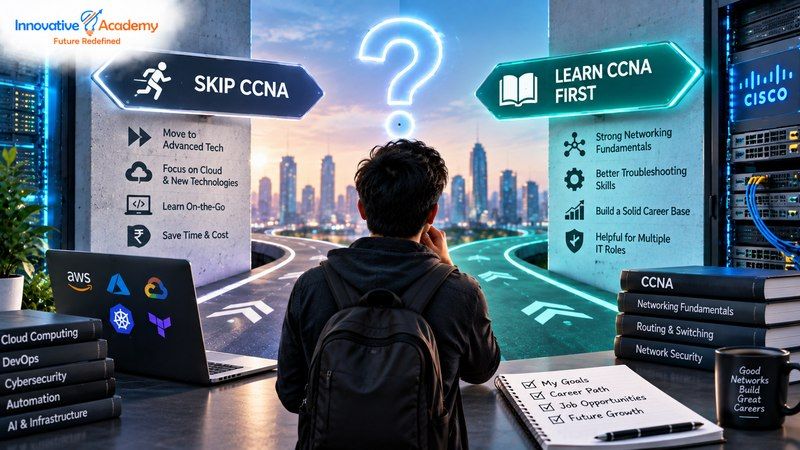

A Networking Beginner's Dilemma: Skip CCNA or Learn It First?
Table of Contents
- 1. A Familiar Situation
- 2. The Argument for Skipping Ahead
- 3. What That Argument Leaves Out
- 4. A Small Experiment Worth Running
- 5. The Honest Middle Ground
- 6. Picking Where to Study
- 7. FAQs
1. A Familiar Situation
Picture someone weighing two IT career paths at the start of 2027: a friend who insists cloud certifications are the only thing worth chasing now, and an older mentor who keeps pointing back to CCNA as the place to actually start. Both of them have a point, and untangling which advice fits your situation better is more useful than simply picking a side.
2. The Argument for Skipping Ahead
The friend's case isn't unreasonable. Job postings increasingly list cloud platform experience as a requirement, virtual infrastructure has replaced a giant share of what used to sit in physical server rooms, and automated tooling now handles configuration work that once required someone manually logging into individual devices.
From that vantage point, spending weeks on traditional routing and switching concepts can look like time spent studying a world that's quietly disappearing.
3. What That Argument Leaves Out
Here's the gap in that reasoning, though: cloud platforms didn't invent new networking concepts—they packaged the same ones, including routing, addressing, access control, and traffic flow, behind a different interface.
A virtual network inside a cloud console still routes traffic between subnets according to the same logic a physical router uses. A misconfigured security group in the cloud fails for essentially the same reason a misconfigured access control list fails on a physical network.
Learning the cloud-specific tooling without first understanding what it's actually doing underneath tends to produce someone who can follow a tutorial successfully but gets stuck the moment a real situation deviates from it even slightly.
4. A Small Experiment Worth Running
Here's a useful test for anyone genuinely torn on this: try explaining, in plain language, why a particular subnet can or can't reach another one, or why a specific piece of traffic gets blocked by a given rule.
If that explanation comes easily, the underlying fundamentals are probably already solid, and jumping straight into cloud-specific tooling is a reasonable move.
If it doesn't come easily—if the honest answer is "I'd have to look that up"—that's a fairly clear signal the foundation isn't there yet. Building it first through something like CCNA can help establish the networking knowledge that later cloud networking courses build upon.
5. The Honest Middle Ground
The mentor isn't wrong that fundamentals matter, and the friend isn't wrong that the industry has moved. Both things are simultaneously true, which is exactly why "skip CCNA entirely" and "ignore cloud skills entirely" are both weaker approaches than treating CCNA as the foundation a cloud specialization can be built on top of, rather than a competing alternative to it.
Cisco has incorporated modern networking concepts into the current CCNA certification, including automation and programmability alongside core networking topics. This reflects a networking profession that looks meaningfully different than it did a decade ago while still resting on fundamental networking principles.
Practically, that foundation can also support career paths such as network administration, network engineering, and technical support, while providing a progression toward more advanced Cisco certifications such as CCNP and CCIE.
None of that becomes irrelevant simply because more infrastructure now runs in the cloud. Networking professionals increasingly need to understand how traditional networking concepts connect with virtualized and cloud environments.
6. Picking Where to Study
Because so much of networking education comes down to genuinely understanding concepts rather than memorizing steps, where you study matters.
Before enrolling in a program, consider checking:
- How much time is dedicated to practical networking labs rather than only classroom presentations.
- Whether instructors can explain how traditional networking concepts apply to cloud environments.
- Whether the curriculum includes troubleshooting and practical scenarios.
- Whether students receive support beyond exam preparation.
- Whether the course is suitable for beginners and students transitioning into networking.
Innovative Academy's CCNA training in Bangalore focuses on building networking fundamentals while helping students understand how those concepts connect with modern networking and cloud-influenced environments. Classes are available both in person and online, with career and placement assistance extending beyond the certification exam.
7. FAQs
1. Is it a waste of time to learn CCNA if I plan to work mostly with cloud infrastructure?
No. Cloud networking uses many of the same underlying concepts covered in CCNA, although they are implemented and managed through different tools and interfaces. A strong networking foundation can make cloud networking concepts easier to understand and troubleshoot.
2. What's a realistic way to tell if I actually need to start with CCNA?
Try explaining why a specific network connection would or wouldn't work, in plain language, without looking anything up. If that is difficult, your networking fundamentals may need strengthening. CCNA can provide a structured way to build that foundation before moving into more specialized cloud networking material.
3. Where in Bangalore can I study CCNA in a way that connects it to modern cloud networking?
Innovative Academy in Bangalore offers CCNA training with an emphasis on networking fundamentals and their relevance to modern IT environments. Students can attend classes in person or remotely and receive placement assistance as part of the training journey.
Conclusion
For someone starting a networking career in 2027, the choice does not necessarily have to be CCNA versus cloud. A practical path can be to build strong networking fundamentals first and then apply those concepts to cloud platforms, automation, and modern infrastructure.
The more important question is whether you understand what the technology is doing underneath the interface. Once that foundation is clear, moving between physical networks, virtual networks, and cloud environments becomes considerably easier.