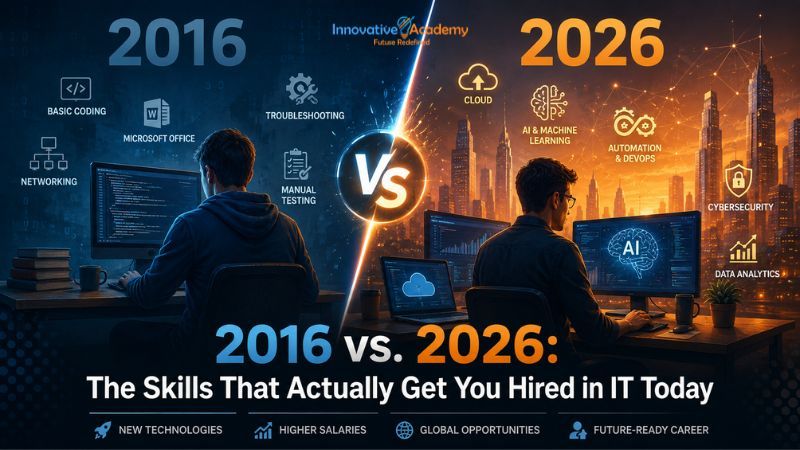

2016 vs. 2026: The Skills That Actually Get You Hired in IT Today
Table of Contents
- What Was the IT Industry Like in 2016?
- How Has IT Changed in 2026?
- 2016 vs. 2026 Skill Comparison
- Cloud Computing
- DevOps
- Linux
- Networking
- Cybersecurity
- Automation
- Artificial Intelligence
- Employer Expectations
- Certifications
- Career Opportunities
- Learning Roadmap
- FAQs
The IT industry has changed more in the last ten years than many other industries have changed in decades. In 2016, learning a programming language or earning a basic certification was often enough to land a decent IT job. Companies focused heavily on traditional infrastructure, desktop support, and manual deployment processes.
Fast forward to 2026, and the hiring landscape looks completely different. Cloud computing, automation, AI, DevOps, cybersecurity, and networking have become the backbone of modern businesses. Employers no longer hire candidates based solely on theoretical knowledge—they want professionals who can solve real-world problems, automate tasks, secure systems, and work across multiple technologies.
If you're planning to start or switch to an IT career, understanding this shift can help you invest your time in learning the right skills.
Let's compare what companies looked for in 2016 versus what they expect in 2026.
The IT Industry in 2016
A decade ago, most organizations relied heavily on physical servers, traditional networking equipment, and on-premise infrastructure.
Popular job roles included:
- Desktop Support Engineer
- System Administrator
- Network Engineer
- Hardware Engineer
- Technical Support Executive
- Database Administrator
Most companies maintained their own data centers, and software deployment was often a manual process.
Popular Skills in 2016
- Windows Server Administration
- CCNA Routing & Switching
- Basic Linux Administration
- Microsoft Office
- SQL
- Java
- PHP
- Manual Testing
- VMware Basics
While these skills were valuable then, technology has evolved significantly.
The IT Industry in 2026
Today's organizations operate differently.
Businesses are moving workloads to the cloud, applications are deployed multiple times a day, cybersecurity threats have increased, and artificial intelligence is changing workflows across industries.
Companies expect IT professionals to understand automation, cloud platforms, containers, infrastructure as code, and security best practices.
The focus has shifted from maintaining infrastructure to building, securing, automating, and optimizing it.
2016 vs. 2026 Skill Comparison
| 2016 | 2026 |
|---|---|
| Hardware Setup | Cloud Infrastructure |
| Manual Deployment | CI/CD Automation |
| Physical Servers | AWS, Azure & Google Cloud |
| Network Configuration | Cloud Networking |
| Basic Linux | Advanced Linux Administration |
| Manual Monitoring | AI-powered Monitoring |
| Traditional Security | Zero Trust Security |
| Basic Scripting | Python Automation |
| Standalone Roles | Cross-functional DevOps Teams |
| Fixed Infrastructure | Infrastructure as Code |
The demand has shifted toward professionals who can work across multiple technologies instead of specializing in only one traditional domain.
Skill #1: Cloud Computing
In 2016, many organizations managed their own physical servers.
Today, businesses prefer cloud providers because they offer scalability, flexibility, cost savings, and reliability.
Cloud computing has become one of the most valuable IT skills.
Popular platforms include:
- Amazon Web Services (AWS)
- Microsoft Azure
- Google Cloud Platform
Companies are actively hiring:
- Cloud Engineers
- Cloud Administrators
- Cloud Support Engineers
- Cloud Architects
- Cloud Consultants
Cloud knowledge has become essential rather than optional.
Skill #2: DevOps
One of the biggest changes between 2016 and 2026 is the rise of DevOps.
Previously:
- Developers wrote code.
- Operations teams deployed applications.
- Deployments often caused downtime.
Today:
DevOps combines development and operations through automation.
Popular DevOps tools include:
- Git
- GitHub
- Jenkins
- Docker
- Kubernetes
- Ansible
- Terraform
DevOps professionals automate deployments, reduce errors, and improve software delivery speed.
Companies love DevOps because it saves both time and money.
Skill #3: Linux
Linux has always been important, but today it's more valuable than ever.
Most cloud servers run Linux.
Popular technologies built on Linux include:
- Docker
- Kubernetes
- Apache
- Nginx
- Jenkins
Without Linux knowledge, learning DevOps or Cloud becomes difficult.
Every aspiring Cloud or DevOps Engineer should have strong Linux fundamentals.
Skill #4: Networking
Many people think networking is becoming obsolete because of the cloud.
The truth is exactly the opposite.
Cloud platforms still rely heavily on networking concepts.
Employers expect candidates to understand:
- IP Addressing
- Routing
- Switching
- VLANs
- DNS
- DHCP
- VPN
- Firewalls
- Network Security
Modern networking now includes cloud networking and software-defined networking.
Networking remains one of the strongest foundations for every IT career.
Skill #5: Cybersecurity
Cyber attacks have increased dramatically over the last decade.
Every organization now prioritizes cybersecurity.
Companies need professionals who understand:
- Identity Management
- Access Control
- Firewalls
- Vulnerability Assessment
- Incident Response
- Security Monitoring
- Cloud Security
- Endpoint Protection
Cybersecurity is now integrated into nearly every IT role.
Skill #6: Automation
Automation has replaced many repetitive manual tasks.
Instead of performing hundreds of configurations manually, IT professionals now automate everything.
Common automation skills include:
- Python
- Bash Scripting
- PowerShell
- Terraform
- Ansible
Automation increases productivity and reduces human error.
Employers highly value candidates who can automate routine operations.
Skill #7: Artificial Intelligence
In 2016, AI was mostly associated with research labs.
In 2026, AI has become part of everyday IT operations.
AI helps professionals:
- Analyze logs
- Detect threats
- Generate code
- Troubleshoot servers
- Automate documentation
- Monitor infrastructure
- Improve customer support
Rather than replacing IT professionals, AI is becoming a productivity tool that rewards those who know how to use it effectively.
Employers Want Problem Solvers
One major hiring trend in 2026 is that employers prioritize practical skills over memorized theory.
Recruiters look for candidates who have:
- Hands-on lab experience
- Real projects
- GitHub portfolios
- Cloud deployments
- Automation scripts
- Troubleshooting skills
Candidates who have completed live projects often stand out over those with only certifications.
Certifications That Matter in 2026
While certifications alone don't guarantee a job, they help validate your knowledge.
Popular certifications include:
Networking
- Cisco CCNA
- CompTIA Network+
Cloud
- AWS Certified Solutions Architect
- Microsoft Azure Administrator
- Google Associate Cloud Engineer
Linux
- RHCSA
- Linux Essentials
DevOps
- Docker Certified Associate
- Kubernetes Certifications
- HashiCorp Terraform Associate
Cybersecurity
- CompTIA Security+
- Certified Ethical Hacker (CEH)
- ISC2 Certified in Cybersecurity (CC)
Pairing certifications with practical experience significantly improves employability.
Soft Skills Are More Important Than Ever
Technical knowledge alone isn't enough.
Companies also evaluate:
- Communication
- Team collaboration
- Time management
- Problem-solving
- Adaptability
- Continuous learning
- Documentation skills
Professionals who combine technical expertise with strong interpersonal skills often progress faster into senior roles.
Skills That Have Become Less Valuable
Some skills that were highly demanded in 2016 have become less important because of automation and cloud adoption.
Examples include:
- Manual server deployment
- Hardware troubleshooting only
- Basic desktop support
- Manual software installation
- Traditional backup methods
- Standalone system administration
While these skills are still useful, they are no longer sufficient on their own.
The Ideal Learning Roadmap for 2026
If you're starting from scratch, consider learning in this order:
- Computer Fundamentals
- Networking
- Linux
- Cloud Computing (AWS or Azure)
- Git & GitHub
- DevOps Tools
- Docker
- Kubernetes
- Terraform
- CI/CD Pipelines
- Monitoring Tools
- AI for IT Productivity
- Cybersecurity Basics
- Real-world Projects
- Interview Preparation
This roadmap builds a strong foundation while aligning with current industry requirements.
Career Opportunities in 2026
Candidates with modern IT skills can pursue roles such as:
- Cloud Engineer
- DevOps Engineer
- Site Reliability Engineer (SRE)
- Network Engineer
- Linux Administrator
- Cloud Support Engineer
- Infrastructure Engineer
- Platform Engineer
- Cybersecurity Analyst
- Cloud Security Engineer
- Systems Engineer
Many of these roles offer competitive salaries and excellent career growth opportunities.
Common Mistakes IT Freshers Make
Many aspiring professionals delay their careers by focusing on outdated approaches.
Avoid these mistakes:
- Learning only theory without hands-on practice.
- Ignoring Linux and networking fundamentals.
- Avoiding cloud platforms because they seem difficult.
- Not building a portfolio of projects.
- Depending only on certifications.
- Ignoring AI and automation tools.
- Failing to practice interview scenarios.
A balanced combination of knowledge, projects, and communication skills makes a stronger candidate.
Final Thoughts
The difference between 2016 and 2026 isn't just about new technologies—it's about a complete transformation in how businesses build, deploy, secure, and manage IT systems.
A decade ago, mastering a single technology could help you secure a job. Today, employers seek professionals with a broad foundation in Networking, Linux, Cloud Computing, DevOps, Automation, Cybersecurity, and AI, along with the ability to adapt and keep learning.
Whether you're a student, a recent graduate, or someone planning a career switch, now is the perfect time to build skills that match the current demands of the IT industry. Focus on practical experience, real-world projects, and continuous learning, and you'll be well-positioned for the opportunities that 2026—and beyond—has to offer.
Frequently Asked Questions (FAQs)
1. Which IT skill is most in demand in 2026?
Cloud Computing, DevOps, AI, Cybersecurity, Networking, and Linux are among the most sought-after skills by employers.
2. Is CCNA still worth learning in 2026?
Yes. Networking fundamentals remain essential for Cloud, DevOps, and Cybersecurity careers, making CCNA a valuable certification.
3. Can I become a DevOps Engineer without coding?
Basic scripting in Python or Bash is highly recommended. You don't need to be a full-time software developer, but automation skills are essential.
4. Is Cloud Computing replacing Networking?
No. Cloud environments still rely heavily on networking concepts such as routing, IP addressing, DNS, VPNs, and firewalls.
5. What is the best IT career path for freshers in 2026?
A strong path is: Networking → Linux → Cloud Computing → DevOps → AI tools → Cybersecurity basics, combined with hands-on projects and interview preparation.