
Table of Contents
- Introduction
- The Release Itself
- Myna: Ubuntu's First Speech-to-Text Agent
- The Security Stack Changed More Than the Desktop Did
- Kernel 7.3, and the Hardware It's Actually Built For
- Finishing a Multi-Year Migration: Rust Coreutils
- RISC-V Gets a Real Desktop Story, Not Just a Checkbox
- What Canonical Didn't Publish Alongside This Release
- Administering Real Systems at Innovative Academy
- FAQs
- Final Thoughts
1. Introduction
Canonical released Ubuntu 26.10, codenamed "Stonking Stingray," on October 15. Buried inside a fairly ordinary-sounding interim release are two changes that don't usually show up in the same version at all: an opt-in, locally-run speech-to-text agent built into the desktop, and a switch to post-quantum-ready cryptography for verifying the packages you install. One of those is a user-facing feature. The other is infrastructure most users will never consciously notice, and arguably the more consequential of the two.
2. The Release Itself
Canonical's own announcement states plainly: "Today Canonical announced the release of Ubuntu 26.10, codenamed 'Stonking Stingray.'" The release ships Linux kernel 7.3 and GNOME 51, alongside an updated toolchain set, LLVM 22.1.6, GCC 15.2.0, Python 3.14.7, Rust 1.97.1, Zig 0.16, and Go 1.27, confirming this isn't a cosmetic update but a genuine refresh of the software sitting underneath everything else on the system. As an interim release rather than a Long Term Support version, it's aimed at people who want the newest capability now, sitting between LTS releases rather than replacing the stability track most production servers should still be running.
3. Myna: Ubuntu's First Speech-to-Text Agent
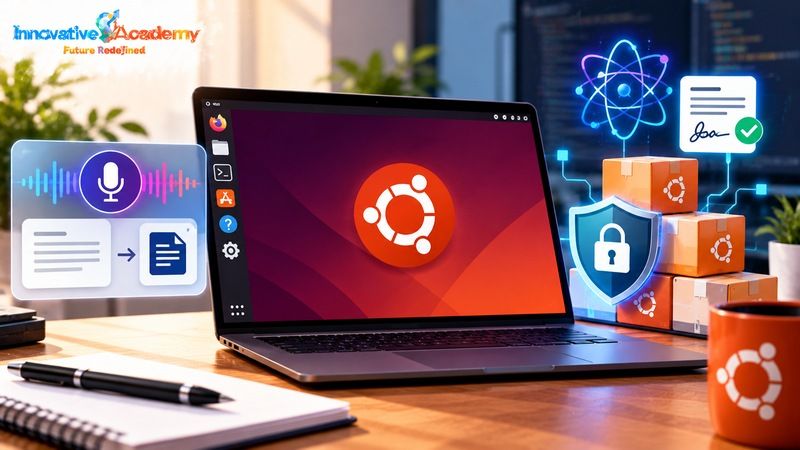
The headline feature is Myna, described in Canonical's announcement as "Ubuntu's speech-to-text agent," named after the myna bird for its "ability to mimic human speech." It's opt-in in this release, runs on local models rather than a cloud service, explicitly framed as speech recognition "without sacrificing privacy," and shows visual feedback while you speak. Canonical frames it as experimental groundwork rather than a finished product: "as Ubuntu 28.04 LTS approaches, it will be included by default with Ubuntu." VP of Ubuntu Engineering Jon Seager tied it to a broader direction for the platform: "Stonking Stingray is symbolic of Ubuntu's journey to not just build up, but also build out." The example use case Canonical gives is specific and practical rather than a gimmick demo, a developer saying "Help me investigate why my tests are failing" directly to the desktop.
4. The Security Stack Changed More Than the Desktop Did
Here's the part of this release that deserves more attention than it's actually getting. Ubuntu 26.10 replaces GnuPG with Sequoia PGP for verifying APT repository signatures, which Canonical describes as "post-quantum ready package signing," a real, structural change to how every package installed on the system gets verified. Alongside that, openCryptoki now supports "PKCS #11 V3.2 coverage" across Soft, EP11, and CCA tokens with ML-DSA and ML-KEM, both post-quantum cryptographic algorithms, not speculative future-proofing but algorithms already standardized for exactly this kind of use. TPM-backed full-disk encryption, first rolled out in the 26.04 LTS release, is now expanded to hardware lacking a dedicated Hardware Root of Trust, with an optional PIN or passphrase. None of this is flashy in a screenshot, but it's a meaningfully larger security overhaul than most interim releases ship in one go.
5. Kernel 7.3, and the Hardware It's Actually Built For
Linux kernel 7.3 brings hardware enablement for specific, named chips: Intel's Xe3P (Nova Lake), AMD's Zen 6, and Nvidia's 615 generation, plus out-of-the-box support for the Lustre distributed filesystem used heavily in high-performance computing. There's also a dedicated installer specifically for amd64v3 hardware, a more modern x86-64 microarchitecture baseline than Ubuntu has defaulted to historically. ROCm, AMD's GPU compute stack, was upgraded to version 10.0 with support for new GPU architectures and serving frameworks like vLLM and SGLang, both widely used for running large language models, a detail that places this release's hardware support squarely inside the current AI-infrastructure moment rather than treating it as a separate concern.
6. Finishing a Multi-Year Migration: Rust Coreutils
Canonical's announcement states that Ubuntu 26.10 "completes the migration to Rust-based coreutils," the basic command-line utilities, ls, cp, cat, and dozens of others, that every Linux user and administrator touches constantly without thinking about it. That's the finish line of a migration that's been running across multiple Ubuntu releases, replacing decades-old C implementations with memory-safe Rust rewrites. For anyone administering real systems, this is the kind of change that's invisible when it works and genuinely significant for long-term security, since a whole category of memory-safety bugs in tools used on effectively every Linux command line becomes structurally harder to introduce going forward.
7. RISC-V Gets a Real Desktop Story, Not Just a Checkbox
Ubuntu 26.10 ships RISC-V desktop images, including support for what Canonical calls "the first RVA23-enabled RISC-V hardware, the SpacemiT K3." RISC-V International CEO Andrea Gallo's quote frames this as a milestone for the architecture generally, not just for Ubuntu: "2026 is the year of RVA23 silicon, so I'm thrilled to see desktop image support arrive for RISC-V in Ubuntu 26.10." RVA23 is a specific, standardized RISC-V profile, and hardware actually shipping against it, rather than development boards running experimental builds, is a meaningfully different stage for an architecture that's spent years being more promise than product on the desktop.
8. What Canonical Didn't Publish Alongside This Release
Worth being direct about the gaps rather than filling them in with assumption: Canonical's release announcement doesn't state a support lifecycle or end-of-life date for 26.10 anywhere in its own text, doesn't include performance benchmarks for any of the changes described, including the coreutils migration or the kernel update, and lists no explicit removed or deprecated features beyond GnuPG's replacement by Sequoia PGP for package signature verification. Interim Ubuntu releases have historically carried nine months of support, but that figure isn't confirmed on this specific page, and it's worth checking Ubuntu's own release notes directly before treating it as settled for this version specifically.
9. Administering Real Systems at Innovative Academy
Innovative Academy's Linux Administration program in Bangalore covers the package management, security configuration, and system-level fundamentals that sit underneath a release like this one, the actual working knowledge of how encryption, signature verification, and core system utilities function, rather than just knowing that a new Ubuntu version exists.
10. FAQs
1. When was Ubuntu 26.10 released?
October 15, 2026, under the codename "Stonking Stingray."
2. What is Myna, and does it send my voice data anywhere?
Myna is Ubuntu's new opt-in speech-to-text agent. According to Canonical's own description, it runs on local models and is explicitly framed as working "without sacrificing privacy," implying local rather than cloud processing, though the announcement doesn't detail the exact technical architecture.
3. What's the single most significant change in this release for system security?
Replacing GnuPG with Sequoia PGP for verifying APT package signatures, described by Canonical as "post-quantum ready package signing," alongside expanded TPM-backed disk encryption and new post-quantum cryptographic token support.
4. Is Ubuntu 26.10 a Long Term Support release?
No. It's an interim release, which typically receives a shorter support window than an LTS version, though Canonical's own release announcement doesn't state the exact support period for 26.10 specifically.
5. Does this release finish the move away from the old C-based command-line tools?
Yes, according to Canonical's announcement, which states that Ubuntu 26.10 "completes the migration to Rust-based coreutils."
11. Final Thoughts
The feature getting the most attention from this release, Myna's speech-to-text, is explicitly described by Canonical itself as an early, opt-in preview of something bigger coming with the next LTS. The changes genuinely worth an administrator's attention are quieter: a completed migration to memory-safe core utilities, a real post-quantum cryptography rollout for package verification, and specific new hardware support that places this release inside the current AI-infrastructure hardware cycle rather than outside it. Reading past the headline feature to the infrastructure underneath is exactly the skill that turns a release announcement into something actually useful.
Innovative Academy — Contact for course details: 8447712333
Website · Facebook · Instagram
Sources: