
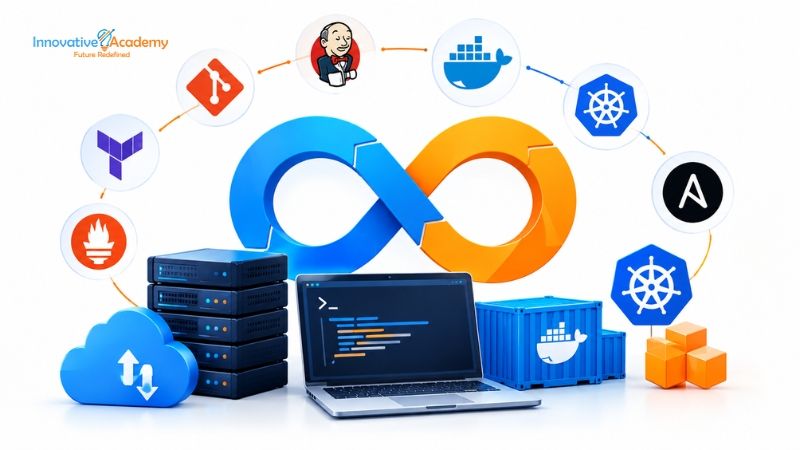

DevOps Course in Bangalore: Complete Guide to Training, Fees & Career in 2026
Table of Contents
- What Is DevOps?
- Why Is DevOps Important in 2026?
- Why Learn DevOps in Bangalore?
- Who Can Learn DevOps?
- What Will You Learn in a DevOps Course?
- DevOps Tools You Should Know
- DevOps Course Duration in Bangalore
- DevOps Course Fees in Bangalore
- DevOps Certification Training in Bangalore
- DevOps Course With Placement in Bangalore
- Career Opportunities After DevOps Training
- DevOps Salary and Career Growth
- How to Choose the Best DevOps Course in Bangalore
- Why Hands-On DevOps Training Matters
- DevOps Projects You Should Work On
- Is DevOps a Good Career Choice in 2026?
- Frequently Asked Questions
- Conclusion
DevOps has become an important technology skill for professionals who want to build careers in cloud computing, automation, infrastructure, and software deployment. As companies continue to adopt cloud platforms and automated development processes, the demand for professionals with practical DevOps skills continues to grow.
Bangalore is one of India's major technology hubs, making it a popular destination for students and IT professionals looking for quality DevOps Training in Bangalore. With a strong ecosystem of IT companies, startups, SaaS businesses, and cloud-based organizations, the city provides excellent opportunities to develop modern technology skills.
If you are searching for a DevOps Course in Bangalore, you may have several questions. What does a DevOps course cover? How much are DevOps course fees in Bangalore? Which tools should you learn? Is certification necessary? Can you get placement assistance after completing the course?
This complete guide explains everything you need to know about DevOps training, syllabus, fees, tools, projects, career opportunities, and choosing the right training institute in Bangalore in 2026.
What Is DevOps?
DevOps stands for Development and Operations. It brings software development and IT operations closer together to make the process of building, testing, deploying, and maintaining applications more efficient.
Instead of development and operations teams working separately, DevOps encourages collaboration, automation, continuous integration, continuous delivery, and continuous monitoring.
A typical DevOps workflow can look like this:
Plan → Code → Build → Test → Release → Deploy → Monitor
For example, when a developer pushes new code to GitHub, an automated pipeline can build the application, run tests, create a Docker image, deploy the application to a cloud environment, and monitor the application.
This approach reduces repetitive manual work and helps organizations deliver software more consistently.
Why Is DevOps Important in 2026?
Cloud computing, automation, containers, and Infrastructure as Code have changed how modern companies develop and manage applications.
Businesses increasingly need technology professionals who can:
- Automate repetitive IT tasks
- Deploy applications efficiently
- Manage cloud infrastructure
- Improve application reliability
- Monitor applications and infrastructure
- Scale infrastructure when required
- Reduce deployment errors
- Support faster software release cycles
DevOps combines many of these practices and technologies into a structured approach to software delivery and infrastructure management.
For professionals working in Linux, networking, system administration, development, or cloud computing, DevOps can also be a valuable career progression.
Why Learn DevOps in Bangalore?
Bangalore has a strong technology ecosystem, making it one of the popular destinations for people searching for DevOps Training in Bangalore.
The city has a large presence of IT service companies, product companies, startups, SaaS organizations, and cloud-focused businesses.
Strong IT Ecosystem
Bangalore's technology ecosystem provides a strong environment for students and professionals who want to develop modern IT skills.
Exposure to Modern Technologies
DevOps is closely connected with cloud computing, automation, containers, Infrastructure as Code, monitoring, and continuous delivery.
Practical Learning Opportunities
A quality training program should focus on hands-on learning rather than teaching DevOps only through theory.
Career-Focused Training
Practical training can help learners understand how different DevOps tools work together in real-world development and deployment environments.
If you are also interested in networking and cloud technologies, you can explore the Networking and Cloud Computing courses at Innovative Academy.
Who Can Learn DevOps?
You do not necessarily need previous DevOps experience to begin learning DevOps.
A structured DevOps program can be suitable for:
- Fresh graduates
- Technical students
- Linux administrators
- System administrators
- Network engineers
- Software developers
- Cloud professionals
- QA professionals
- IT support professionals
- Infrastructure professionals
- IT professionals planning a career transition
Basic knowledge of Linux, networking, scripting, or cloud computing can make the learning process easier. However, beginners can also build these fundamentals during their training.
What Will You Learn in a DevOps Course?
A good DevOps Course in Bangalore should combine fundamental concepts with practical implementation.
1. Linux
Linux is an important foundation for DevOps. Students may learn:
- Linux commands
- File and directory management
- Users and groups
- File permissions
- Processes
- Package management
- SSH
- Services
- Logs
- Basic networking
- Shell scripting
2. Git and GitHub
Git is a fundamental version-control technology used in modern software development.
A DevOps course should introduce learners to:
- Git fundamentals
- Repository management
- Branches
- Merging
- Pull requests
- Git workflows
- Conflict resolution
- GitHub repositories
- Collaborative development
3. Jenkins
Jenkins is commonly used to automate software development and deployment workflows.
Training may cover:
- Jenkins installation
- Jobs
- Pipelines
- Build automation
- Git integration
- Automated testing
- Deployment workflows
- Jenkins plugins
4. Docker
Docker allows applications and their dependencies to be packaged into portable containers.
Students may learn:
- Docker architecture
- Docker images
- Containers
- Dockerfiles
- Volumes
- Docker networks
- Docker Compose
- Container registries
- Application containerization
5. Kubernetes
Kubernetes is used to manage and orchestrate containerized applications.
Important concepts include:
- Kubernetes architecture
- Pods
- Deployments
- Services
- Namespaces
- ConfigMaps
- Secrets
- ReplicaSets
- Ingress
- Scaling
6. Ansible
Ansible is used for automation and configuration management.
Students may learn:
- Ansible architecture
- Inventory
- Modules
- Playbooks
- Variables
- Roles
- Configuration management
- Server automation
7. Terraform
Terraform is an Infrastructure as Code tool that allows infrastructure to be defined and managed through configuration files.
Topics may include:
- Terraform fundamentals
- Providers
- Resources
- Variables
- Outputs
- State management
- Modules
- Infrastructure provisioning
8. AWS
Cloud knowledge is highly relevant to modern DevOps roles. An AWS-focused DevOps program may introduce learners to:
- Amazon EC2
- IAM
- VPC
- S3
- CloudWatch
- Load Balancers
- Auto Scaling
- Route 53
- RDS
Students who want to build broader cloud knowledge can also explore AWS and cloud computing training at Innovative Academy.
DevOps Tools You Should Know
DevOps professionals commonly work with several technologies rather than relying on a single tool.
| Area | Technologies |
|---|---|
| Operating System | Linux |
| Version Control | Git, GitHub |
| CI/CD | Jenkins |
| Containers | Docker |
| Container Orchestration | Kubernetes |
| Automation | Ansible |
| Infrastructure as Code | Terraform |
| Cloud Platform | AWS |
| Scripting | Bash, Python |
You do not need to master every technology immediately. Start with the fundamentals and gradually develop deeper skills through labs and projects.
DevOps Course Duration in Bangalore
The duration of DevOps Classes in Bangalore varies depending on the institute, curriculum, learning format, and depth of practical training.
When comparing course duration, don't look only at the number of weeks. Consider:
- How much practical training is included?
- Are hands-on labs available?
- Are live projects included?
- Is Kubernetes covered in depth?
- Is AWS included?
- Are CI/CD pipelines taught practically?
- Are Terraform and Ansible included?
- Is interview preparation provided?
A course that provides consistent hands-on practice may offer more value than a shorter program that only covers concepts quickly.
DevOps Course Fees in Bangalore
One of the most common questions students ask is: “What are the DevOps Course Fees in Bangalore?”
There is no single fixed fee because the cost can vary depending on several factors.
- Course duration
- Number of technologies covered
- Practical lab access
- Trainer experience
- Classroom or online format
- Live projects
- Learning resources
- Interview preparation
- Placement assistance
Instead of choosing a course based only on price, compare the complete training package and the practical value you receive.
A useful comparison is:
Course Fee + Practical Training + Lab Access + Projects + Career Support
DevOps Certification Training in Bangalore
Certification can help demonstrate your knowledge of specific technologies or cloud platforms. However, certification should not be the only goal of DevOps training.
A job-ready learner should also understand how to:
- Work with Linux
- Use Git
- Build CI/CD pipelines
- Containerize applications
- Work with Kubernetes
- Deploy applications on AWS
- Automate infrastructure
- Troubleshoot deployment issues
- Explain practical projects
When looking for DevOps Certification Training in Bangalore, consider programs that combine certification-oriented learning with practical implementation.
DevOps Course With Placement in Bangalore
Many students search specifically for a DevOps Course with Placement in Bangalore because they want career support after completing their training.
When comparing placement assistance, don't look only at the phrase “placement assistance.” Ask what support is actually provided.
Resume Building
A good resume should clearly present your technical skills, projects, tools, and relevant experience.
LinkedIn Profile Optimization
A professional LinkedIn profile can help you present your technical skills and project experience to recruiters.
Mock Interviews
Mock interviews give learners an opportunity to practice technical and HR questions before attending actual interviews.
Technical Interview Preparation
Students should prepare for questions related to Linux, Git, Jenkins, Docker, Kubernetes, AWS, Terraform, and Ansible.
Project Discussion
Candidates should be able to explain their projects clearly, including the technologies used, challenges faced, and how the solution was implemented.
For broader career-focused IT training, you can also visit Innovative Academy's technology training programs.
Career Opportunities After DevOps Training
Completing DevOps training can help learners explore several technology career paths.
Depending on your background, skills, and experience, potential roles include:
- DevOps Engineer
- Junior DevOps Engineer
- Cloud Engineer
- Cloud Support Engineer
- Automation Engineer
- Build and Release Engineer
- Infrastructure Engineer
- Site Reliability Engineer
- System Administrator
- Platform Engineer
Your first job may not necessarily have “DevOps” in the title. Professionals can also enter through cloud support, infrastructure, system administration, or automation roles and later move into DevOps positions.
DevOps Salary and Career Growth
DevOps professionals can build strong careers because the field combines cloud infrastructure, automation, software delivery, and operations.
However, completing a DevOps course does not guarantee a specific salary.
Career growth and compensation can depend on:
- Technical skills
- Professional experience
- Cloud knowledge
- Automation skills
- Linux expertise
- Kubernetes knowledge
- Scripting ability
- Project experience
- Problem-solving ability
- Interview performance
- Company and job role
How to Choose the Best DevOps Course in Bangalore
There are many institutes offering DevOps training, so it is important to compare the complete program before enrolling.
If you're searching for the Best DevOps Course in Bangalore, consider the following factors.
1. Check the Curriculum
Look for a curriculum covering important technologies such as:
Linux → Git → Jenkins → Docker → Kubernetes → Ansible → Terraform → AWS
2. Look for Practical Labs
DevOps is a hands-on field. Make sure students get enough opportunities to work directly with the tools.
3. Check Trainer Experience
Experienced trainers can explain both technical concepts and real-world implementation scenarios.
4. Ask About Projects
Find out whether students actually build projects or simply watch demonstrations.
5. Understand Placement Support
Ask the institute what placement assistance includes and what career support is provided after training.
6. Consider the Learning Format
Choose a learning format that fits your schedule, such as:
- Weekday classes
- Weekend classes
- Classroom training
- Online training
- Hybrid learning
7. Check Lab Availability
Regular practice is essential for DevOps. Access to a suitable lab environment can make the learning process much more effective.
Why Hands-On DevOps Training Matters
DevOps is difficult to master through theory alone.
For example, understanding what Docker is does not necessarily mean you can create a Dockerfile, build an image, configure networking, troubleshoot a container, and deploy an application.
The same applies to Kubernetes, Jenkins, Terraform, Ansible, and AWS.
Effective DevOps Training in Bangalore should allow students to follow a practical learning process:
Learn → Practice → Build → Troubleshoot → Deploy
Consistent hands-on practice helps learners develop confidence with real-world technical scenarios.
DevOps Projects You Should Work On
Projects are an important part of learning DevOps because they connect multiple technologies into a complete workflow.
Example: CI/CD Pipeline Project
A practical project can use:
GitHub → Jenkins → Docker → AWS
The workflow can be:
- A developer pushes code to GitHub.
- Jenkins detects the code change.
- Jenkins starts the build process.
- Automated tests are executed.
- A Docker image is created.
- The application is deployed.
- AWS infrastructure hosts the application.
- Monitoring tools track the application.
Projects like this help learners understand how DevOps technologies work together rather than learning each tool independently.
Is DevOps a Good Career Choice in 2026?
For people interested in cloud infrastructure, automation, application deployment, and IT operations, DevOps can be a strong career path in 2026.
However, learning DevOps should not be limited to memorizing commands or collecting certificates.
You should understand:
- How applications are developed
- How source code is managed
- How applications are tested
- How deployments are automated
- How containers work
- How cloud infrastructure is created
- How infrastructure can be automated
- How applications are monitored
- How deployment failures are investigated
Once you understand these concepts, it becomes easier to adapt to new tools and technologies as the DevOps ecosystem evolves.
Why Choose Innovative Academy for DevOps Training?
Innovative Academy offers a practical DevOps Bootcamp designed for learners who want to develop hands-on skills in modern DevOps technologies.
The program covers key technologies including:
- Linux
- Git
- GitHub
- Jenkins
- Docker
- Kubernetes
- Ansible
- Terraform
- AWS
The training focuses on practical projects such as:
- CI/CD pipeline implementation
- Application containerization
- Infrastructure as Code deployment
- Cloud-based deployment workflows
Along with technical training, learners can receive career-oriented support including resume building, LinkedIn optimization, and mock interview preparation.
If you are looking for a structured DevOps Course in Bangalore with practical learning and career support, you can explore DevOps training at Innovative Academy.
Frequently Asked Questions
Is DevOps suitable for beginners?
Yes. Beginners can learn DevOps through a structured program. Starting with Linux, networking, Git, and basic scripting can make the learning process easier.
Can a fresher learn DevOps?
Yes. Freshers can learn DevOps, but practical experience is important. Building projects can help demonstrate your skills during interviews.
What should I learn before DevOps?
Basic Linux, networking, Git, and scripting knowledge can be helpful. However, a beginner-friendly course can introduce these concepts as part of the training.
What are the DevOps Course Fees in Bangalore?
DevOps course fees vary depending on the institute, duration, syllabus, practical labs, projects, trainer experience, and placement support. Compare the complete course package rather than focusing only on the price.
Is DevOps certification mandatory for getting a job?
No. Certification can strengthen your profile, but employers may also evaluate practical skills, projects, troubleshooting ability, cloud knowledge, and understanding of DevOps practices.
Which DevOps tools should beginners learn?
A good starting technology stack includes Linux, Git, Jenkins, Docker, Kubernetes, Ansible, Terraform, and AWS.
Can networking professionals move into DevOps?
Yes. Networking knowledge can be useful when working with cloud infrastructure, connectivity, security, and application environments.
Can Linux administrators become DevOps engineers?
Yes. Linux administration provides a strong foundation for learning automation, cloud infrastructure, containers, CI/CD, and Infrastructure as Code.
Conclusion
DevOps has become an important part of modern IT because organizations need faster deployments, better automation, reliable infrastructure, and efficient software delivery.
If you're considering a DevOps Course in Bangalore, don't choose a program simply because it has a long list of tools or promises a quick career.
Instead, look for a course that combines:
Strong Fundamentals + Hands-On Labs + Real Projects + Cloud Technologies + Automation + Interview Preparation
The right training can help you move beyond learning individual tools and understand how modern development, infrastructure, cloud, and automation work together.
Whether you're a fresher, Linux administrator, network engineer, developer, or IT professional planning a career transition, building practical DevOps skills can help you prepare for the changing technology landscape in 2026.
Start with the fundamentals, practice consistently, build real projects, and keep improving your skills. That's the foundation for building a successful DevOps career.
Ready to start? Explore DevOps and Cloud training at Innovative Academy and take the next step toward building practical IT skills.