
Have questions? Speak to our experts at 8447712333 Connect With Us
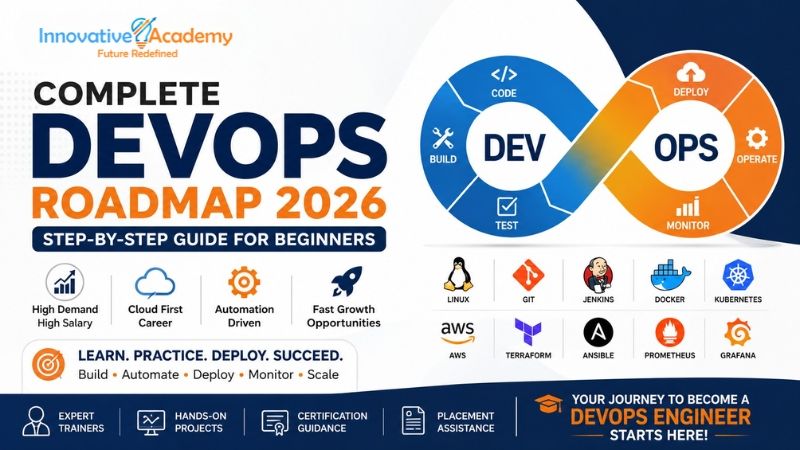
Complete DevOps Roadmap 2026: Step-by-Step Guide for Beginners

Complete DevOps Roadmap 2026: Step-by-Step Guide for Beginners

July 21, 2026
10 min read
Complete DevOps Roadmap 2026: Step-by-Step Guide for Beginners

Complete DevOps Roadmap 2026: Step-by-Step Guide for Beginners

The demand for DevOps professionals continues to grow rapidly in 2026. Organizations across the globe are adopting cloud computing, automation, containerisation, and CI/CD pipelines to deliver software faster and more efficiently. As a result, the need for skilled DevOps Engineers has reached an all-time high.

If you're a student, IT graduate, software developer, system administrator, or someone looking to switch careers, this guide will help you understand the complete DevOps roadmap from beginner to job-ready professional.

Whether you're planning to join a DevOps course or looking for a self-learning roadmap, this guide covers every important skill you need to master.

What is DevOps?

DevOps is a combination of Development (Dev) and Operations (Ops). It is a modern software development approach that enables developers and IT operations teams to collaborate effectively, automate repetitive tasks, and deliver applications quickly with fewer errors.

Instead of waiting weeks or months to release software, DevOps helps organizations deploy updates multiple times a day using automation.

A DevOps professional works with developers, testers, cloud engineers, and system administrators to ensure seamless software delivery.

Why Learn DevOps in 2026?

Technology is evolving rapidly. Companies are migrating to cloud platforms and automating infrastructure to reduce costs and improve efficiency.

Key Reasons to Choose a DevOps Career:

  • High salary packages
  • Massive job demand worldwide
  • Cloud-first organizations driving adoption
  • Automation-driven industry standards
  • Excellent career growth trajectory
  • Abundant remote work opportunities
  • Globally recognized certifications
  • Multiple specialization paths

Learning DevOps today prepares you for future technologies including AI-powered automation, Kubernetes, Cloud Native applications, and Infrastructure as Code.

If you're serious about building a rewarding IT career, enrolling in a structured DevOps training program can significantly accelerate your learning.

Who Should Learn DevOps?

DevOps is suitable for professionals and aspirants across various domains:

  • Freshers & Computer Science Students
  • Software Developers
  • Linux Administrators & System Engineers
  • Network Engineers & Cloud Engineers
  • IT Support Professionals & QA Engineers
  • Career Switchers seeking higher-growth IT roles

Even if you have no prior experience, you can become job-ready by following a structured, step-by-step roadmap.

Complete DevOps Roadmap

To master DevOps effectively without feeling overwhelmed, beginners should learn concepts in the following sequential order:

Step 1: Learn Linux Administration

Linux is the backbone of DevOps. Most production servers run Linux, making it an essential foundation.

Core Topics to Master:

  • Linux Installation & File System Architecture
  • File Permissions, Users & Groups Management
  • Process Management & Package Management
  • Shell Commands & Bash Scripting
  • Cron Jobs & Disk Management
  • Networking Commands & SSH Configuration

Tip: Spend enough time practicing Linux because every DevOps tool interacts directly with Linux servers.

Step 2: Understand Networking Fundamentals

Networking knowledge helps you configure infrastructure, manage routing, and troubleshoot deployments effectively.

Important Concepts:

  • IP Addressing, Subnetting, DNS, DHCP
  • HTTP & HTTPS Protocols, TCP/IP Model
  • Routing, Switching, Firewalls & VPNs
  • Load Balancers, Ports, and Reverse Proxies

Step 3: Learn Programming & Scripting

You don't need to become a full-time software developer, but scripting is essential for automation.

Essential Languages & Data Formats:

  • Bash: For shell automation and system administration scripts.
  • Python: Widely used for complex automation, SDKs, and cloud interaction.
  • YAML & JSON: Required for Kubernetes manifests, Ansible playbooks, and CI/CD pipelines.

Step 4: Master Git & GitHub

Version control is the heart of DevOps, enabling collaboration and change tracking across development teams.

Key Skills:

  • Git Installation & Repository Setup
  • Clone, Commit, Push, Pull, and Merge operations
  • Branching Strategies & Pull Request workflows
  • GitHub Actions for automated workflows

Step 5: Continuous Integration using Jenkins

Jenkins automates software builds, tests, and deployments to eliminate manual human intervention.

Topics Include:

  • Jenkins Installation & Architecture
  • Jenkinsfile & Pipeline as Code
  • Build Automation & Plugin Management
  • Integration with GitHub & Build Triggers
  • Automated Notifications & Testing

Step 6: Learn Docker

Docker revolutionized software deployment by packaging applications and dependencies into lightweight containers.

Important Topics:

  • Docker Images & Container Lifecycle
  • Writing Dockerfiles & Multi-stage Builds
  • Docker Compose for multi-container apps
  • Docker Hub, Container Networking, and Volumes

Step 7: Kubernetes Orchestration

Kubernetes (K8s) is the industry standard platform for container management, scaling, and orchestration.

Essential Concepts:

  • Pods, ReplicaSets, and Deployments
  • Services, Ingress Controllers, and Namespaces
  • ConfigMaps, Secrets, and Persistent Volumes
  • Auto Scaling (HPA) and Rolling Updates

Step 8: Learn AWS Cloud Computing

Cloud computing is an integral part of modern DevOps infrastructure.

Essential AWS Services:

  • Compute & Security: EC2, IAM, Auto Scaling, ELB
  • Storage & Database: S3, RDS
  • Networking & DNS: VPC, Route53
  • Container & Ops: ECS, EKS, CloudWatch

Step 9: Infrastructure as Code (IaC)

Infrastructure should be automated and version-controlled just like application software code.

Popular Tools & Concepts:

  • Terraform: Providers, Variables, Resources, Modules, State Files, and Outputs.
  • AWS CloudFormation: Native AWS templating and infrastructure management.

Step 10: Configuration Management

Automate server provisioning, software configuration, and patch management at scale.

Ansible Essentials:

  • Ansible Architecture, Inventories & Playbooks
  • Roles, Variables, Templates (Jinja2), and Modules

Step 11: Monitoring & Logging

Production systems require real-time visibility to maintain uptime and ensure health metrics.

Industry Standard Tools:

  • Prometheus & Grafana: Metrics collection and visualization dashboards.
  • ELK Stack / Loki: Centralized log aggregation and analysis.
  • AWS CloudWatch: Native cloud observability.

Step 12: DevSecOps (Security Integration)

Security is no longer an afterthought; it must be embedded throughout the entire software lifecycle.

Core DevSecOps Focus Areas:

  • IAM Best Practices & Secrets Management (HashiCorp Vault)
  • Container Vulnerability Scanning (Trivy, Clair)
  • Static Code Analysis (SonarQube)
  • OWASP Top 10 Security Basics

Step 13: Build Real-Time Projects

Hands-on projects demonstrate your practical expertise to potential employers.

Recommended Projects:

  • Deploy a Java Application using Jenkins CI/CD
  • Build automated CI/CD Pipelines with GitHub & Jenkins
  • Dockerize a Python Web Application with database integration
  • Kubernetes Deployment with Ingress and Auto-scaling
  • Provision AWS Cloud Infrastructure using Terraform
  • Automate Server Configuration with Ansible
  • Set up Monitoring Dashboards using Prometheus & Grafana

Step 14: Prepare for Technical Interviews

Focus on real-world troubleshooting scenarios and core concepts:

  • Linux System Commands & Scripting
  • Docker Containerization & Networking
  • Kubernetes Deployment Scenarios
  • AWS Cloud Architecture & Security
  • CI/CD Pipeline Design in Jenkins
  • Terraform State Management & Ansible Playbooks

DevOps Certifications Worth Pursuing

Certifications validate your expertise and significantly improve resume credibility for recruiters.

Top Recommended Industry Certifications:

  • AWS Certifications: AWS Certified Developer, AWS Solutions Architect Associate, AWS DevOps Engineer Professional
  • Kubernetes Certifications: Certified Kubernetes Administrator (CKA), Certified Kubernetes Application Developer (CKAD)
  • Containerization: Docker Certified Associate (DCA)
  • Infrastructure as Code: HashiCorp Certified: Terraform Associate
  • Linux Administration: Red Hat Certified System Administrator (RHCSA)

Career Opportunities After Learning DevOps

Completing this roadmap opens up diverse and lucrative career pathways across startups and enterprises:

  • DevOps Engineer
  • Cloud Engineer
  • Site Reliability Engineer (SRE)
  • Build & Release Engineer
  • Platform Engineer
  • Infrastructure Engineer
  • Automation Engineer
  • CI/CD & Kubernetes Engineer

Skills Employers Expect in 2026

Recruiters look for well-rounded candidates with demonstrated hands-on technical and soft skills:

Must-Have Skillset:

Linux Administration • Git/GitHub • Jenkins Pipelines • Docker & Kubernetes • AWS Cloud • Terraform • Ansible • Bash & Python Scripting • Observability Tools • Infrastructure Automation • Technical Troubleshooting • Team Communication

How to Choose the Best DevOps Course

Evaluating potential learning platforms carefully ensures you receive maximum return on investment. Look for programs offering:

  • Updated 2026 curriculum reflecting modern industry standards
  • Experienced trainers with real industry exposure
  • Hands-on lab environments and live cloud project execution
  • Comprehensive coverage of AWS, Docker, Kubernetes & Terraform
  • Resume building, mock interviews, and career placement assistance
  • Flexible weekday or weekend learning schedules

Why Hands-On Practice Matters

Reading theoretical documentation is not enough. Employers expect engineers who can configure live environments and troubleshoot pipelines on day one.

Set Up Your Personal Home Lab to Practice:

  1. Provision Linux virtual machines (VMs or Cloud EC2).
  2. Initialize Git repositories and push multi-branch workflows.
  3. Build end-to-end Jenkins automation pipelines.
  4. Package applications into containerized Docker images.
  5. Deploy, scale, and manage workloads in Kubernetes clusters.
  6. Write Terraform code to provision scalable cloud environments.
  7. Automate server patching and setups with Ansible.
  8. Monitor metrics and log aggregation using Prometheus & Grafana.

Training and Placement Support

Technical competency paired with structured career guidance accelerates job landing:

  • Career Mentoring: Guidance on choosing specialized cloud paths.
  • Resume Optimization: Highlighting real-world projects and certifications.
  • LinkedIn Strategy: Building visibility for recruiter inbound outreach.
  • Mock Interviews: Behavioral and deep-dive technical practice.

Online Learning vs Classroom Learning

Both delivery modes offer unique advantages depending on your schedule and style:

  • Online Learning: Offers unmatched flexibility, self-paced access, recorded sessions, and global mentor access.
  • Classroom Learning: Offers structured face-to-face instruction, instant doubt clearing, and collaborative physical peer labs.

Final Thoughts

"DevOps is one of the most future-proof career paths in the IT industry. As organizations continue embracing cloud-native architectures, automation, and continuous delivery, skilled DevOps engineers will remain in ultra-high demand."

Start with Linux and networking fundamentals, then systematically progress through Git, Jenkins, Docker, Kubernetes, AWS, Terraform, Ansible, and observability tools. Practice daily, build portfolio projects on GitHub, and prepare for certifications.

Consistency and practical execution are your key drivers to success in 2026!

Share this article: