
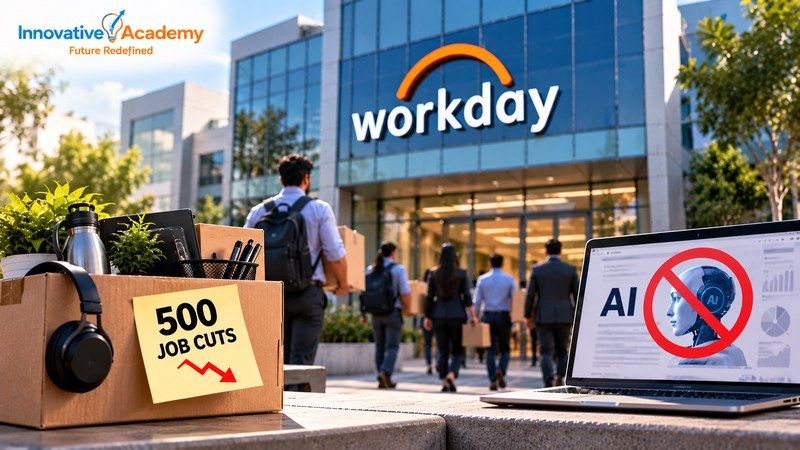

Workday Just Cut 500 More Jobs—and, Unlike Last Week's Layoffs, Didn't Reach for "AI" as the Reason
Table of Contents
- 1. Introduction
- 2. What Workday Actually Does, for Anyone Unfamiliar
- 3. What Workday Actually Announced
- 4. This Isn't Workday's First Round This Year
- 5. The Detail Worth Noticing: No AI Framing at All
- 6. But the Numbers Around It Tell a Fuller Story
- 7. The Part That Complicates the "Not AI" Story Further
- 8. Why the Framing Still Matters, Even If the Underlying Cause Is Murkier
- 9. Where This Sits Against the Rest of 2026's Layoff Numbers
- 10. What This Means for Someone Building a Technical Career
- 11. Learning Python at Innovative Academy
- 12. FAQs
- 13. Final Thoughts
1. Introduction
Enterprise software maker Workday announced its second round of layoffs this year on September 29, and the detail worth noticing isn't simply the headcount number—it's what the company didn't say.
In a year where "AI" has become a frequently cited explanation for technology layoffs, Workday's own language does not attribute these cuts to artificial intelligence. Instead, the company described the move as an organizational restructuring designed to better align teams with its strategic priorities.
That distinction matters. A company's stated reason for reducing its workforce should be examined alongside its financial performance, business strategy, and investment priorities rather than automatically being replaced with whichever explanation is dominating the technology news cycle.
2. What Workday Actually Does, for Anyone Unfamiliar
Workday makes enterprise software that organizations use to manage human resources and financial operations. Its products cover areas such as payroll, benefits administration, recruiting, workforce planning, financial management, and financial close processes.
The company primarily sells subscription-based software to businesses and government organizations rather than individual consumers.
That context matters when interpreting the layoffs. A workforce reduction at Workday is an internal decision by an enterprise software vendor. It is not automatically evidence that demand for enterprise software, HR technology, or technology professionals as a whole has collapsed.
The announcement should therefore be viewed as one company's organizational and financial decision rather than as a complete measure of the technology employment market.
3. What Workday Actually Announced
Workday announced plans to eliminate approximately 500 positions, representing roughly 2.5% of its workforce, according to the company's September 29, 2026 securities filing.
The cuts primarily affect product and technology teams, although the company has not publicly provided a detailed breakdown of the positions affected within those functions.
Workday described the restructuring as an effort to better align team structures with strategic priorities. At the same time, the company said it expects to continue hiring in key strategic areas and locations during fiscal 2027.
That combination is important. Workforce reductions do not necessarily mean that every part of a company has stopped hiring. Companies can reduce headcount in selected functions while continuing recruitment for areas they consider strategically important.
As of July 31, 2026, Workday reported approximately 20,896 employees worldwide.
4. This Isn't Workday's First Round This Year
The September announcement represents Workday's second major layoff event of 2026.
In February, the company cut approximately 400 positions. The fact that two workforce reductions occurred within the same calendar year, with product and technology functions substantially affected, provides additional context for the September announcement.
Rather than viewing the September reduction as an isolated event, it is more useful to consider it as part of Workday's broader organizational adjustments during 2026.
5. The Detail Worth Noticing: No AI Framing at All
One of the most notable aspects of the announcement is the absence of an artificial-intelligence explanation.
Several technology companies have connected workforce reductions during 2026 to AI, automation, restructuring, or changes in how work is performed. Workday, however, has not attributed either its February or September 2026 workforce reductions directly to AI.
Instead, the company's explanation centers on organizational restructuring and strategic alignment.
That does not prove that AI has had no indirect influence on Workday's workforce planning. It simply means that the publicly stated explanation for these specific layoffs is not AI-driven job replacement.
This distinction is particularly useful when reading technology-layoff coverage. Headlines can sometimes simplify a complicated business decision into a single explanation, while company filings provide more specific language about the actual restructuring.
6. But the Numbers Around It Tell a Fuller Story
The restructuring is also taking place against a broader financial backdrop.
Workday expects the workforce reduction to generate approximately $65 million to $80 million in restructuring charges, with much of the impact occurring during the third quarter of fiscal 2027.
The restructuring also comes alongside changes to the company's fiscal 2027 outlook. This suggests that the workforce reduction should be understood within the wider context of enterprise software spending, operating margins, customer budgets, and company-specific financial planning.
Workday's stock performance during the year also reflected broader investor concerns around enterprise software companies and spending conditions.
The important distinction is that financial pressure and AI-driven automation are not mutually exclusive concepts—but neither should automatically be treated as the explanation for a specific workforce reduction without supporting evidence.
7. The Part That Complicates the "Not AI" Story Further
There is another part of Workday's strategy worth considering: the company has continued investing heavily in artificial intelligence products for its customers.
Workday's AI strategy includes its Workday Illuminate platform, which incorporates AI capabilities into areas such as financial operations, workforce management, and employee-related workflows.
Examples of Workday's AI-related product development include tools designed to identify anomalies in financial transactions, assist with workforce scheduling and staffing decisions, and help organizations understand employee skills.
However, there is an important limitation here.
There is no publicly established evidence that directly connects Workday's Illuminate investments to the specific positions eliminated during either of its 2026 layoff rounds.
It would therefore be inappropriate to conclude that the layoffs were secretly caused by AI simply because Workday is simultaneously expanding its AI products.
The more defensible observation is that Workday can invest in AI products for customers while restructuring its own workforce for financial or organizational reasons.
8. Why the Framing Still Matters, Even If the Underlying Cause Is Murkier
Workday's "strategic realignment" explanation does not necessarily mean that AI plays no role anywhere in the company's long-term workforce strategy.
At the same time, nothing in the available public explanation establishes that AI automation directly replaced the jobs affected by these layoffs.
There are several potential business factors that can exist simultaneously:
- Enterprise software spending conditions
- Changes in customer budgets
- Operating-margin considerations
- Organizational restructuring
- Changes in product priorities
- Investment in new technology and AI capabilities
The useful lesson is to separate the stated reason for a layoff from the broader financial and strategic environment surrounding it.
That approach avoids two opposite assumptions: that every technology layoff must be caused by AI, or that AI can have no connection to workforce planning simply because a company does not mention it in a layoff announcement.
9. Where This Sits Against the Rest of 2026's Layoff Numbers
Workday's approximately 500-person reduction represents only a small portion of the technology layoffs reported during 2026.
Industry-wide tracking has recorded hundreds of technology companies announcing workforce reductions during the year, affecting well over 200,000 workers across the sector.
AI and automation have featured prominently in the explanations surrounding some of these announcements. However, not every technology layoff has been attributed to AI.
Workday therefore provides a useful example of another category: workforce reductions publicly explained through organizational restructuring, strategic realignment, and financial considerations rather than a direct claim that AI replaced the affected jobs.
That distinction is important when attempting to understand the broader technology employment market.
10. What This Means for Someone Building a Technical Career
Two workforce reductions at the same company within a single year demonstrate why building a technical career around one employer's stability can be risky.
Companies change priorities. Products evolve. Budgets shift. Departments can be expanded while others are reduced.
For technology professionals, one practical response is to build skills that can be demonstrated and transferred between employers.
That means focusing not only on certificates or job titles but also on practical technical capabilities, projects, problem-solving, communication, and the ability to demonstrate what you can actually build or operate.
For someone entering software or automation-related roles, programming remains one example of a transferable technical foundation.
11. Learning Python at Innovative Academy
Innovative Academy's Python training in Bangalore is designed around building programming fundamentals and applying them through practical projects.
The program runs for eight weeks and focuses on helping learners move beyond basic syntax toward practical programming skills that can be demonstrated through projects.
For students preparing for a technical career, the broader objective is to develop skills that can be applied across different employers and technology environments rather than depending on the stability of one organization.
Interested in learning Python? Explore the Python Training Course in Bangalore at Innovative Academy to learn more about the program.
12. FAQs
1. Did Workday blame AI for these layoffs?
No. Workday's public explanation for its 2026 workforce reductions has focused on organizational restructuring and aligning team structures with strategic priorities rather than directly attributing the cuts to AI.
2. Is Workday actually struggling financially?
The layoffs occurred alongside financial considerations, including restructuring charges and changes to the company's fiscal 2027 outlook. Broader concerns about enterprise software spending also provide context for the company's restructuring.
However, financial pressure should not automatically be interpreted as proof that AI caused the layoffs.
3. How is this different from other 2026 technology layoffs?
Some technology companies have explicitly connected workforce reductions to AI, automation, or changes in operating models. Workday's 2026 announcements have instead emphasized organizational restructuring and strategic alignment.
4. Does Workday's investment in AI contradict its "not AI" explanation?
Not necessarily. A company can invest in AI products while restructuring its workforce for other reasons.
There is currently no established public evidence showing that Workday's AI product investments directly caused the specific roles eliminated during its 2026 layoffs.
5. What should someone take away if they work in enterprise software or SaaS?
A company's product strategy and internal workforce strategy can change simultaneously for different reasons. Building transferable technical skills, practical experience, and demonstrable project capabilities can help professionals remain adaptable as companies reorganize.
13. Final Thoughts
Workday's second 2026 layoff round is notable because the company's public explanation does not rely on the increasingly common "AI replaced these jobs" narrative.
Instead, Workday has described the move in terms of strategic alignment and organizational restructuring, while the wider financial context includes restructuring costs, changes to its fiscal outlook, and concerns surrounding enterprise software spending.
At the same time, Workday continues to invest in AI products for its customers. That combination makes the situation more nuanced than either a simple "AI caused the layoffs" explanation or a claim that AI has nothing to do with the company's workforce strategy.
The broader lesson is straightforward: when reading technology layoff announcements, look beyond the headline. Examine what the company actually said, the financial context surrounding the decision, and the evidence available before assigning a single cause.
For professionals and students, the practical takeaway is to continue developing technical skills that can be demonstrated through real projects and applied across different organizations and technology environments.