
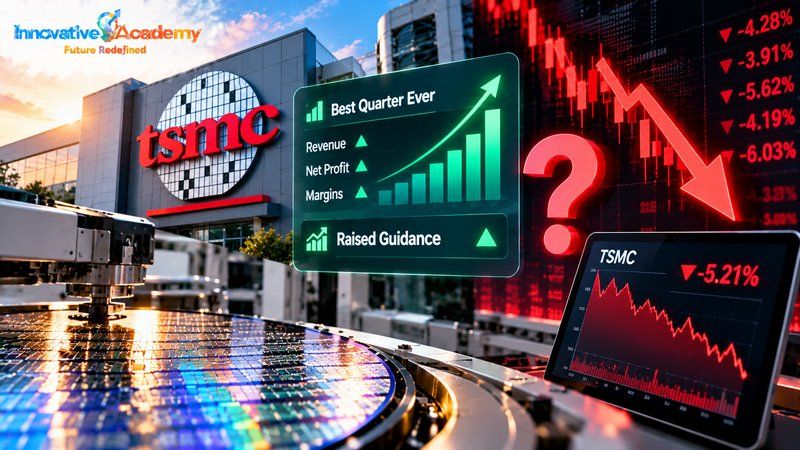

TSMC Just Posted Its Best Quarter Ever and Raised Guidance — So Why Did the Stock Fall?
1. Introduction
TSMC held its full Q3 2026 earnings call on October 15, reporting its highest-ever quarterly net profit and raising its own full-year revenue forecast in the same breath. The stock fell anyway. That combination, a genuine beat-and-raise quarter paired with a same-day share price drop, deserves a closer look rather than getting flattened into a single clean headline either way.
2. The Numbers That Were Still Missing Last Week, Now Confirmed
TSMC's preliminary revenue release on October 8 had already shown a record NT$1.49 trillion top line. What that release didn't include, profit, margin, and forward guidance, is now on the record. Net profit came in at NT$763.06 billion, up 68.7% year-on-year and above the NT$746.3 billion analyst estimate, Reuters described it as the company's highest-ever quarterly net income. Net margin landed at 51.1%. Earnings per ADR hit $4.60, versus a $4.45 analyst average and just $2.92 a year earlier. Revenue in dollar terms came to $46.72 billion, above both TSMC's own prior guidance and the $45.62 billion consensus.
3. Beating Guidance on Every Line That Matters
Gross margin landed at 66.4%, inside the company's own 65–67% guidance band, though down from 67.7% in the prior quarter. Operating margin came in at 58.7%, above the 56.0–58.0% range TSMC itself had guided to. The revenue mix showed exactly where the growth is concentrated: high-performance computing, the bucket that includes AI accelerators, made up 68% of revenue, with smartphones at 21%. Automotive was the fastest-growing segment sequentially, up 23%. On the manufacturing side, 3-nanometer wafers contributed 33% of revenue and 2-nanometer 8%, with chips at 7-nanometer or more advanced processes together accounting for 79% of the total, a useful reminder of how much of TSMC's business still runs on nodes that aren't this quarter's newest story.
4. The Q4 Outlook: Guidance Went Up, Not Down
TSMC didn't just confirm a strong quarter, it raised its outlook for the one ahead. Fourth-quarter revenue guidance came in at $52.3 billion to $54.3 billion, roughly 14% higher sequentially at the midpoint and about 58% year-on-year. Gross margin guidance for Q4 sits at 65.0–67.0%, operating margin at 56.5–58.5%. For the full year, TSMC raised its 2026 revenue growth forecast to roughly 44% in dollar terms, up from a prior forecast of "more than 40%." None of that reads like a company bracing for a slowdown.
5. So Why Did a Beat-and-Raise Quarter Send the Stock Down?
Here's the part that doesn't fit the simple "good quarter, stock goes up" story: shares closed the regular session down 3.4% at $430, then slid further after hours to $421.49. Coverage of the move attributes it to investors focusing on two specific things buried inside an otherwise strong report, future margin dilution and the scale of planned capital spending, rather than on the headline beat itself. That's an important distinction to hold onto: nothing about this reaction contradicts the numbers in sections 2 through 4, it's a case of the market pricing a forward risk harder than it rewarded a trailing result.
6. The Actual Mechanism: What's Eating Into the Margin
The specific, named cause of this quarter's 130-basis-point sequential margin drop is TSMC's 2-nanometer production ramp, early-stage advanced manufacturing is expensive before yields mature. CFO Wendell Huang added a second, longer-running pressure: margin dilution from overseas fabs, currently about 2 percentage points, which he said is expected to widen to 3–4 percentage points as US-based fabs ramp up in the years ahead. Q4's margin guidance already bakes in roughly 40 basis points of further compression at the midpoint from these same two sources. On capital spending, TSMC reaffirmed its 2026 capex plan at $60–64 billion, and Huang said capex from 2026 through 2028 will be "significantly higher" than the prior three years combined, a figure large enough on its own to explain why some investors reacted to the plan rather than the quarter.
7. The Caution That Mattered More Than the Beat
CEO C.C. Wei's own words carried more weight with the market than the beat did. Wei said management is "being prudent in our business planning going into 2027," and separately flagged that consumer and price-sensitive end markets are facing pressure from rising component prices and macroeconomic uncertainty, a notably different tone from the AI-demand enthusiasm that's carried most of this year's TSMC coverage. Gary Tan of Allspring Global Investments, a TSMC shareholder, offered a more measured read on that same caution, calling it "sensible expectation management rather than a change in the sector's long-term fundamentals." Wei also pushed back against reading too much into the margin story either way, noting that "there is no ceiling for TSMC's profitability, but a dramatic increase will not happen overnight either."
8. Closing a Loop: What Last Week's Coverage Couldn't Tell You Yet
Coverage of TSMC's preliminary revenue release last week was explicit about what it couldn't confirm: profit, margin detail, and guidance were all still pending the full earnings call. That's no longer true. The record revenue figure from October 8 held up, and the fuller picture behind it turned out to be more complicated than either a pure celebration or a pure warning sign, a genuine profit and guidance beat, sitting next to a real, named cost pressure from the 2-nanometer ramp and overseas fab buildout that the market chose to price immediately. Both things are true about the same earnings call, which is exactly why the stock's reaction looks confusing if you only read the headline growth numbers.
9. Building the Fundamentals at Innovative Academy
Innovative Academy's Hardware & Networking program in Bangalore digs into how manufacturing nodes, yield curves, and capital-intensive fab economics actually operate day to day. Without that grounding, a quarter like this one just reads as "stock up" or "stock down." With it, a 130-basis-point margin dip tied to a 2-nanometer ramp and a multibillion-dollar capex plan both become specific, explainable mechanics rather than background noise around a single day's share price.
10. FAQs
1. Did TSMC actually miss analyst expectations this quarter?
No. Revenue, profit, EPS, and operating margin all came in above analyst estimates and above TSMC's own prior guidance. The stock's decline reflects investor focus on future margin dilution and capex, not a miss on the quarter itself.
2. Is TSMC lowering its guidance for the quarters ahead?
No, the opposite. TSMC raised its full-year 2026 revenue growth forecast to about 44% in dollar terms, up from a prior "more than 40%," and guided Q4 revenue up roughly 14% sequentially.
3. What specifically is causing the margin pressure?
Two named sources: early-stage 2-nanometer production, which is less efficient before yields mature, and dilution from overseas fabs, currently about 2 percentage points and expected to widen to 3–4 points as US fabs ramp up.
4. Does CEO C.C. Wei's caution about 2027 mean AI chip demand is slowing?
Not according to the reporting here. Wei's caution was specifically about prudent planning and pressure in consumer and price-sensitive markets, not a change in AI-driven demand, which a shareholder quoted in coverage described as "sensible expectation management" rather than a shift in fundamentals.
5. How much is TSMC planning to spend on capital expenditure?
The 2026 capex plan was reaffirmed at $60–64 billion, with CFO Wendell Huang saying 2026–2028 spending overall will be significantly higher than the prior three years.
11. Final Thoughts
The honest read on this earnings call isn't "great quarter" or "warning sign," it's both, reported at the same time, about the same company. TSMC's actual numbers, record profit, a guidance raise, a bigger full-year growth forecast, resolve last week's open question about whether the preliminary revenue figure would hold up under full scrutiny. It did, comfortably. What moved the stock was a separate, specific, forward-looking cost story about node ramps and overseas fab economics that the market chose to weigh more heavily than the trailing beat, a reminder that a strong quarter and a cautious market reaction aren't a contradiction once you see what each one is actually responding to.
If you want to build the hardware fundamentals behind stories like this one, explore the Hardware & Networking Course in Bangalore at Innovative Academy. Contact for course details: 8447712333.